
About Satanta
Lived 1820 – 1878 (aged 57–58). Satanta was a traditional leader or chief and artist.
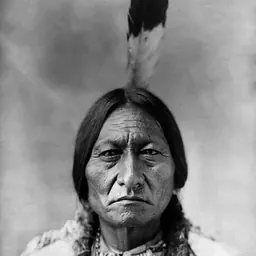
Satanta (IPA: [seˈtʰæntə]) (Set:t’aiñde ([séʔ.tˀã́j.dè]) or White Bear) ( – October 11, 1878) was a Kiowa war chief. He was a member of the Kiowa tribe, born around 1815, during the height of the power of the Plains Tribes, probably along the Canadian River in the traditional winter camp grounds of his people.
One of the best known, and last, of the Kiowa War Chiefs, he developed a reputation as an outstanding warrior and in his twenties was made a sub-chief of his tribe, under Dohäsan, as Chief. He fought with him at the First Battle of Adobe Walls, and earned enduring fame for his use of an army bugle to confuse the troops in battle.
Satanta was born the son of Chief Red Tipi and a Spanish captive and spent his youth south of the Arkansas River enjoying the peaceful alliance between the Kiowa and Comanche tribes.
Orator and warrior One of best known leaders of his tribe in the 1860s–1870s, Satanta was well known for both his prowess as a warrior, and his soaring oratorical powers. Dohäsan was the principal Chief until his death. The Indian forces assembled from their nearby winter encampments vastly outnumbered the Army detachment, which retreated in good order.
Medicine Lodge Treaty
At Medicine Lodge, Satanta, a tall, muscular man, came to be known as the "Orator of the Plains."
Like most treaties of the time, these agreements failed utterly to bring peace on the frontier. The Kiowa and Comanche accepted the treaty offerings and promised to no longer raid outside their reservation. But shortly after signing, the chiefs went into northern Texas on raiding missions, violating the treaty. In fact the Red River War erupted shortly afterwards. Unhappy that the reservation had reduced the Kiowa lands to nearly the size of Connecticut for the nearly wigwams, the chiefs began leading their young men on raiding parties off the reservations. In fact, records have documented over 250 innocent farmers, ranchers, women and children murdered and kidnapped by the Kiowa and Comanche warriors during the 1860s and 1870s. This situation, unstable in and of itself, worsened significantly with the death of Dohäsan, the last Kiowa Chief (over the entire Kiowa People) in 1866.
Without his binding personal leadership, Kiowa unity dissolved as a number of subchiefs, Tene-angopte, and, on the other side, Satanta and Guipago (Gui-pah-gho, Lone Wolf), struggled for power and to fill his place. The competition between the three set off a wave of raids across the southern plains from Kansas to Texas during the fall of 1866 and into 1867.
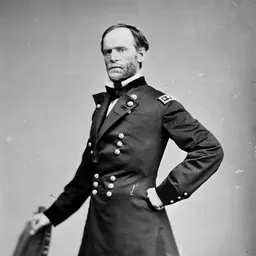
In one instance Satanta and a joint Kiowa-Comanche war party raided into the Texas panhandle and, after killing James Box, captured the man's wife and four children, whom they sold to the army at Fort Dodge, Kansas. His undoing came with the Warren Wagon Train Raid on May 18, 1871. Immediately prior to that attack, the Indians had allowed an Army Ambulance with a small guard to pass unharmed; in it was General William Tecumseh Sherman, but Mamanti, the medicine man, had advised the other chiefs to wait for a richer loot.
The wagon train had attempted to fight the war party by shifting into a ring formation, and all the mules were put into the center of the ring. Despite this, the warriors captured all of the supplies in the train, killing and mutilating seven of the wagoner's bodies. Five men however, managed to escape. As soon as Col. Ranald S. Mackenzie learned of the incident, he informed Sherman. Sherman and Mackenzie searched for the warriors responsible for the raid.
Satanta foolishly bragged of his, Satank (Sitting Bear), and Ado-ete (Big Tree)'s involvement of the raid, and, in spite of Guipago's intervention (the head chief came in well equipped with loaded rifles and revolvers, fit to fight for his friend's liberty, but had to surrender in front of the massive presence of military troops) Sherman personally arrested him.
Trial of Satanta and Big Tree
General Sherman ordered the trial of Satanta and Big Tree, along with Satank making them the first Native American Leaders to be tried for raids in a US court.
His presence at the battle violated his parole, and was likely the reason the government called for his arrest. He surrendered in October 1874, and was returned to the state penitentiary at Huntsville, Texas. Guards reported that Satanta, forced to work on the road, would stare for hours at the traditional hunting grounds of his people, and seemed to wither away. In his book, the History of Texas, Clarance Wharton reports of Satanta in prisonAfter he was returned to the penitentiary in 1874, he saw no hope of escape. For a while he was worked on a chain gang which helped to build the Missouri–Kansas–Texas Railroad. He became sullen and broken in spirit, and would be seen for hours gazing through his prison bars toward the north, the hunting grounds of his people.
Satanta is reported to have killed himself while incarcerated by jumping from a window on 11th October, 1878.
Satanta was originally buried in the prison cemetery in Huntsville. In 1963 his grandson, an artist named James Auchiah, received permission to transfer Satanta's remains to Fort Sill, Oklahoma.
The character of Blue Duck in Larry McMurtry's Pulitzer Prize winning novel Lonesome Dove was partially based on the life and death of Satanta.
The actor Rodolfo Acosta played Satanta in 1959 in the third episode of the ABC western television series, The Rebel, starring Nick Adams.
Don’t just read it —
keep it.
Full-length biographies made to live with: read them, listen on the way to work, watch them tonight.
- E-book
- Audio
- Video
Instant download · yours to keep · every purchase keeps this site free
Important facts
People in Satanta's life
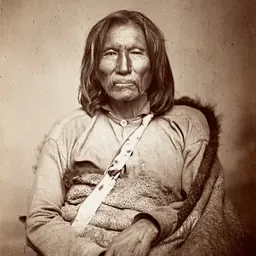
Named in this biography and alive at the same time

Related people
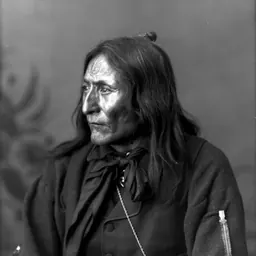
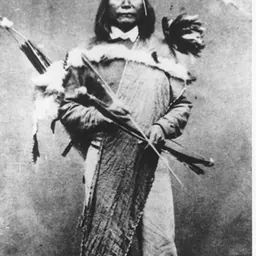
Same field, nearest in time


Contemporaries
People whose lives overlapped Satanta's




Frequently asked questions
Who was Satanta?
Kiowa chief
When was Satanta born?
Satanta was born in 1820.
When did Satanta die?
Satanta died on 11 October 1878 in Huntsville.
What was Satanta's occupation?
Satanta was a traditional leader or chief and artist.
Sources & further reading
Cite this page
APA: Biography.guide. (2026). Satanta. https://biography.guide/satanta/
MLA: "Satanta." Biography.guide, https://biography.guide/satanta/.
Chicago: "Satanta." Biography.guide. https://biography.guide/satanta/.
Data last updated: 2026-09-20 · Spot an error? Report a correction.
Page generated 2026-09-27 05:25 UTC