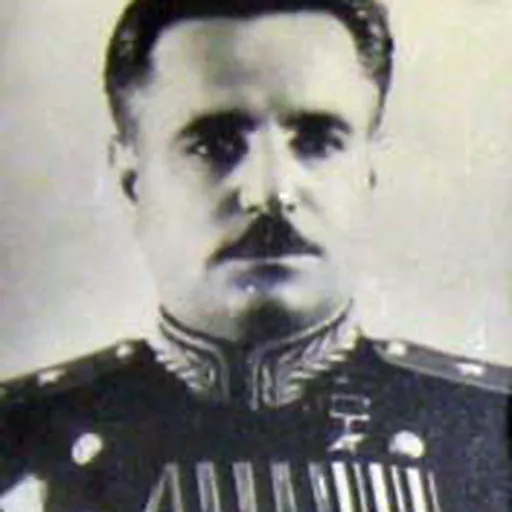
Sargis Martirosyan
Soviet military personnel, Hero of the Soviet Union
About Sargis Martirosyan
Lived 1900 – 1984 (aged 83). Sargis Martirosyan was a Russian military personnel.
Sarkis Sogomonovich Martirosyan (, ; – 15 February 1984) was a Soviet–Armenian general-leytenant of the Red Army.
Martirosyan joined the Red Guards and fought in the Battle of Baku during the Russian Civil War. After fleeing to independent Armenia he was conscripted into that country's army, and joined the Red Army upon the Soviet invasion of Armenia. During the interwar period he rose to division chief of staff, before being imprisoned for almost a year during the Great Purge. After being freed and restored in the army Martirosyan became a division chief of staff, beginning World War II in that capacity. After distinguishing himself in the Battle of Kiev, he commanded the 340th Rifle Division in the Battle of Moscow, Battle of Voronezh, and the Soviet advance into Ukraine in early 1943. In mid-1943 he was promoted to command the 50th Rifle Corps, and in March 1944 transferred to command the 73rd Rifle Corps. He was made a Hero of the Soviet Union for his leadership of the 73rd Rifle Corps in the January 1945 Sandomierz–Silesian offensive. After the end of the war Martirosyan held corps command before ending his career as an assistant army commander.
Early life and Russian Civil War An Armenian, Sarkis Sogomonovich Martirosyan was born on 21 September 1900 in the village of Matrasa, Baku Governorate. The son of a priest, he graduated from the village school, then studied at the Gevorgian Seminary in Echmiadzin from August 1914 to July 1917. During the Russian Civil War, in March 1918, Martirosyan joined the 19th Workers' Battalion of the Red Guards, with which he took part in the defense of Baku from advancing Ottoman forces in the Battles of Kurdamir, Goychay, and Shemakha. After the Ottoman capture of the Transcaucasus and the overthrow of the Baku Commune in September, Martirosyan crossed through Georgia to Armenia and was unemployed. On 16 July 1919 during a round-up in Yerevan he was conscripted into the Army of the Republic of Armenia and sent to the Yerevan Guard Battalion as a ryadovoy. From March 1920 he served in the 1st Armenian Cavalry Regiment at Yelizavetpol. After graduating from a short-term machine gun training held by the machine gun squadron in September he was promoted to junior unter-ofitser and appointed commander of a machine gun section. In November of that year, after the Soviet invasion of Armenia, he joined the Red Army. Between February and April 1921 he served as gun-layer of a medium machine gun and commander of a machine gun platoon during the suppression of the February Uprising and the capture of Yerevan.
Interwar period From June 1922 he served in the 2nd Armenian Rifle Regiment of the Armenian Rifle Division of the Separate Caucasus Army as a platoon and company commander, and acting regimental chief of staff. During this period he completed the machine gun section refresher courses for command personnel at the army headquarters in Tbilisi in 1924, the reconnaissance section of the refresher courses in 1925, and the Command Personnel Improvement Courses for reconnaissance in Moscow in 1928. He became a member of the Communist Party in 1925. Martirosyan participated in the suppression of resistance to collectivization in Armenia in October and November 1930. From April 1931 he served on the division staff as assistant chief of the 1st department and chief of the 2nd section. From October 1937 he temporarily served as chief of staff and assistant chief of staff of the 76th Mountain Rifle Division (redesignated from the Armenian Rifle Division). During the Great Purge, he was imprisoned by the NKVD investigation in July 1938, and as a result was dismissed from the army on 5 August. In June 1939 he was freed due to lack of evidence, restored in the army and appointed chief of the operations section of the staff of the 121st Rifle Division of the Belorussian Special Military District. In this capacity he took part in the Soviet invasion of Poland in September. Martirosyan was transferred to the Kharkov Military District in March 1941, where he served as chief of staff of the new 227th Rifle Division at Slavyansk.
World War II After the German invasion of the Soviet Union began on 22 June, the division was dispatched to the Southern Front between 30 June and 2 July. The 227th was transferred to the 26th Army of the Southwestern Front on 19 July and took part in the Battle of Kiev. Then-Lieutenant Colonel Martirosyan temporarily commanded the division between 24 and 31 July, and was evaluated as having coped well with the responsibilities of command. With the arrival of re-appointed division commander Colonel Yefim Makarchuk Martirosyan returned to his primary duties as chief of staff. Makarchuk characterized Martirosyan as a "tactically competent chief of staff...quickly orienting himself in the situation, skillfully organizes the direction of the troops and implementation of command decisions." With the 26th Army, the division fought on the Vinnytsia axis east of Proskurov. During the Battle of Kiev the division took part in counterattacks conducted by the army south of Kiev against the units of the German 1st Panzer Group in the vicinity of Tarashcha, Luki, Boguslav, Yanovka, and Kovali. Wounded in the leg during the fighting, Martirosyan was treated at Evacuation Hospital No. 1683 and discharged on 22 September.
In September, Martirosyan was appointed commander of the new 340th Rifle Division, supervising its formation in the Volga Military District at Balashov. On 27 November the division was sent to the Western Front and as part of the 50th and then the 49th (from 10 December) Armies took part in the Tula and Kaluga offensive operations, part of the Soviet counteroffensive during the Battle of Moscow, and in the liberation of the cities of Aleksin and Kaluga. For his leadership of the division in the Tula offensive, Martirosyan was awarded the Order of the Red Banner on 12 April. The recommendation read: A great contribution in the Great Patriotic War for the liberation of our Motherland and the countries allied to us from the yoke of the German-Fascist invaders belongs to Major General Martirosyan.
Commanding the 73rd Rifle Corps from June 1943, he led his formation through the fields of Ukraine, and in difficult battles defended every inch of native Ukrainian soil.
In the destruction of the Korsun-Shevchenkovsky grouping, in the destruction of thirty enemy divisions in the Jassy-Kishinev operation, in the breakthrough of the powerful, deeply echeloned enemy defenses in the vicinity of Yassy, Romania, the 73rd Rifle Corps under the command of Major General Martirosyan always was on the main axis and always successfully carried out the tasks of the army military council.
On 12 January 1945, the 73rd Rifle Corps inflicted a destructive strike against the enemy forces on the Sandomierz bridgehead and pursuing the shattered units rapidly moved forward.
On the night of 20/21 January 1945 it was the first to enter the territory of Germany and by 28 January reached a major economic and strategic center of Germany, the city of Breslau.
Just in battles on German territory sixteen cities were captured, more than 1,600 settlements, more than 20,600 soldiers and officers destroyed, 83 tanks, 21 aircraft, and 128 depots with materiel captured.
In the course of all combat operations during the Great Patriotic War Major General Martirosyan displayed exemplary mastery of the knowledge of commanding troops, courage and valor in battle, and selfless loyalty to the Motherland. He cultivated hundreds of thousands of order-bearers and hundreds of Heroes of the Soviet Union. For masterful leadership of troops, for personal courage and valor in battle, for exemplary fulfillment of the tasks of the Military Council of the army in the Great Patriotic War, he is worthy of the state award of the Order of the Patriotic War, 1st class.
Postwar After the end of the war, Martirosyan continued to command the 73rd Rifle Corps, then studied at the Voroshilov Higher Military Academy. After his graduation from the academy he took command of the 27th Rifle Corps of the Carpathian Military District in April 1947. In February 1951 he was transferred to the Transcaucasian Military District to serve as assistant commander of the 7th Guards Army. Transferred to the reserve on 11 April 1953, Martirosyan died in Yerevan on 15 February 1984. He was buried at the Tokmakh cemetery in Yerevan.
Awards and honors
60px Jubilee Medal "In Commemoration of the 100th Anniversary of the Birth of Vladimir Ilyich Lenin"
60px Medal "For the Victory over Germany in the Great Patriotic War 1941–1945" 60px Jubilee Medal "Twenty Years of Victory in the Great Patriotic War 1941–1945"
60px Jubilee Medal "XX Years of the Workers' and Peasants' Red Army"
60px Jubilee Medal "40 Years of the Armed Forces of the USSR" 60px Jubilee Medal "50 Years of the Armed Forces of the USSR" 60px Jubilee Medal "60 Years of the Armed Forces of the USSR"
Martirosyan was declared an honorary citizen of Sumy, Wieluń and Wrocław. A street in Kiev was named for him until October 2022, when it was renamed following the Russian invasion of Ukraine.
Don’t just read it —
keep it.
Full-length biographies made to live with: read them, listen on the way to work, watch them tonight.
- E-book
- Audio
- Video
Instant download · yours to keep · every purchase keeps this site free
Important facts
Related people
Same field, nearest in time





Contemporaries
People whose lives overlapped Sargis Martirosyan's





Frequently asked questions
Who was Sargis Martirosyan?
Soviet military personnel, Hero of the Soviet Union (1900–1984)
When was Sargis Martirosyan born?
Sargis Martirosyan was born on 21 September 1900 in Mədrəsə.
When did Sargis Martirosyan die?
Sargis Martirosyan died on 15 February 1984 in Yerevan.
What was Sargis Martirosyan's occupation?
Sargis Martirosyan was a military personnel.
What nationality was Sargis Martirosyan?
Sargis Martirosyan was Russian.
Sources & further reading
· Wikipedia: Sargis Martirosyan
Cite this page
APA: Biography.guide. (2026). Sargis Martirosyan. https://biography.guide/sargis-martirosyan/
MLA: "Sargis Martirosyan." Biography.guide, https://biography.guide/sargis-martirosyan/.
Chicago: "Sargis Martirosyan." Biography.guide. https://biography.guide/sargis-martirosyan/.
Data last updated: 2026-09-22 · Spot an error? Report a correction.
Portrait: Wikimedia Commons · author & licence
Page generated 2026-09-27 05:01 UTC