
Sarah Wildes
American "witch"
About Sarah Wildes
Lived 1627 – 1692 (aged 65). Sarah Wildes was an English, known for Salem witch trials.
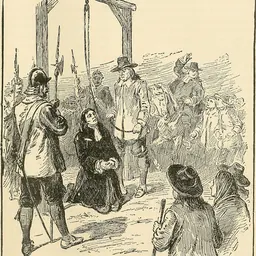
Sarah Wildes (née Averell/Averill; baptized March 16, 1627 – ) was wrongly convicted of witchcraft during the Salem witch trials and was executed by hanging. She maintained her innocence throughout the process, and was later exonerated. Her husband's first wife was a member of the Gould family, cousins of the Putnam family, the primary accusers, and court records document the family feuds which led to her persecution.
Family Sarah was one of seven children born to William Averell and Abigail Hynton, immigrants from Chipping Norton, England who settled in Ipswich, Massachusetts. William was a bailiff in Chipping Norton in 1634, and Ipswich town records first mention him in 1637, which brackets their migration to the intervening time period, when Sarah was around 7–10 years old.
Sarah married English immigrant John Wildes (born ), a widower with eight children, and had a son, Ephraim. Ephraim held the positions of town treasurer and constable during the period of the conspiracy. They were residents of Topsfield, a neighboring town of Salem, in the Massachusetts Bay Colony. John held several positions in the town government and was affectionately called "Old Father Wildes". Two of John's daughters, Sarah (Wildes) Bishop and Phoebe (Wildes) Day, and a son-in-law, Edward Bishop Jr., were also accused of witchcraft. Sarah Averill Wildes and Sarah Wildes Bishop, her stepdaughter, have often been confused (as have Sarah Wildes Bishop and Bridget Bishop).
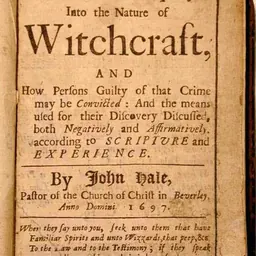
One of Sarah's stepsons, Jonathan, was known for strange behavior, which local ministers theorized could be mental distraction, possession by the devil, or fakery, a story that Rev. John Hale related during Sarah's trial, retrospectively considering it to be possible evidence of Sarah's witchcraft. Jonathan died in King Philip's War, and no resolution was ever reached.
Hale also related the story of another stepson, John, who had also died young (and was, therefore, not around to substantiate or refute the story). John, portrayed as "an honest young man" went to the house of his uncle and aunt, the Reddingtons, to confide in them his belief that his stepmother was, indeed, a witch.
Because she married John so soon after his first wife's death (about 7 months later), John's former in-laws held something of a grudge against her. This is particularly notable as the Goulds were related to the Putnam family, who were the principal accusers in the witchcraft hysteria. John Wildes testified against his first wife's brother, Lieutenant John Gould, in a treason trial, which further angered the family. Shortly after, John's ex-sister-in-law, Mary Gould Reddington, began circulating rumors that Sarah was a witch. When John Wildes threatened to charge her with slander, she retracted her claims.
Salem witch trials
Arrest
On 21 April 1692, John Hathorne and Jonathan Corwin ordered Sarah, along with her stepdaughter, Sarah Wildes Bishop, Sarah Bishop's husband, Edward Bishop, and six others (William and Deliverance Hobbs, Nehemiah Abbot, Mary Eastey, Mary Black, and Mary English) to be arrested on "high suspicion" of witchcraft performed on Ann Putnam Jr., Mercy Lewis, Mary Walcott, and others, due to a complaint by Thomas Putnam and John Buxton.
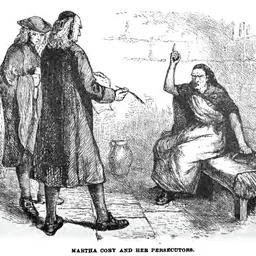
Sarah was arrested by the Marshall, George Herrick, who then ordered Constable Ephraim Wildes to arrest Deliverance Hobbs. Hobbs, whether through coercion or not, made a jailhouse confession and implicated Sarah Wildes as a witch. Ephraim himself testified that he believed Hobbs' accusation to be vengeance against him for arresting her. She was transferred back to Salem on 18 June, along with George Burroughs, George Jacobs Sr., Giles and Martha Corey, Ann Pudeator, Sarah Cloyse, Sarah Root, and Dorcas Hoar.
When the site of the execution was finally confirmed in January 2016 by the Gallows Hill Project, led by Professor Emerson Baker of Salem State University, no human remains were found using ground-penetrating radar, supporting traditional beliefs that the families of the victims returned at night to recover their bodies and reinter them elsewhere.
Aftermath Stepdaughter Phoebe Wildes Day was arrested in September 1692, but there is no record of her going to trial. Stepdaughter Sarah Wildes Bishop and her husband, Edward, having been transferred to Boston prison, escaped in October 1692 and went into hiding.
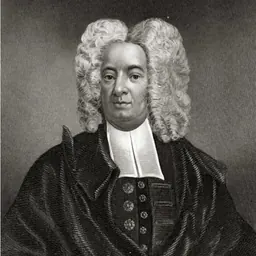
In his book Wonders of the Invisible World, Cotton Mather attempted to defend his participation in the trials, laying out what he considered to be the strongest cases for genuine witchcraft. He did not include Sarah's.
On 26 June 1693, John Wildes married Mary, the widow of George Jacobs Sr. (George having been executed for witchcraft, as well). He died on 14 May 1705, in Topsfield.
Exoneration Sarah was exonerated by the Massachusetts General Court in 1710, along with many other condemned. Her son Ephraim, responding that "the los of so dere a frind ... cannot be mede up" , was awarded 14 pounds as restitution.
Memorials
This is the memorial bench for Sarah Wildes at the Salem Witch Trials Memorial Park in Salem. The Salem Witch Trials Memorial includes a bench inscribed with the names of all those executed, including Sarah Wildes. Arthur Miller, who wrote The Crucible, a play based on the trials, spoke at the dedication, as did Nobel Laureate and Holocaust survivor Elie Wiesel. The city of Danvers also created a memorial to the victims. The execution site was finally pinpointed in January 2016, by the University of Virginia's Gallows Hill Project, and the city plans to create a new memorial to the victims there.
Don’t just read it —
keep it.
Full-length biographies made to live with: read them, listen on the way to work, watch them tonight.
- E-book
- Audio
- Video
Instant download · yours to keep · every purchase keeps this site free
Important facts
People in Sarah Wildes's life
Named in this biography and alive at the same time


Contemporaries
People whose lives overlapped Sarah Wildes's






Frequently asked questions
Who was Sarah Wildes?
American "witch"
When was Sarah Wildes born?
Sarah Wildes was born on 16 March 1627 in Chipping Norton.
When did Sarah Wildes die?
Sarah Wildes died on 19 July 1692 in Danvers.
What was Sarah Wildes known for?
Sarah Wildes was known for Salem witch trials.
What nationality was Sarah Wildes?
Sarah Wildes was English.
Sources & further reading
Cite this page
APA: Biography.guide. (2026). Sarah Wildes. https://biography.guide/sarah-wildes/
MLA: "Sarah Wildes." Biography.guide, https://biography.guide/sarah-wildes/.
Chicago: "Sarah Wildes." Biography.guide. https://biography.guide/sarah-wildes/.
Data last updated: 2026-09-22 · Spot an error? Report a correction.
Page generated 2026-09-27 05:20 UTC