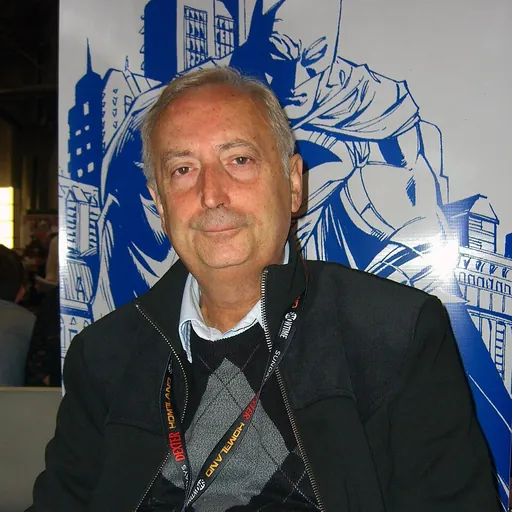
Sandu Florea
Comic book and comic strip creator
About Sandu Florea
Born 1946. Sandu Florea is a Romanian and American lithographer, architect, science fiction writer, comics artist, penciller and inker.
Sandu Florea (; born 28 June 1946) is a Romanian-American comic book and comic strip creator, also known as an inker and book illustrator. A trained architect and a presence on the science fiction scene during the 1970s, he became a professional in the comics genre with albums such as Galbar, and was allegedly the only artist to have obtained a steady income in this way during the communist period. A prolific contributor to Romanian children's magazines, Florea had his activity curbed by communist censorship when he first publicized his intention of emigrating to the United States. He eventually left the country shortly after the 1989 Revolution, and soon after began collaborating with Marvel, DC Comics and other leading enterprises in the field of comic book publishing. He became especially noted for his activities as an inker, with contributions on series such as Buffy the Vampire Slayer, The Executioner, X-Men: The End, Batman R.I.P. and Batman: Battle for the Cowl.
Florea has maintained enduring contacts with his native country, and has taken an initiative in popularizing the American comic book style in Romania. He has been described as one of the most successful among his colleagues, and claimed to be one of the most recognizable Romanians in his field.
Biography Early life and career in Romania
Born in Ghelari, Hunedoara County, Sandu Florea first became interested in comics while in fifth grade, his first contact with the medium being through a copy of the French youth magazine Pif Vaillant. This encounter, he recalled in a 2004 interview, left him with "an impression that cannot be erased", and "the wish that I myself could draw such appealing and interesting characters." In 1971, Florea graduated from Bucharest's Architectural College, and subsequently worked for a building design institute in his adoptive city of Timișoara. In 1975, he and Timișoara native Marcel Luca published what is thought to be the first-ever Romanian coloring book with a science fiction subject, Vreau să fiu cosmonaut ("I Want to be a Cosmonaut"), which reputedly sold 45,000 copies. and Wallachian Prince Michael the Brave). The full list includes: Cavalerul alb ("The White Knight"; Editura Facla, 1976), Călugăreni (referencing the Battle of Călugăreni; Editura Ion Creangă, 1977), Misiune de sacrificiu ("Suicidal Mission"; Editura Ion Creangă, 1979), În lumea lui Harap Alb ("Inside Harap Alb's World"; Editura Sport-Turism, 1979), Burebista, regele dacilor ("Burebista, King of the Dacians"; Editura Sport-Turism, 1980), ("Decebalus and Trajan"; Editura Sport-Turism, 1981), ("Carousel"; Editura Sport-Turism, 1982), Sarmizegetusa eroică ("Heroic Sarmizegetusa"; Editura Sport-Turism, 1983). This, literary critic Michael Hăulică notes, made Florea one in a final wave of Romanian Eurocon laureates to have emerged under communism (also including writers Vladimir Colin, Ion Hobana and Gheorghe Săsărman). In 1982, Stănescu began working with him on the album Semne şi desemne ("Signs and Designs"). Florea printed the lithographs to go with the poems, but the project was cut short when Stănescu died (December 1983). Although initially discouraged by the competition among comic book artists, Florea recounts, he decided to contact Marvel recruiters within three months of his arrival, submitting a sample of his take on Conan the Barbarian.
The publication, which went out of print after only two issues due to distribution problems, included Romanian-language reprints of American comics such as Conan the Barbarian and Aliens, alongside original collaborations between Florea and his Romanian colleagues: Două paloşe ("Two Backswords", with Florea as artist and György Györfi-Deák as writer), Ultima frontieră ("The Final Frontier", text by Florea, Marian Mirescu and Eddie Pandele, drawings by Daniel Rizea and Cătălin Gospodin), Toxic (text by Florea, drawings by Tudor Popa), Leviathan (written by Cristian Lăzărescu, illustrated by Florea). The magazine also featured Borderland, a comic series conceived especially for a Romanian public by writer John Warner and illustrated by Florea, depicting the confrontation between three worlds: of the Mortals, of Magic and of the Demons. According to a 2008 piece in the Romanian daily Evenimentul Zilei, Florea shares the distinction of "best known Romanian comic book artist" with Mircea Arapu, the latter being known for his contribution in Francophone comics.
An annual Romanian comic book fan convention in Constanţa awards the Sandu Florea Prize to artists with a long contribution in their field. In 2010, Florea was guest of honor at the European Comic Strip Salon, organized by the Romanian Cultural Institute (ICR) at the National Theatre Bucharest. He exhibited his work, including the never before seen Semne şi desemne collection, at the Bucharest "Comic Book Museum" exhibit, jointly organized by the ICR and the Belgian Comic Strip Center in 2011.
Don’t just read it —
keep it.
Full-length biographies made to live with: read them, listen on the way to work, watch them tonight.
- E-book
- Audio
- Video
Instant download · yours to keep · every purchase keeps this site free
Important facts
People in Sandu Florea's life
Named in this biography and alive at the same time





Related people
Same field, nearest in time

Contemporaries
People whose lives overlapped Sandu Florea's

Frequently asked questions
Who is Sandu Florea?
Comic book and comic strip creator
When was Sandu Florea born?
Sandu Florea was born on 28 June 1946 in Ghelari.
What is Sandu Florea's occupation?
Sandu Florea is a lithographer, architect, science fiction writer, comics artist, penciller and inker.
What nationality is Sandu Florea?
Sandu Florea is Romanian and American.
Sources & further reading
Cite this page
APA: Biography.guide. (2026). Sandu Florea. https://biography.guide/sandu-florea/
MLA: "Sandu Florea." Biography.guide, https://biography.guide/sandu-florea/.
Chicago: "Sandu Florea." Biography.guide. https://biography.guide/sandu-florea/.
Data last updated: 2026-09-21 · Spot an error? Report a correction.
Portrait: Wikimedia Commons · author & licence
Page generated 2026-09-27 05:00 UTC