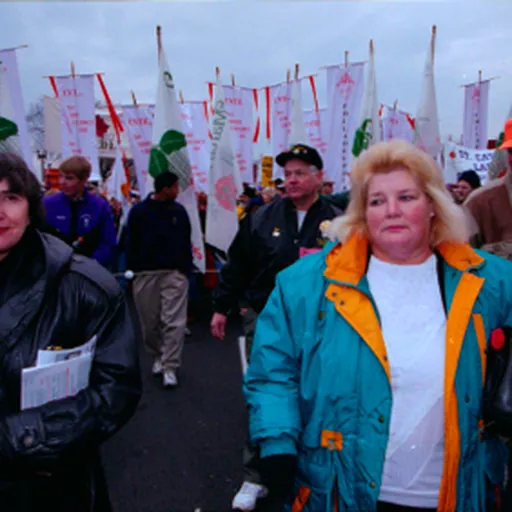
Sandra Cano
Plaintiff in the 1973 United States Supreme Court case Doe v. Bolton
About Sandra Cano
Lived 1947 – 2014 (aged 66–67). Sandra Cano was an American.
Sandra Cano (born 1947/1948 – September 30, 2014), (née Race) better known by the legal pseudonym "Mary Doe," was the plaintiff in the lawsuit case Doe v. Bolton, the companion case to Roe v. Wade (1973) which legalized abortion in the United States. Cano held anti-abortion views and claimed she had been manipulated by her lawyer, Margie Pitts Hames. She repeatedly attempted to have the decision overturned. She also undertook anti-abortion activism, with Norma Jane McCorvey (Jane Roe) among others, and filed a Friend of the Court brief seeking to limit partial birth abortions.
Early life Cano was born in 1947/1948 in Georgia to an impoverished, abusive family. She stood out among her peers, as she was overweight, had Bell's palsy, and had a learning disability. She went to school until she dropped out in the ninth grade. She met Joe Bensing, a gas station employee from Oklahoma, when she was seventeen years old and soon became pregnant with his child. Her parents called a "shotgun" wedding in 1965 when they found out. Prior to their relationship, Bensing was convicted multiple times as a child molester and kidnapper and continued to violate his probation throughout their marriage. She still had concerns with her mental stability, causing the juvenile court's decision to place her children in foster care. When she was twenty-two years old, she sought out a lawyer to help her get a divorce and gain custody of her two children in foster care. She discovered the Atlanta Legal Aid Office and was introduced to an ACLU lawyer named Margie Pitts Hames when she was pregnant with her fourth child. It was sent to the Supreme Court, as both Hames and Bolton appealed. Hames claims that she informed Cano of a chance to testify her wishes to have an abortion, and Cano agreed.
Legal argument On the day of the Supreme Court case, Hames prepared three arguments supporting the reformation of Georgia's abortion law. First, she argued that there was a conflict of what constituted a "legal abortion" due to the vague requirements that doctors had to meet in order to approve an abortion. She claimed this was a violation of the due process clause of the Fourteenth Amendment. Hames's second claim was that the abortion law of Georgia did not have the right to override women's decisions to have an abortion. She used the decision made in Griswold v. Connecticut and the Fourteenth Amendment to support her claim. Finally, Hames argued that Georgia's abortion law negatively impacted medical professionals and marginalized women, as abortions were only allowed to be performed in state approved hospitals. This limited the number of hospitals women could receive abortions at, which infringed on the equal protection clause of the Fourteenth Amendment. Bolton emphasized the fact that Cano was never asked if she was pregnant or if she ever wanted an abortion. If Cano was given the chance to testify, the court would have discovered Cano's anti-abortion stance.
Decision The decision for Doe v. Bolton was given on January 22, 1973, the same day as the famous companion case Roe v. Wade. The majority was given by Justice Blackmun in the 7–2 decision, which restricted Georgia's anti-abortion law. The Supreme Court used the Fourteenth Amendment's implied right to privacy to back up their decision. The decision established the definition of the "health of the mother," clarifying that the definition of health includes multiple factors: "physical, psychological, familial, and the woman's age."
Life after court decision After the 1973 decision, Sandra strongly reiterated that she was anti-abortion and searched for ways to overturn the decision. In the following year, she went to Georgia Right to Life, attempting to find someone who could analyze the impact of her role in Doe v. Bolton. She failed to reverse the decision in 1989, She was quoted as saying she "[didn't] want to be part of something that is so deadly wrong..." They wanted the Bush administration to elect anti-abortion members of the judicial branch who would have a different stance on abortion.
Cano died on September 30, 2014.
Don’t just read it —
keep it.
Full-length biographies made to live with: read them, listen on the way to work, watch them tonight.
- E-book
- Audio
- Video
Instant download · yours to keep · every purchase keeps this site free
Important facts
People in Sandra Cano's life
Named in this biography and alive at the same time


Contemporaries
People whose lives overlapped Sandra Cano's




Frequently asked questions
Who was Sandra Cano?
plaintiff in the 1973 United States Supreme Court case Doe v. Bolton
When was Sandra Cano born?
Sandra Cano was born in 1947.
When did Sandra Cano die?
Sandra Cano died on 30 September 2014.
What nationality was Sandra Cano?
Sandra Cano was American.
Sources & further reading
· DBpedia: Sandra Cano (Mary Doe)
Cite this page
APA: Biography.guide. (2026). Sandra Cano. https://biography.guide/sandra-cano-1947/
MLA: "Sandra Cano." Biography.guide, https://biography.guide/sandra-cano-1947/.
Chicago: "Sandra Cano." Biography.guide. https://biography.guide/sandra-cano-1947/.
Data last updated: 2026-09-21 · Spot an error? Report a correction.
Portrait: Wikimedia Commons · author & licence
Page generated 2026-09-27 04:58 UTC