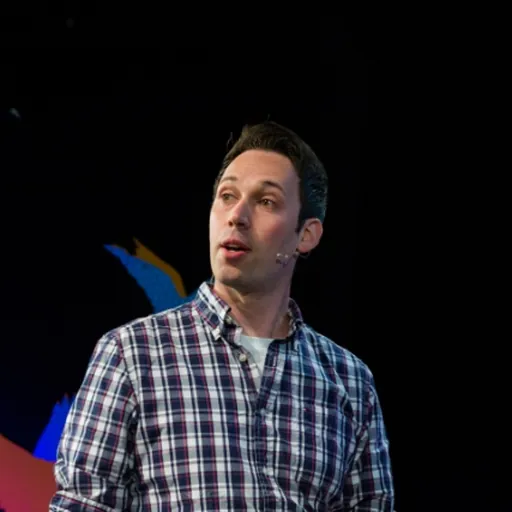
Sander van der Linden
Social psychologist (born 1986)
About Sander van der Linden
Born 1986. Sander van der Linden is a Dutch psychologist, university teacher, scientist and adviser, known for Bad News (video game) and Gateway belief model.
Sander L. van der Linden (born 1986) is a Dutch social psychologist and author who is Professor of Social Psychology at the University of Cambridge. He studies the psychology of social influence, risk, human judgment, and decision-making. He is known for his research on the psychology of social issues, such as fake news, COVID-19 conspiracy theories, and climate change denial.
He has written books for general audiences, including Foolproof: Why We Fall for Misinformation and How to Build Immunity, which is about the psychology of misinformation and fake news.
Education Van der Linden earned his undergraduate degree from the University of Amsterdam and California State University, Chico. He received his Ph.D. from the London School of Economics and Political Science and completed a postdoctoral fellowship in the department of psychology and the Woodrow Wilson School of Public Affairs at Princeton University.
Career Van der Linden is Professor of Social Psychology in Society at the University of Cambridge, England. At Cambridge, he is Director of the Social Decision-Making Laboratory, a Professorial Fellow at Churchill College, and sits on the management board of the Winton Centre for Risk and Evidence Communication. He is also affiliated with the Yale Program on Climate Change Communication at Yale University.
Van der Linden serves on the editorial board of several academic journals, including Psychology, Public Policy, and Law; Personality and Individual Differences; Current Research in Social and Ecological Psychology; and the Journal of Risk Research. From 2018 to 2021, he was editor-in-chief of the Journal of Environmental Psychology.
Research contributions
Misinformation Van der Linden has conducted research on how to protect people from fake news, misinformation, and disinformation. The research draws on inoculation theory where, following the biomedical analogy, forewarning people and exposing them to a severely weakened dose of fake news can generate psychological resistance against it. In a 2021 Science News interview, he referred to his notion of inoculation as "prebunking":
He co-developed the fake news game Bad News, which simulates a social media feed and teaches people about the manipulation techniques used in the production of fake news. A 2020 version of the game called GoViral! sought to inoculate people specifically against misinformation about COVID-19.
Gateway belief model Van der Linden is known for the Gateway belief model (GBM), a dual-process theory of reasoning. The model postulates a two-step process of attitude change. In the first step, perceptions of agreement among a group of influential referents (e.g. experts) influence key private attitudes that people may hold about an issue (e.g., that global warming is human-caused). In turn, these central cognitive and affective beliefs are hypothesized to shape public attitudes and support for science. to eliciting subsequent changes in related beliefs that people hold about contested social and scientific issues. The model has been applied in a variety of contexts, including climate change, vaccination, the Brexit debate, and GMOs. One analysis from Skeptical Science of 37 published papers notes that about 86% of them support the broad tenets of the GBM.
Conspiracy theories Van der Linden and others have surveyed more than 5,000 Americans online about their political preferences, asking them to respond to questions developed to measure conspiratorial thinking and paranoia. They found that those at the extremes of the political spectrum were more conspiratorial than those in the middle. Researchers also found that extreme conservatives were more prone to conspiracy thinking than extreme liberals. Van der Linden speculates that this may reflect strong identification with the The Paranoid Style in American Politics and attempts to manage uncertainty.
Awards 2026, British Psychological Society Presidents' Award for Distinguished Contributions to Psychological Knowledge. 2026, Elected Fellow, British Psychological Society. 2025, Elected Fellow, Academy of Social Sciences. 2022, Clarivate Highly Cited Researcher top 1% by citations in the social sciences category. 2020, Frank Prize, University of Florida. 2019, Sage Young Scholar Award, Society for Personality and Social Psychology.
Don’t just read it —
keep it.
Full-length biographies made to live with: read them, listen on the way to work, watch them tonight.
- E-book
- Audio
- Video
Instant download · yours to keep · every purchase keeps this site free
Important facts
People in Sander van der Linden's life
Named in this biography and alive at the same time

Related people
Same field, nearest in time





Contemporaries
People whose lives overlapped Sander van der Linden's





Frequently asked questions
Who is Sander van der Linden?
Social psychologist (born 1986)
When was Sander van der Linden born?
Sander van der Linden was born in 1986.
What is Sander van der Linden's occupation?
Sander van der Linden is a psychologist, university teacher, scientist and adviser.
What is Sander van der Linden known for?
Sander van der Linden is known for Bad News (video game) and Gateway belief model.
What nationality is Sander van der Linden?
Sander van der Linden is Dutch.
Sources & further reading
· Wikipedia: Sander van der Linden
· DBpedia: Sander van der Linden
Cite this page
APA: Biography.guide. (2026). Sander van der Linden. https://biography.guide/sander-van-der-linden/
MLA: "Sander van der Linden." Biography.guide, https://biography.guide/sander-van-der-linden/.
Chicago: "Sander van der Linden." Biography.guide. https://biography.guide/sander-van-der-linden/.
Data last updated: 2026-09-20 · Spot an error? Report a correction.
Page generated 2026-09-27 05:10 UTC