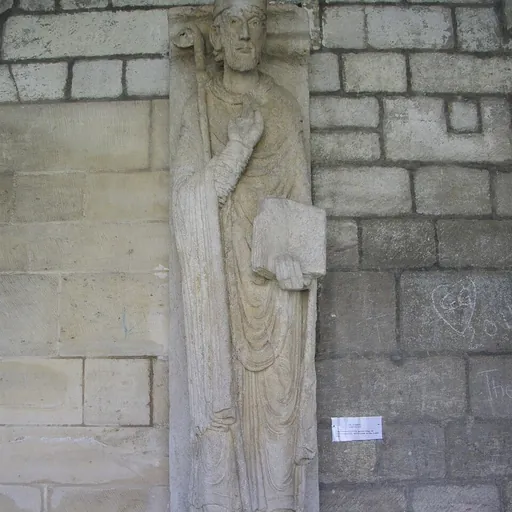
About Sanctinus
Lived 270 – 356 (aged 85–86). Sanctinus was a catholic priest and bishop.
Saint Sanctinus of Meaux (, also Saint Santin, Saintin or Sanctin; ; c. 270 – 356) was a Gallo-Roman bishop and missionary, traditionally named as the first bishop of Meaux and also of Verdun.
Legend According to the legend of Hincmar in the 9th century, Dionysius of Paris trained several priests to preach in Gaul. He appointed Sanctinus as bishop of Chartres and of Meaux. When Dionysius was mortally wounded by soldiers of the usurper Domitian, he sent Sanctinus and a certain Antoninus to Athens to inform the Athenians of his martyrdom. En route in the Roman castellum of Verdun, Sanctinus left the gravely ill Antoninus behind. A local innkeeper promised to take care of Antoninus for a fee. Sanctinus learned in Rome of Antoninus' death and the innkeeper's evil role in it. Sanctinus returned to Verdun in about 330, evangelised the city of Verdun, became its first bishop, and founded a church dedicated to Saints Peter and Paul.
Narrative "...Sanctinus's background and literally every aspect of the history of his cult is clouded in obscurity." The name Sanctinus, (Santin or Saintin), derived from the Latin Sanctus, because his real name is not known. According to tradition, Sanctinus was born about 270. A disciple of Dionysius of Paris, Sanctinus is considered the first bishop in both Meaux and Verdun. He preached the gospel throughout the area, and he is said to have preached also in Picardy and in Champagne. His chief helper was the holy priest Antoninus (Antonius, Antoninestus), whom he is said to have raised from the dead. The Bollandists have made a thorough investigation of the legend, and they concluded that it is not historically sustainable. They put the time of his apostolic activity at the middle of the 4th century. This controversy goes hand in hand over where the relics of Sanctinus lie: in the cathedral of Verdun or in Meaux. Thus, there is a story that around 1044 starving citizens of Meaux sold the relics of Sanctinus to itinerant merchants of Verdun. His tooth is preserved in a reliquary in Verdun Cathedral. This explains the veneration of Sanctinus both in Meaux, where he is held a martyr, and at Verdun, where he is considered a bishop and confessor. In the thirteenth century Meaux gave some of Sanctinus's relics to St. Denis.
In the Roman Martyrology of 1627, he is commemorated on 22 September. More recently his feast day is celebrated on 11 October, his day of death.
There are several dedications to him, including churches at Mogeville, Vaux-lès-Palameix and Courgeon, and chapels at Auteuil and Bellême. A votive feast has long been celebrated on September 22 at Auteuil-le-Roi in the department of Yvelines in the region of Île-de-France, in honor of Sanctinus, who preached there.
Don’t just read it —
keep it.
Full-length biographies made to live with: read them, listen on the way to work, watch them tonight.
- E-book
- Audio
- Video
Instant download · yours to keep · every purchase keeps this site free
Important facts
Related people
Same field, nearest in time




Contemporaries
People whose lives overlapped Sanctinus's



Frequently asked questions
Who was Sanctinus?
bishop of Verdun
When was Sanctinus born?
Sanctinus was born in 270.
When did Sanctinus die?
Sanctinus died in 356 in Meaux.
What was Sanctinus's occupation?
Sanctinus was a catholic priest and bishop.
Sources & further reading
Cite this page
APA: Biography.guide. (2026). Sanctinus. https://biography.guide/sanctinus/
MLA: "Sanctinus." Biography.guide, https://biography.guide/sanctinus/.
Chicago: "Sanctinus." Biography.guide. https://biography.guide/sanctinus/.
Data last updated: 2026-09-22 · Spot an error? Report a correction.
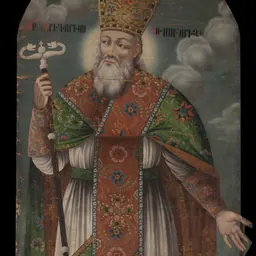
Portrait: Wikimedia Commons · author & licence
Page generated 2026-09-27 05:04 UTC