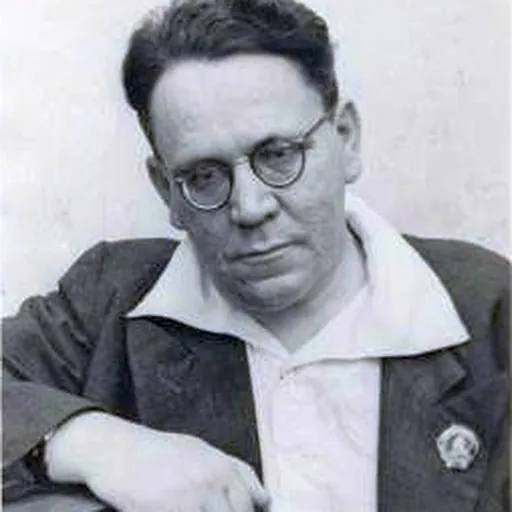
About Samuil Marshak
Lived 1887 – 1964 (aged 76). Samuil Marshak was a Russian linguist, poet, writer, screenwriter, playwright and literary critic.
Samuil Yakovlevich Marshak (alternative spelling: Marchak) (; 4 July 1964) was a Soviet writer of Belarusian Jewish origin, translator and poet who wrote for both children and adults. He translated the sonnets and some other of the works of William Shakespeare, English poetry (including poems for children), and poetry from other languages. Maxim Gorky proclaimed Marshak to be "the founder of Russia's (Soviet) children's literature". His father was a foreman at a soap-making plant.
Marshak grew up with 2 brothers and 3 sisters. His older brother- Moisey (1885—1944) became an economist. His older sister- Susanna (1889—1985) became Schwartz after marriage. His younger brother Ilya (who wrote under the pseudonym ) (1896—1953) became a chemical engineer and a popular science writer. His younger sister Liliya (who wrote as ) (1901—1964) also became Soviet author. Finally, his youngest sister Yudif' (1893) was pianist and a memoire writer.
In 1902, the Marshak family moved to Saint Petersburg. There was a complication: as a Jew, Marshak could not legally live outside the Pale of Settlement, thus he could not attend school while living in the city. Philanthropist and scholar Baron David Günzburg took an interest in Marshak and introduced him to the influential critic Vladimir Stasov.
In 1904, Samuil was diagnosed with tuberculosis and could no longer continue to live in the cold climate of Saint Petersburg. Maxim Gorky arranged for Samuil to live with his family in the Black Sea resort town of Yalta in Crimea (1904–1907). Gorky and Chaliapin also paid for his education and therapy. However, he spent much of this period in Kerch also in Crimea, living with the Fremerman family.
Young poet, philosopher and translator
In 1904, he published his first works in the magazine Jewish Life and in the mid- to late 1900s, Marshak created a body of Zionist verse, some of which appeared in such periodicals as Young Judea.
Marshak had a prolific career in children's literature. Soviet critic Viktor Shklovsky wrote that "Samuil Marshak understood that many new writers would appear in the new Soviet republic. He stood at the door of literature, a benevolent angel, armed not with a sword or with a pencil, but with words on work and inspiration." Marshak's contributions to the field of children's literature was not just limited to his own writings. In 1924, he became the head of the children's branch of the state publishing house Gosizdat (GIZ), a position he held for over a decade. Through his role as editor, Marshak attracted some of Russia's best writers to try their hand at writing for children, including Evgeny Schwartz and OBERIU member Daniil Kharms.
Translations Among his Russian translations there are William Shakespeare's sonnets and songs from Shakespeare's plays, The Merry Wives of Windsor (together with Mikhail Morozov, who translated prosaic scenes), poems of Robert Burns, William Blake, Lord Byron, Percy Bysshe Shelley, John Keats, William Wordsworth, Alfred, Lord Tennyson, Robert Browning, Robert Louis Stevenson, W. B. Yeats, Edward Lear, Lewis Carroll, Rudyard Kipling, T. S. Eliot, A. A. Milne, English and Scottish folk ballads, poems from nursery rhymes. Besides English poetry, he translated poems of Heinrich Heine, Sándor Petőfi, Gianni Rodari and Hovhannes Tumanyan.
His main work in this area is translation of Shakespeare's sonnets (1948). This translation has enjoyed great success over the years. Some Shakespeare sonnets in Marshak's translation have been set to music (in classical style by Dmitry Kabalevsky, in pop style by Tikhon Khrennikov, Mikael Tariverdiev, Alla Pugacheva and others, even in rock style — Cruise). His translations are considered classics in Russia. But many of Marshak's poetic translations became so entrenched in Russian culture, that it was often quipped that he was not so much a translator as a co-author. During World War II, he published satires against the Nazis. After the war he continued to publish children's books including: Разноцветная книга (Multicolored book) 1948, Круглый год (All year round) 1948, Тихая сказка (A Quiet tale) 1956, etc.
In the last years of his life, he wrote aphoristic verses that he named lyrical epigrams. They were published in his last book, Selected Lyrics (Избранная Лирика) in 1963. He also published three tale plays: The Twelve Months 1943, Afraid of Troubles - Cannot Have Luck 1962, and Smart Things 1964.
Although not widely known, in the Soviet era, Marshak was on a (political) razor's edge and barely escaped death in 1937.
Samuil Marshak died on 4 July 1964 and was buried in Moscow in Novodevichy Cemetery. He survived by one son Immanuil Marshak (1917—1977), a physicist. His other son and daughter did not survive till adulthood.
Honours and awards
Four Stalin Prizes: second degree (1942) – a poetic text to posters and cartoons second degree (1946) – for the play-tale "Twelve Months" (1943) second degree (1949) – translations of sonnets by William Shakespeare first degree (1951) – a collection of "Verses for Children" Lenin Prize (1963) – for the book "Selected poetry for children" (1962) and children's books: "A quiet tale", "Big pocket", "The Adventure of the road", "Calm down", "From one to ten", "Vaks Blob", "Who can find a ring", "Merry journey from A to Z". Two Orders of Lenin, incl 1939 Order of the Patriotic War, 1st class (1945) Order of the Red Banner of Labour Honorary president of Robert Burns World Federation (1960) In 2012, his books were included in an exhibit at the Museum of Modern Art
Don’t just read it —
keep it.
Full-length biographies made to live with: read them, listen on the way to work, watch them tonight.
- E-book
- Audio
- Video
Instant download · yours to keep · every purchase keeps this site free
Important facts
People in Samuil Marshak's life
Named in this biography and alive at the same time





Related people
Same field, nearest in time

Contemporaries
People whose lives overlapped Samuil Marshak's




Frequently asked questions
Who was Samuil Marshak?
Russian and Soviet poet, playwright, translator, literary critic, screenwriter, author of popular children's books (1887–1964)
When was Samuil Marshak born?
Samuil Marshak was born on 22 October 1887 in Voronezh.
When did Samuil Marshak die?
Samuil Marshak died on 4 July 1964 in Moscow.
What was Samuil Marshak's occupation?
Samuil Marshak was a linguist, poet, writer, screenwriter, playwright and literary critic.
What nationality was Samuil Marshak?
Samuil Marshak was Russian.
Sources & further reading
Cite this page
APA: Biography.guide. (2026). Samuil Marshak. https://biography.guide/samuil-marshak/
MLA: "Samuil Marshak." Biography.guide, https://biography.guide/samuil-marshak/.
Chicago: "Samuil Marshak." Biography.guide. https://biography.guide/samuil-marshak/.
Data last updated: 2026-09-23 · Spot an error? Report a correction.
Portrait: Wikimedia Commons · author & licence
Page generated 2026-09-27 05:07 UTC