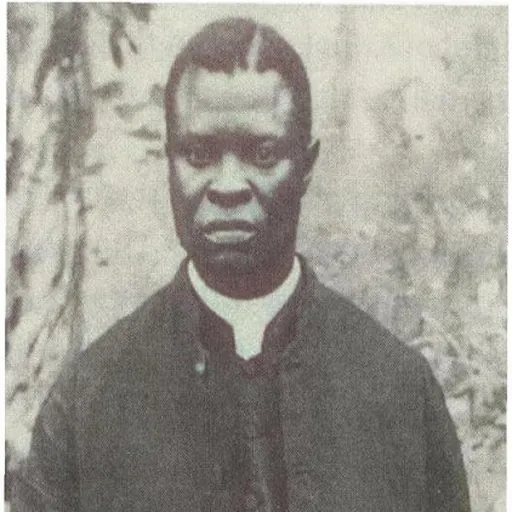
About Samuel Johnson
Lived 1846 – 1901 (aged 54). Samuel Johnson was a Nigerian historian, deacon, priest, writer and missionary.
The Rev. Samuel Johnson (; 24 June 1846 – 29 April 1901) was an Anglican priest, diplomat, and historian, as well as the great-grandson of Alaafin Abiodun, a powerful king of the Oyo Empire. He is most notable for his magnum opus The History of the Yorubas, published posthumously in 1921, in which Johnson endeavored to record the oral traditions and history of the Yoruba people, which he feared were fast fading into obscurity. Lost, rewritten, and then narrowly escaping destruction during WWI, his history has since become "the most frequently cited and most influential volume about the Yoruba-speaking people". Besides his historical contributions, Johnson led an active life, variously serving as a minister, teacher, and school superintendent in Ibadan, capital city of the Oyo state in Nigeria. During the Yoruba Wars, he was an emissary involved in negotiations between the British, Ibadan chiefs, and the king of Oyo.
Biography Samuel Johnson was born a recaptive Creole in Freetown, Sierra Leone, as the third of seven children of Henry Erugunjinmi Johnson and Sarah Johnson on June 24, 1846. His father, who gave himself the Yoruba name Erugunjinmi, was born in 1810 in the town of Oyo-Ile, capital of the Oyo Empire. Henry was an Omoba (prince) of the Oyo clan, and was a grandson of the 18th-century alaafin (king) Abiodun. He was later captured and sold into the Atlantic Slave Trade but was rerouted to Sierra Leone, like many Yorubas, such as Samuel Ajayi Crowther (his distant cousin) and others. He later met the English writer and literary critic Samuel Johnson, whose name he gave to his son. Johnson had 2 older brothers, Henry and Nathaniel, and a younger brother, Obadiah. Henry and Nathaniel both became missionaries and archdeacons like Samuel, while Obadiah became the first indigenous Yoruba medical doctor. He completed his education at the Church Missionary Society (CMS) Training Institute and subsequently taught during what became known as the Yoruba civil war.
Johnson and Charles Phillips, also of the CMS, arranged a ceasefire in 1886 and then a treaty that guaranteed the independence of the Ekiti towns. The people of Ilorin refused to cease fighting however, and the war dragged on. In 1880, he became a deacon and in 1888 a priest. He was based in Oyo from 1881 onward and completed a work on Yoruba history in 1897. Johnson declared that his chief aim in committing pen to paper was to safeguard the annals of Yoruba history, a heritage swiftly slipping into oblivion. Thus, he wrote:
He first entrusted his manuscript to the Christian Missionary Society, who conveyed it to other publishers—the manuscript was later "misplaced" and lost to posterity. Johnson would not live to see his work published. It was only discovered and forwarded to the printer two years later, after the United States had entered WWI. However, printing was at this time impossible due to paper shortages, and the book was put on hold till the war's end. In 1921, Obadiah finally succeeded in publishing the manuscript, titling the work The History of the Yorubas from the Earliest Times to the Beginning of the British Protectorate. The book has since been likened to The Decline and Fall of the Roman Empire by Edward Gibbon.
Don’t just read it —
keep it.
Full-length biographies made to live with: read them, listen on the way to work, watch them tonight.
- E-book
- Audio
- Video
Instant download · yours to keep · every purchase keeps this site free
Important facts
People in Samuel Johnson's life
Named in this biography and alive at the same time


Related people
Same field, nearest in time

Contemporaries
People whose lives overlapped Samuel Johnson's



Frequently asked questions
Who was Samuel Johnson?
Nigerian historian
When was Samuel Johnson born?
Samuel Johnson was born on 24 June 1846 in Freetown.
When did Samuel Johnson die?
Samuel Johnson died on 29 April 1901 in Lagos.
What was Samuel Johnson's occupation?
Samuel Johnson was a historian, deacon, priest, writer and missionary.
What nationality was Samuel Johnson?
Samuel Johnson was Nigerian.
Sources & further reading
· DBpedia: Samuel Johnson (Nigerian historian)
Cite this page
APA: Biography.guide. (2026). Samuel Johnson. https://biography.guide/samuel-johnson/
MLA: "Samuel Johnson." Biography.guide, https://biography.guide/samuel-johnson/.
Chicago: "Samuel Johnson." Biography.guide. https://biography.guide/samuel-johnson/.
Data last updated: 2026-09-22 · Spot an error? Report a correction.
Portrait: Wikimedia Commons · author & licence
Page generated 2026-09-27 05:03 UTC