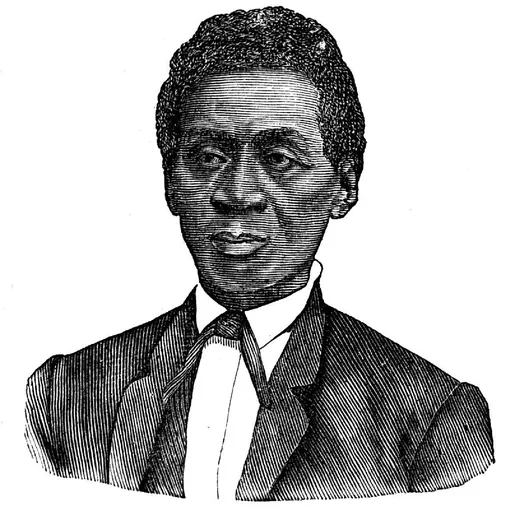
About Samuel Green
Lived 1802 – 1877 (aged 74–75). Samuel Green was a christian minister.
Samuel Green (c. 1802 – ) was a slave, freedman, and minister of religion. A conductor of the Underground Railroad, he was tried and convicted in 1857 of possessing a copy of the anti-slavery novel Uncle Tom's Cabin by Harriet Beecher Stowe following the Dover Eight incident. He received a ten-year sentence, and was pardoned by the Governor of Maryland Augustus Bradford in 1862, after he served five years.
An African American lay minister, he was a founder and trustee of the Mt. Zion Methodist Church (now Faith United Methodist Church) in New East Market. After the American Civil War, he co-founded and worked at the Centenary Biblical Institute (now Morgan State University). The school taught men to become ministers. The Greens were members of the Orchard Street United Methodist Church in Baltimore.
Early life Born around 1802 in East New Market, Maryland, little is known about his parents. His father's status is not known, but his mother was enslaved. It is possible that he was related to Harriet "Ritt" Green, the mother of Harriet Tubman.
He died of pneumonia in 1875 at 45 years of age. He was suspected to have been involved in the incident and Sheriff Robert Bell searched his house after Green returned from a trip to visit his son in Canada. Among other documents, Bell found a letter from his son Samuel who lived in Canada, a map of Canada, railroad schedules, and the book Uncle Tom's Cabin (1852) by Harriet Beecher Stowe. Green was arrested on April 4, 1857, for having Uncle Tom's Cabin, considered an "abolitionist handbill".
Trial Charles F. Goldsborough prosecuted the case against Green in a two-week trial in a Dorchester County, Maryland court. He was sentenced to at least ten years at the Maryland Penitentiary in Baltimore on May 14, 1857. It was very unusual for someone to be convicted of possessing an anti-slavery book. In March 1862, Governor Augustus Bradford pardoned Green under the condition that he left the state within 60 days.
In 1870, Green returned to Dorchester County, He was a member of the Delaware Conference of the Methodist Episcopal Church, where he focused on education. They settled in Baltimore in 1874. The school taught men to become ministers. Baltimore's oldest African-American cemetery. The play was written and produced by Barry O. Foreman, a local playwright. There is also a historical marker at the Faith United Methodist Church that relates the story of Green's life. Nkeiru Okoye wrote the opera Harriet Tubman: When I Crossed that Line to Freedom which depicts Green as a character. It was first performed in 2014.
Don’t just read it —
keep it.
Full-length biographies made to live with: read them, listen on the way to work, watch them tonight.
- E-book
- Audio
- Video
Instant download · yours to keep · every purchase keeps this site free
Important facts
People in Samuel Green's life
Named in this biography and alive at the same time

Related people
Same field, nearest in time



Contemporaries
People whose lives overlapped Samuel Green's






Frequently asked questions
Who was Samuel Green?
African American abolitionist and former slave
When was Samuel Green born?
Samuel Green was born in 1802 in East New Market.
When did Samuel Green die?
Samuel Green died on 28 February 1877.
What was Samuel Green's occupation?
Samuel Green was a christian minister.
Sources & further reading
· DBpedia: Samuel Green (freedman)
Cite this page
APA: Biography.guide. (2026). Samuel Green. https://biography.guide/samuel-green-christian-minister/
MLA: "Samuel Green." Biography.guide, https://biography.guide/samuel-green-christian-minister/.
Chicago: "Samuel Green." Biography.guide. https://biography.guide/samuel-green-christian-minister/.
Data last updated: 2026-09-22 · Spot an error? Report a correction.
Portrait: Wikimedia Commons · author & licence
Page generated 2026-09-27 05:03 UTC