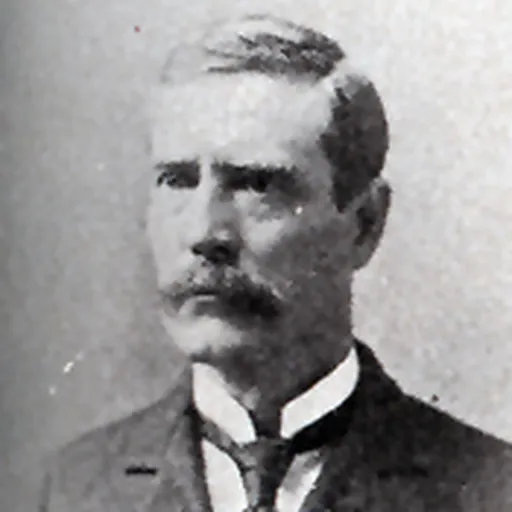
About Samuel A. Cook
Lived 1849 – 1918 (aged 69). Samuel A. Cook was an American politician.
Samuel Andrew Cook (January 28, 1849 – April 4, 1918) was an American businessman, Republican politician, and Wisconsin pioneer. He served one term in the U.S. House of Representatives, representing Wisconsin's 6th congressional district during the 54th U.S. Congress (1895–1897). Cook aligned with the conservative or stalwart faction of the Republican Party during the intra-party struggle against the progressive faction in the early 20th century. Later in life, he served as commander of the Wisconsin chapter of the Grand Army of the Republic (1915–1916).
Before his election to Congress, he served as the 13th mayor of Neenah, Wisconsin, (1889–1890), and represented northern Winnebago County in the Wisconsin State Assembly during the 1891–1892 term. His name was often abbreviated as .
Early life Samuel A. Cook was born in what is now York, Ontario. At the time of his birth, this area was in the West Canada district of the Province of Canada, part of the dominion of the United Kingdom. His parents had come to Canada from Pennsylvania for the opportunity to own their own farm, but decided to return to the United States and settle in the new state of Wisconsin for an opportunity to own a larger farm. Cook's father and brother went first to Fond du Lac, Wisconsin, in 1853. Cook later emigrated with the rest of the family in 1855, settling a new farm in the town of Stockbridge, in Calumet County, Wisconsin.
Civil War service The outbreak of the American Civil War occurred just a few months after the Lady Elgin disaster. Cook and his brothers were all quite interested in supporting the Union cause.
Cook joined the regiment at Memphis, Tennessee, where they engaged in scouting duty until April. As the war was winding down after that time, the regiment was assigned to protect civilian lives and property from bandits and returned rebel soldiers. In June, they were sent to Alexandria, Louisiana, where about half the regiment mustered out on July 3. The Cook brothers, with the remainder of the regiment, were assigned to the Military Division of the Southwest, under General George Armstrong Custer, as part of the Union occupation forces to begin reconstruction. The regiment traveled through Louisiana to Hempstead, Texas, where they camped and engaged in drilling, training, and patrol duty. At the end of October, they proceeded to Austin, Texas, where the regiment was mustered out of federal service. They arrived back in Madison, Wisconsin, on December 11, 1865, where they disbanded.
Business career For the next five years, Cook worked as a farmhand for his family and neighbors. During that time he continued his studies privately. He made his first foray into business about age 20, when he was hired as a subcontractor for a railroad project. He succeeded, and began working steadily in railroad contracting. Around 1876, Cook moved to the village of Unity, Wisconsin, where he took over contracts to supply wood, ties, and other material for railroad construction. He also built and operated a general store in the village, bringing him additional income.
Political career Cook quickly grew in popularity in Neenah, and made his first foray into active politics with the Republican Party of Wisconsin. In 1888, he accepted the Republican nomination to run for mayor of Neenah, Undaunted, Cook ran again the next year and defeated Arnemann by a substantial majority.
He served only one year as mayor and did not run for re-election in 1890. Instead, that fall he accepted the Republican nomination for Wisconsin State Assembly in Winnebago County's 2nd Assembly district. At the time, his district comprised the northern quarter of the county, including Neenah but excluding sister-city Menasha. In an absolutely dreadful election for Wisconsin Republicans, Cook managed to prevail in his district with 54% of the vote and joined the Republican minority in the 40th Wisconsin Legislature. He was one of only two Republican representatives elected from the eastern quarter of the state. That fall, Cook declined renomination for a second term in the Assembly, but rumors emerged that he would run for U.S. House of Representatives instead. Cook ultimately did not run that year. His legislative duties kept him busy later than normal into the fall, due to two special sessions trying to pass a redistricting law.
Cook remained active in political and civic affairs after leaving office. He sold his interest in the Neenah Paper Company in 1894; that spring new rumors spread that he would run for Congress, with early endorsements from several newspapers. Cook began accumulating delegates in county conventions that summer, and by the time of the congressional convention had a clear majority and an easy course to the nomination. He was nominated unanimously by the convention on July 20, 1894.
His district was Wisconsin's 6th congressional district, which then comprised his home county, Winnebago, along with Calumet, Manitowoc, , Marquette, Green Lake, and Waushara. It was one of the more Democratic-friendly districts in the state in that era, but by the 1894 general election, the political mood had turned decisively against the Democrats due to the Panic of 1893. Cook won his election by a 17 point margin, receiving 56% of the vote and defeating incumbent Democrat Owen A. Wells.
Cook was sworn in as a member of the 54th U.S. Congress in March 1895. His first year was troubled when his wife, Jennie, fell ill; her sister had died of tuberculosis in the spring. Cook took his wife to Canada in the fall, hoping that the climate would help her recovery, but she died in September, leaving Cook a widower. Cook did not return to Washington until December. Although Cook was widely expected to win re-election, he announced in July 1896 that he would decline renomination, to devote more time to his children and personal business.
The one true political campaign that Cook engaged in during his later years was the 1908 U.S. Senate primary. This was the first primary election for the office of U.S. senator in Wisconsin history, previously the party nominee would be selected by the party's elected state legislators in caucus before they met for the election. Cook was quickly joined in the primary field by former state senator William H. Hatten and Milwaukee district attorney Francis E. McGovern. The incumbent U.S. senator, Isaac Stephenson, was not initially expected to run for re-election; he was nearly 80 years old and had only been elected in a last-minute compromise by the 48th Wisconsin Legislature after a month-long drama and 22 official ballots. Stephenson surprised the field by announcing that he would run for another term in June. Stephenson had been elected in 1907 with the support of the progressive faction, but had fallen out with progressive leader Robert M. La Follette. La Follette ultimately endorsed William Hatten, but was unable to deliver the full support of the progressive faction, as many instead favored McGovern and some remained loyal to Stephenson. On the other hand, Stephenson was also embraced by many stalwarts, splitting the conservative vote with Cook. With both factions divided, Stephenson prevailed with just 31% of the vote; Cook came in second with 26%. The primary didn't end the drama, as Stephenson was subsequently accused of campaign finance violations and the legislature refused to conclude his election until the last possible day.
In 1915, Cook was elected commander of the Wisconsin department of the Grand Army of the Republic, and served a one-year term. James Milton Cook (1845–1936) enlisted in the 2nd Wisconsin Cavalry Regiment and mostly served as part of the escort for general officers in the Missouri and Arkansas theater until the end of combat operations. He and Sam were then on the post-war expedition with Custer into Texas until late in 1865. James mustered out as a veteran corporal.
Samuel's younger brother, Alfred M. Cook (1850–1921), was too young to fight in the Civil War, but went on to have his own political career in Marathon County, Wisconsin, serving as a state representative in the 1901–1902 term as a Democrat.
Samuel Cook married twice. His first wife was Abbie F. Kelliher, who he met in Stockbridge. They married in 1873, but a year later Abbie died after giving birth to their first son. The child died a few weeks later and the two were buried together. Two years later, Cook married Jennie Christie, also of Stockbridge, on May 17, 1876. They had two children together and were married for 19 years before her sudden death from tuberculosis in September 1895, during Cook's first year in Congress.
Their daughter, Maud Christie Cook, married successful investment broker Charles F. Lancaster of Boston. Their son, Henry Harold "Harry" Cook, went into the paper industry in Indiana.
Electoral history Neenah mayor (1888, 1889) Year Election Date
Total Plurality
Don’t just read it —
keep it.
Full-length biographies made to live with: read them, listen on the way to work, watch them tonight.
- E-book
- Audio
- Video
Instant download · yours to keep · every purchase keeps this site free
Important facts
People in Samuel A. Cook's life
Named in this biography and alive at the same time



Related people
Same field, nearest in time




Contemporaries
People whose lives overlapped Samuel A. Cook's



Frequently asked questions
Who was Samuel A. Cook?
American politician (1849-1918)
When was Samuel A. Cook born?
Samuel A. Cook was born on 28 January 1849 in Ontario.
When did Samuel A. Cook die?
Samuel A. Cook died on 4 April 1918 in Neenah.
What was Samuel A. Cook's occupation?
Samuel A. Cook was a politician.
What nationality was Samuel A. Cook?
Samuel A. Cook was American.
Sources & further reading
Cite this page
APA: Biography.guide. (2026). Samuel A. Cook. https://biography.guide/samuel-a-cook/
MLA: "Samuel A. Cook." Biography.guide, https://biography.guide/samuel-a-cook/.
Chicago: "Samuel A. Cook." Biography.guide. https://biography.guide/samuel-a-cook/.
Data last updated: 2026-09-23 · Spot an error? Report a correction.
Portrait: Wikimedia Commons · author & licence
Page generated 2026-09-27 05:06 UTC