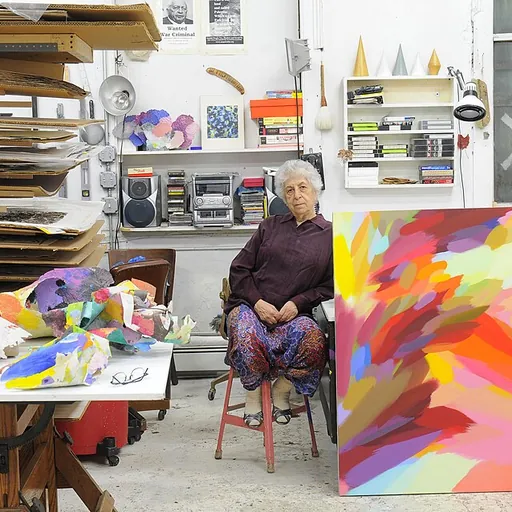
About Samia Halaby
Born 1936. Samia Halaby is an American artist, university teacher, painter and art historian.
Samia A. Halaby (born 1936) is a Palestinian-American visual artist, activist, educator, and scholar. Halaby is recognized as a pioneer of abstract painting and Computer art. Since beginning her artistic career in the late 1950s, she has exhibited in museums, galleries, and art fairs throughout Europe, Asia, and North America. Her work is housed in public and private collections around the world, including the Solomon R. Guggenheim Museum (New York), the Institut du Monde Arabe (Paris), and the Palestinian Museum (Birzeit). Her work was included in the 2024 Venice Biennale. She is represented by Andrée Sfeir-Semler's gallery, operating in Beirut and Hamburg.
Early life Halaby was born in Jerusalem on December 12, 1936, during the British Mandate of Palestine.
Halaby attended the British Tabitha Mission School. She was 11 years old. Her family fled to Lebanon, residing in Beirut until 1951, before eventually settled in Cincinnati, Ohio. Halaby graduated from North College Hill High School. She also taught at the University of Hawaii, Indiana University, the Cooper Union, the University of Michigan, and the Kansas City Art Institute.
Based in New York City since 1976,
Scholarship on Palestinian art As an independent scholar she has contributed to the documentation of Palestinian art of the twentieth century through many texts including her 2001 book Liberation Art of Palestine: Palestinian Painting and Sculpture in the Second Half of the 20th Century (H.T.T.B. Publications), and a chapter titled "The Pictorial Arts of Jerusalem During the First Half of the 20th Century" that appears in the 2012 book Jerusalem Interrupted: Modernity and Colonial Transformation 1917-Present (ed. , Olive Branch Press), and through several curated exhibitions of Palestinian art in the US. She has also lectured widely on the subject in galleries and universities throughout the United States and in venues in the Arab world.
She was instrumental in the 2003 landmark exhibition Made in Palestine, which was organized by the Station Museum of Contemporary Art in Houston and curated by James Harithas, Tex Kerschen, and Gabriel Delgado. Halaby actively assisted the curators in researching Palestinian artists, both in the United States and the Arab world, introducing them to such artists as the late Mustapha Hallaj in Syria and Abdul Hay al Mussalam in Jordan, for example. The first museum exhibition of Palestinian art to be held in the US, Made in Palestine went on to tour throughout the country.
The 2004 exhibition The Subject of Palestine, which Halaby curated for the DePaul Art Museum, was described by the Chicago Tribune as presenting "the work of 16 contemporary Palestinian artists that even the least informed of viewers are likely to come away with the sense that they have seen and grasped something important." The review went on to congratulate DePaul Art Museum for its "incisive presentation".
Cancelled 2024 retrospective Halaby's first retrospective exhibition in the United States, titled Centers of Energy and curated by Elliot Josephine Leila Reichert, was scheduled to open in 2024 at Indiana University Bloomington’s Eskenazi Museum of Art, but the show was cancelled in December 2023. The University cited "safety concerns" as the reason for cancelling her show. Halaby believed the reason for the cancellation of her show was to suppress Palestinian voices during the Gaza war, saying the cancellation was "an extension of what's happening in Gaza, where Palestinians are not allowed to speak or express our opinion." In October 2024, Michigan State University removed Six Golden Heroes, a painting referring to the escape of Palestinian political prisoners.
Painting style Halaby primarily works in abstraction but has also utilized a documentary-style of figurative drawing in more politically oriented works, such as her Kafr Qasm series. She has designed dozens of political posters and banners for various anti-war causes, and is featured in the publication The Design of Dissent. The development of her work over the past fifty years has been closely related to locating the many principles of abstraction in nature utilizing a materialist approach. A number of her paintings have been created by building upon the methods and forms of certain historical applications of abstraction, such as that of the Russian Constructivists, and examples of traditional Arabic arts and Islamic architecture. The visual culture of Palestine and its natural setting have also figured into her paintings, as has the dynamism of New York City as experienced in the sights of people in motion and its busy streets
Her approach to abstraction has ranged from works exploring the visual properties of the geometric still life to free-form paintings in the form of collaged pieces of canvas that are joined to create larger abstractions that she calls "free from the stretcher". Halaby describes these pieces as previously painted fragments that are cut, stitched and reformed into hanging sculptures with paint applied to both sides. As of 2020, her oeuvre contained more than 3,000 works, including paintings, digital media, three-dimensional hanging sculptures, artist books, drawings, and limited edition artist prints. Her Helixes and Cycloid series, as well as her Diagonal Flight series, are examples of her perceptual theory.
After retiring from teaching, Halaby began experimenting with electronic art forms, teaching herself how to program Basic and C programming languages on an Amiga computer and later on a PC. Creating programs that would allow viewers to witness the process of live computerized painting, she enlisted the help of musicians for kinetic art performances that were inspired by jam sessions. Her "Kinetic Painting Group" toured extensively in the late 1990s, and video works continue to be shown across the world.
Abstract color (1963–1965)
During her final student days and for a period after, Halaby's approach to painting was characterized by flat color; in these works, relationships of luminosity and simultaneous contrast were inspired by the minimalists and by the work of Josef Albers and his book Interaction of Color. In terms of shape, the work depended essentially on the rectangular surfaces of human life, be they walls, windows, writing paper, floors, cards, or gently hung weavings. The variety of scale and placement was clearly an abstraction from ways of examining the world we see. During that short span, Halaby left Bloomington to teach in Honolulu at the University of Hawaii, then moved to Kansas City to teach at the Kansas City Art Institute, her second teaching position.
Geometric still-life (1966–1970) After 1965, a scientific attitude of exactly how we observe and interpret what we see overtook her. She has written, "I began to feel that I must make a clean, new beginning and erase my teachers and my past out of my thoughts." At this point, Halaby relied on what she saw at museums and her knowledge of art history to develop her new way of thinking. She examined Rembrandt and his use of light and color in portraiture, and was particularly impressed with the Old Master collection at the Kansas City Museum. After an extended and frustrating exploration, a small orange on a windowsill captured Halaby's attention and started the new series. This inspiration can be attributed to the painting Virgin and Child in Domestic Interior ( 1467–69) by Flemish master Petrus Christus in the collection of the Nelson-Atkins Gallery of Art in Kansas City. Halaby was then teaching at the Kansas City Art Institute and leading a boldly experimental program for first-year students.
As she describes her interest in later writing, Halaby tells of revisiting the museum to examine how artists historically treated edges. From her thorough education at the University of Cincinnati, Halaby understood the failures of perspective. She wanted to know exactly what it is we see when our eye travels over the surface of a spherical or cylindrical object, reaches the edge and then jumps to a far background. Finding no answers, Halaby realized that how we see is educated. Over millennia, artists have contributed the multitude of small discoveries that created the monument of visual culture that teaches us how to see—what Halaby calls "visual conjugation." This then became, to Halaby, the important challenge as she insisted that painting is exploration not performance.
Helixes and Cycloids (1971–1975)
As the geometric still-life series had satisfied her curiosity, Halaby found herself at a critical point on her artistic path. She felt that she could explore one of two directions, either focus on the individual and the self or life outside. She tested the first direction by doing a portrait of a friend but quickly decided to embrace the latter. She interpreted the idea of life outside the self as painting that expands its content outside the frame.
As a point of reference, Halaby had purchased several used books on geometry, with some devoted to pipe fitting. Her exploration of these books led to her Helixes and Cycloids series.
Diagonal Flight (1974–1979)
While teaching at the Yale School of Art, Halaby worked on the new Diagonal Flight series. The title had occurred to her while watching children play with arms outstretched while running, making engine sounds, pretending to be airplanes. She had been wondering to which direction the diagonal horizons of her new paintings should lean. The children, being mostly right-handed, banked their pretend flight to the right. She determined immediately to follow their natural habits.
Although still cognizant of the commitment to pursue the idea of conjugation emanating from the geometric still lifes, Halaby was testing the irrationality of perspective and shading by creating an accurately shaded space that we cannot read according to our educated skills. How would viewers see a carefully shaded cylinder if it extended outside the perimeter of the painting on both ends? The information on the depth of the cylinder would be so concretely provided by the circular ends and would not be visible. The result was that scale became relative and the space of the paintings could easily be read as variedly colored horizons such as one might see out of the window of an airplane. Geometry and the convergence of measurements continued to dominate her thoughts.
Dome of the Rock (1980–1982) In 1979, Halaby felt that she had reached the end of the Diagonal Flight series. Instead of experimenting with new directions, she stopped painting entirely for a short period then painted profusely, most of which she ultimately destroyed. It was an important pivotal moment where she shifted into the second broad phase of her artistic life, that of abstraction. In essence, Halaby explains, it was essentially a continuation of seeing but with the addition of the fourth dimension of time.
Finally, the Dome of the Rock series was inspired by a visit to Jerusalem in 1966. Forty-five-degree diagonal lines emanate from the corners while points of diamonds began and ended at measured locations on the perimeter. Here, she added cylinders and textures inspired by inlaid Arabic art.
Autumn Leaves and City Blocks (1982–1983)
Another short series based on investigations the artist did many years earlier is Autumn Leaves and City Blocks. Her focus on the cells between veins in autumn leaves and their similarity to city blocks that she knew in New York connected together formed basis for this series. At that time Halaby lived in New York and commuted to New Haven while teaching at the Yale School of Art.
Halaby noticed that human building was dominated by the right angle, but that in the growth of highways and city blocks those right-angled rectangles were often disturbed and thus truncated by the necessities imposed by natural land formations. They resembled the cells between veins in a maple leaf. The ways in which bridges crossed rivers, at right angles then bend according to land formation also formed a part of the inspiration. Halaby determined that her paintings, to be as beautiful as nature, had to grow according to principles extracted from nature. Thus what is unique in this series is that it is based on the process of growth she observed in nature.
Growing Shapes and Centers of Energy (1984–1992) Ideas regarding imitating principles of growth dominated her creativity during the 1980s. Her series Growing Shapes and Centers of Energy continued her interest in natural processes.
A few years later, during the early 1990s, Halaby began programing on a PC, converting the keyboard into an abstract painting piano. This program was also called Kinetic Painting and was not published but remained the artist's private tool. She used it to perform live with musicians. Multi-percussion musician, Kevin Nathaniel Hylton became her main collaborator as she began the public performance process utilizing her program. With musician Hasan Bakr they formed the Kinetic Painting Group and performed at numerous off-Broadway venues often accompanied by other musicians. In 2023, Halaby presented kinetic paintings on large-scale LED screens in public spaces at the Manar Abu Dhabi light art festival. These works were first developed in the 1990s, but were presented in a grander and newer architectural context. Her eventual acquisition by major institutions has been understood by critics as a belated recognition of a practice that had long operated outside of, and in deliberate resistance to, those institutions. In 2011, the Palestinian conceptual artist Khalil Rabah included a portrait of Halaby for his large-scale project of "ready mades" that stood as a "subjective" overview of contemporary Palestinian art history. Rabah's portrait is based on a photograph from the artist's archive that was taken at one of her first exhibitions in the 1960s.
Public collections including Halaby's work The Guggenheim Museum (New York and Abu Dhabi) The Art Institute of Chicago Detroit Institute of Art The Cleveland Museum of Art Cincinnati Art Museum Indianapolis Museum of Art The National Museum of Women in the Arts Mead Art Museum Arab World Institute Mathaf: Arab Museum of Modern Art Eskenazi Museum of Art, Indiana University Darat al Funun - The Khalid Shoman Foundation, Amman, Jordan
Exhibitions of Palestinian art curated by Halaby Palestinian Art (2001), Headquarters of Union DC 1707, Manhattan, NY (curator) Williamsburg Bridges Palestine (2002), Williamsburg Art & Historical Center, Brooklyn, NY (co-curator with Zena El-Khalil) Palestine: Art of Resistance (2003), Tribes Gallery, Manhattan, NY (co-curator with Zena El-Khalil and Janine Al-Janabi) The Subject of Palestine (2004), Depaul Art Museum, Chicago, IL (curator) (which later traveled to the Jerusalem Fund Gallery in Washington DC in 2005) Art of Palestine (2005), Zeitgeist Gallery, Cambridge, MA (curator)
Performances and presentations of Kinetic Painting Group Third and Fourth International Symposiums on Electronic Art (1993, 1994), Minneapolis, MN Brooklyn Museum of Art (1994) Philadelphia College of Art (1997) Galerie Le Pont (1997), Aleppo, Syria Atassi Gallery (1997), Damascus, Syria Sakakini Art Center (1997), Sakakini Art Center, Ramallah, West Bank Beirzeit University (1997), BeirZeit, West Bank Darat al Funun (1997), Amman, Jordan Lebanese American University (1998), Beirut, Lebanon Lincoln Center (1998) Williamsburg Art and Historical Center (1998), Brooklyn, New York Taipei Fine Arts Museum (2023), Taipei, Taiwan
Publications
Liberation Art of Palestine: Palestinian Painting and Sculpture in the Second Half of the 20th Century. New York: H.T.T.B. Publications, 2001. London: Booth-Clibborn, 2014. Publication of color reproductions of a diversity of Halaby's work. Wooster, OH: Palestine Books in collaboration with Ayyam Gallery, 2017. A theoretical account of how shapes evolved in her abstract painting practice from 1980s-on. Drawing the Kafr Qasem Massacre. Amsterdam: Schilt Publishing, 2017. Halaby's documentary drawings on the Kafr Qasem massacre, an attack on Palestinian Arab villagers by Israeli Border Police. Samia Halaby: Centers of Energy. Munich: Hirmer Publishers, 2024. Catalog for Halaby's unrealized retrospective which includes essays by the artists on her history of digital art and the theory of abstraction.
Don’t just read it —
keep it.
Full-length biographies made to live with: read them, listen on the way to work, watch them tonight.
- E-book
- Audio
- Video
Instant download · yours to keep · every purchase keeps this site free
Important facts
People in Samia Halaby's life
Named in this biography and alive at the same time





Related people
Same field, nearest in time


Contemporaries
People whose lives overlapped Samia Halaby's





Frequently asked questions
Who is Samia Halaby?
Palestinian artist (born 1936)
When was Samia Halaby born?
Samia Halaby was born in 1936 in Jerusalem.
What is Samia Halaby's occupation?
Samia Halaby is an artist, university teacher, painter and art historian.
What nationality is Samia Halaby?
Samia Halaby is American.
Sources & further reading
Cite this page
APA: Biography.guide. (2026). Samia Halaby. https://biography.guide/samia-halaby/
MLA: "Samia Halaby." Biography.guide, https://biography.guide/samia-halaby/.
Chicago: "Samia Halaby." Biography.guide. https://biography.guide/samia-halaby/.
Data last updated: 2026-09-21 · Spot an error? Report a correction.
Portrait: Wikimedia Commons · author & licence
Page generated 2026-09-27 05:00 UTC