About Sam the Sham
Born 1937. Sam the Sham is an American singer-songwriter.
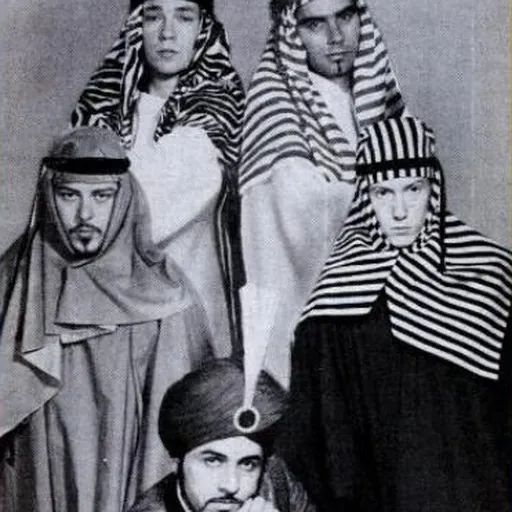
Domingo Samudio (born February 28, 1937), better known by his stage name Sam the Sham, is a retired American rock and roll singer. Sam the Sham is known for his camp robe and turban and hauling his equipment in a 1952 Packard hearse with maroon velvet curtains. As the front man for the Pharaohs, he sang on several Top 40 hits in the mid-1960s; "Wooly Bully" by Sam the Sham and the Pharaohs was the number one song of 1965 according to Billboard magazine's year-end Hot 100. However, the song never reached number one on the weekly charts. "Li'l Red Riding Hood" was another charting song for Samudio.
Biography
Early career Samudio made his singing debut in second grade, representing his school in a radio broadcast. Later, he took up guitar and formed a group with friends, one of whom was Trini Lopez. After graduating from high school, Samudio joined the Navy, where he was known as "Big Sam." He lived in Panama for six years, until his discharge.
Back in the States, Samudio enrolled in college, studying voice at Arlington State College, now the University of Texas at Arlington. He recalled: "I was studying classical in the daytime and playing rock and roll at night. That lasted about two years, before I dropped out and became a carny."
Personal life
Most sources refer to Samudio's ancestry as Mexican-American. However, a 1998 article by the Chicago Tribune described Samudio as being of Basque/Apache descent. In a 2007 conversation with music writer Joe Nick Patoski, Samudio described his grandparents fleeing the Mexican Revolution and settling in Texas, where his family supported themselves working in the cotton fields.
After leaving the music business, Samudio worked in Mexico as an interpreter and as a mate on small commercial boats in the Gulf of Mexico. He later became a motivational speaker and still makes occasional concert appearances. He was inducted into the Memphis Music Hall of Fame in 2016.
Sam the Sham and the Pharaohs
In Dallas in 1961, Samudio formed the Pharaohs, the name inspired from the costumes in Yul Brynner's portrayal as pharaoh in the 1956 film The Ten Commandments. The other members of the Pharaohs were Carl Miedke, Russell Fowler, Omar "Big Man" Lopez, and Vincent Lopez (no relation to Omar). In 1962, the group made a record that did not sell and later disbanded.
In May 1963, Vincent Lopez was playing for Andy and the Nightriders in Louisiana. When their organist quit, Samudio joined. Andy and the Nightriders were Andy Anderson, David A. Martin, Vincent Lopez, and Samudio. The Nightriders became house band at The Congo Club, near Leesville, Louisiana. It was here that Samudio took the name Sam the Sham from a joke about his lack of ability as a vocalist. Once MGM picked up the record, "Wooly Bully" ended up selling three million copies and reaching No. 2 on the Billboard Hot 100 on 5 June 1965, at a time when American pop music charts were dominated by the British Invasion. Leonard Stogel was their manager.
Although "Wooly Bully" never reached No. 1, it lingered on the Hot 100 for 18 weeks, the most weeks for any single within the calendar year 1965, 14 of which were in the top 40. The record achieved the distinction of becoming the first Billboard "Number One Record of the Year" not to have topped a weekly Hot 100 and remained the only one for 35 years, until Faith Hill's "Breathe", Lifehouse's "Hanging by a Moment", and Dua Lipa's "Levitating" in 2000, 2001, and 2021, respectively.
The Pharaohs' next releases – "Ju Ju Hand" (No. 26 US, Canadian No. 31) and "Ring Dang Doo" – were minor successes.
New lineup and second hit
In late 1965, 11 months after "Wooly Bully", David A. Martin, Jerry Patterson, Ray Stinnett, and Butch Gibson left over a financial dispute.
Sam's manager, Leonard Stogel, discovered Tony Gee & the Gypsys at the Metropole Cafe in Times Square, New York City, and brought them on as the new Pharaohs. The band, besides Sam, was Tony "Butch" Gerace (bass guitar and vocals), Frankie Carabetta (keyboards, saxophone and vocals), Billy Bennett (drums and percussion), and Andy Kuha (guitar and vocals). This new set of Pharaohs recorded "Lil' Red Riding Hood". On the Hot 100, "Lil' Red Riding Hood" began its two-week peak at No. 2 the week of August 6, 1966, just as another fairy tale title, Crispian St. Peters' "The Pied Piper", ended its third and final week there at No. 4.
A series of mostly novelty tunes followed, all on the MGM label, keeping the group on the charts into 1967. Titles included "The Hair on My Chinny Chin Chin" (US No. 22, Canadian No. 13), "How Do You Catch a Girl" (US No. 27, Canadian No. 12), "I Couldn't Spell !!*@!", and "Oh That's Good, No That's Bad" (US No. 54).
Post-Pharaohs career In late 1966, three women, Fran Curcio, Lorraine Gennaro, and Jane Anderson, joined as the Shamettes. The group traveled to Asia as Sam the Sham & the Pharaohs and the Shamettes and released the album titled The Sam the Sham Revue (originally to be titled Nefertiti by Sam the Sham and the Pharaohs, which is printed on the inside record labels). Samudio also released a solo album in late 1967, titled Ten of Pentacles.
Domingo Samudio, better known as Sam the Sham, had a small acting role as the 1st Expressman in the 1967 Metro-Goldwyn-Mayer Western comedy film "The Fastest Guitar Alive", which starred legendary singer Roy Orbison.
In 1970, Samudio went off on his own, and in 1971, issued an Atlantic album called Sam, Hard and Heavy. He also wrote the liner notes on the album, which won the Grammy Award for Best Album Notes in 1972. The album featured Duane Allman on guitar, the Dixie Flyers, and the Memphis Horns. He formed a new band in 1974. In the late 1970s, he worked with baritone saxophonist Joe Sunseri and his band, based in New Orleans. The early 1980s found Samudio working with Ry Cooder and Freddy Fender on the soundtrack for the film The Border. Wooly Bully (June 1965) MGM E (Mono)/SE (Stereo) 4297 Their Second Album (November 1965) MGM E/SE 4314 On Tour (March 1966) MGM E/SE 4347 Li'l Red Riding Hood (July 1966) MGM E/SE 4407 The Best of Sam the Sham & the Pharaohs (February 1967) MGM SE 4422 The Sam the Sham Revue [titled Nefertiti in Canada] (October 1967) MGM E/SE 4479 Pharaohization: The Best of Sam the Sham and the Pharaohs (1985) Rhino 122
As Sam the Sham: Ten of Pentacles [inside labels read "The 10 of Penticles" by Sam the Sham & the Pharaohs] (February 1968) MGM E/SE 4526 Won't Be Long (1994) Samara Productions, Inc. SAM002A
As Sam Samudio: Sam, Hard and Heavy (March 1971) Atlantic SD 8271
As Sam and Charity: Running With the Rabbits (1983)
Singles As Sam the Sham and the Pharaohs:
As Sam the Sham:
As Sam Samudio: Year Titles (A-side, B-side) US Hot 100 Album1970"Key to the Highway"b/w "Me and Bobby McGee" (Non-album track)-Sam, Hard and Heavy
Don’t just read it —
keep it.
Full-length biographies made to live with: read them, listen on the way to work, watch them tonight.
- E-book
- Audio
- Video
Instant download · yours to keep · every purchase keeps this site free
Important facts
People in Sam the Sham's life
Named in this biography and alive at the same time







Related people
Same field, nearest in time



Contemporaries
People whose lives overlapped Sam the Sham's




Frequently asked questions
Who is Sam the Sham?
American rock and roll singer
When was Sam the Sham born?
Sam the Sham was born on 28 February 1937 in Dallas.
What is Sam the Sham's occupation?
Sam the Sham is a singer-songwriter.
What nationality is Sam the Sham?
Sam the Sham is American.
Sources & further reading
Cite this page
APA: Biography.guide. (2026). Sam the Sham. https://biography.guide/sam-the-sham/
MLA: "Sam the Sham." Biography.guide, https://biography.guide/sam-the-sham/.
Chicago: "Sam the Sham." Biography.guide. https://biography.guide/sam-the-sham/.
Data last updated: 2026-09-22 · Spot an error? Report a correction.
Portrait: Wikimedia Commons · author & licence
Page generated 2026-09-27 05:03 UTC