
About Salvian
Lived 400 – 470. Salvian was a Roman writer, historian and theologian.
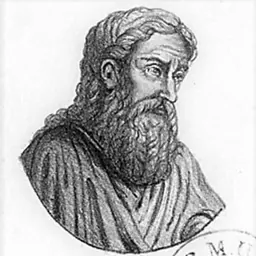
Salvian (or Salvianus) was a Christian writer of the 5th century in Roman Gaul.
Personal life Salvian's birthplace is uncertain, but some scholars have suggested Cologne or Trier some time between 400 and 405. He was educated at the school of Trier and seems to have been brought up as a Christian. His writings appear to show that he had made a special study of the law; and this is the more likely as he appears to have been of noble birth and could describe one of his relations as being "of no small account in her own district and not obscure in family". He was certainly a Christian when he married Palladia, the daughter of pagan parents, Hypatius and Quieta, whose displeasure he incurred by persuading his wife to retire with him to a distant monastery, which is almost certainly that founded by St Honoratus at Lerins. For seven years there was no communication between the two branches of the family, till at last, when Hypatius had become a Christian, Salvian wrote him a most touching letter in his own name, his wife's, and that of his little daughter Auspiciola, begging for the renewal of the old affection. This whole letter is a most curious illustration of Salvian's reproach against his age that the noblest man at once forfeited all esteem if he became a monk.
It was presumably at Lerins that Salvian made the acquaintance of Honoratus (died 429), Hilary of Arles (died 449), and Eucherius of Lyon (died 449). That he was a friend of the former and wrote an account of his life we learn from Hilary. To Eucherius's two sons, Salonius and Veranus, he acted as tutor in consort with Vincent of Lérins. As he succeeded Honoratus and Hilary in this office, this date cannot well be later than the year 426 or 427, when the former was called to Arles, whither he seems to have summoned Hilary before his death in 429.
Later work Salvian continued his friendly intercourse with both father and sons long after the latter had left his care; it was to Salonius (then a bishop) that he wrote his explanatory letter just after the publication of his treatise Ad ecclesiam; and to the same prelate a few years later he dedicated his great work, the De gubernatione Dei ("The Government of God"). If French scholars are right in assigning Hilary's Vita Honorati to 430, Salvian, who is there called a priest, had probably already left Lyons for Marseille, where he is known to have spent the last years of his life (Gennadius, ap. Migne, lviii. 1099). It was probably from Marseille that he wrote his first letter — presumably to Lerins — begging the community there to receive his kinsman, the son of a widow of Cologne, who had been reduced to poverty by the barbarian invasions. It seems a fair inference that Salvian had divested himself of all his property in favour of that society and sent his relative to Lerins for assistance (Ep. i., with which compare Ad eccles. ii. 9, 10; iii. 5). It has been conjectured that Salvian paid a visit to Carthage; but this is a mere inference based on the minute details he gives of the state of this city just before its fall to the Vandals (De gub. vii. viii). He seems to have been still living at Marseille when Gennadius wrote under the papacy of Gelasius (492–496). It was published after the capture of Litorius at Toulouse (439), to which he plainly alludes in vii.40. and after the Vandal conquest of Carthage in the same year (vi. 12), but before Attila's invasion (451), as Salvian speaks of the Huns, not as enemies of the empire, but as serving in the Roman armies (vii. 9). The words "proximum bellum" seem to denote a year very soon after 439. (vii. 9, II, 21). It is curious that Salvian shows no such hatred of the heterodox barbarians as was rife in Gaul seventy years later. It is difficult to credit the universal wickedness adduced by Salvian, especially in face of the contemporary testimony of Symmachus, Ausonius and Sidonius Apollinaris.
Ad ecclesiam Ad ecclesiam is explained by its common title, Contra avaritiam (Against Avarice). It strongly commends meritorious almsgiving to the church. It is quoted more than once in the De gubernatione. Salvian published it under the name of Timothy, and explained his motives for so doing in a letter to his old pupil, Bishop Salonius (Ep. ix.).
This work is chiefly remarkable because in some places it seems to recommend parents not to bequeath anything to their children, on the plea that it is better for the children to suffer want in this world than that their parents should be damned in the next (iii. 4). Salvian is very clear on the duty of absolute self-denial in the case of sacred virgins, priests and monks (ii. 8–10).
Editions The Ad ecclesiam was first printed in Sichard's Antidoton (Basel, 1528); the De gubernatione by Brassican (Basel, 1530). The two appeared in one volume at Paris in 1575. Pithoeus added variae lectiones and the first seven letters (Paris, 1580); Ritterhusius made various conjectural emendations (Altorf, 1611), and Baluze many more based on manuscript authority (Paris, 1663–1669).
Numerous other editions appeared from the 16th to the 18th century, all of which are now superseded by those of Karl Felix Halm (Berlin, 1877) and F. Pauly (Vienna, 1883).
The two oldest manuscripts of the De gubernatione belong to the 10th century (Cod. Paris, No. 13,385) and the 13th (Brussels, 10,628); of the Ad ecclesiam to the 10th (Paris, 2172) and the 11th (Paris, 2785); of Epistle IX to the 9th (Paris, 2785); of Epistle VIII. to the 7th or 8th century (Paris, 95,559) and to the 9th or 10th century (Paris, 12,237, 12,236). Of the first seven epistles there is only one manuscript extant, of which one part is now at Bern (No. 219), the other at Paris (No. 3791). See Histoire littéraire de France, vol. ii.; Zschimmer's Salvianus (Halle, 1875).
Salvian's works are reprinted (after Baluze) in Migne's Cursus patrologiae, ser. lat. vol. liii. For bibliography, see T. G. Schoenemann's Bibliotheca patrum (ii. 823), and the prefaces to the editions of C. Halm (Monum. Germ., 1877) and F. Pauly (Vienna, Corp. scr. eccl. Lat., 1883).
Gennadius, Hilary and Eucherius may be consulted in Migne, vols. lviii. and I. See also Samuel Dill, Roman Society in the Last Century of the Western Empire, pp. 115–120.
Don’t just read it —
keep it.
Full-length biographies made to live with: read them, listen on the way to work, watch them tonight.
- E-book
- Audio
- Video
Instant download · yours to keep · every purchase keeps this site free
Important facts
People in Salvian's life
Named in this biography and alive at the same time




Related people
Same field, nearest in time


Contemporaries
People whose lives overlapped Salvian's





Frequently asked questions
Who was Salvian?
Gaulish writer
When was Salvian born?
Salvian was born in 400 in Trier.
When did Salvian die?
Salvian died in 470 in Marseille.
What was Salvian's occupation?
Salvian was a writer, historian and theologian.
What nationality was Salvian?
Salvian was Roman.
Sources & further reading
Cite this page
APA: Biography.guide. (2026). Salvian. https://biography.guide/salvian/
MLA: "Salvian." Biography.guide, https://biography.guide/salvian/.
Chicago: "Salvian." Biography.guide. https://biography.guide/salvian/.
Data last updated: 2026-09-20 · Spot an error? Report a correction.
Page generated 2026-09-27 05:04 UTC