
Salusbury Pryce Humphreys
Royal Navy officer during the French Revolutionary and Napoleonic Wars and the War of 1812
About Salusbury Pryce Humphreys
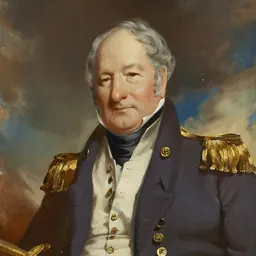
Lived 1778 – 1845 (aged 66). Salusbury Pryce Humphreys was a British naval officer.
Rear-Admiral Sir Salusbury Pryce Davenport (born Salusbury Pryce Humphreys; 24 November 1778 – 17 November 1845) was a Royal Navy officer who served in the French Revolutionary and Napoleonic Wars.
He entered the navy during the Nootka Crisis in 1790 and served aboard a number of ships, starting at the level of able seaman and rising through the ranks, having reached midshipman on the outbreak of the French Revolutionary Wars. A lieutenancy followed while serving in the Caribbean, where he acted in support of army operations against enemy colonies and islands, before his return to Britain. He was afterwards employed in the English Channel and North Sea, where he distinguished himself on a cutting out expedition off the Dutch island of Schiermonnikoog, narrowly escaping death when a ship he tried and failed to board suddenly exploded. After again supporting land operations, this time in Holland, he was promoted to commander though he had to then wait two years for a command.
Promotion to post-captain soon followed, and he went to North America to command the flagship of the admiral in command there. Desertion from Royal Navy ships had become a pressing issue and Humphreys, by then in command of the 50-gun , was ordered to intercept the , which was suspected to have several deserters as part of her crew. Humphreys did so, and requested permission to search her. Chesapeakes captain refused, so Humphreys fired upon her, the poorly prepared American ship surrendered and Humphreys took off several British deserters. The backlash from the Chesapeake-Leopard Affair, as it became known as, was severe. A political crisis was precipitated between the governments of Britain and the United States, and to mollify the Americans, Humphreys was given no further commands. He was already wealthy, having married an heiress, and settling at the estates of Bramall Hall. He was promoted to rear admiral in 1837, and then restored on the active lists, having changed his surname to Davenport in 1838 on the occasion of his wife's inheritance. He died in 1845.
Family and early life Salusbury Pryce Humphreys was born at Clungunford Rectory, Shropshire, on 24 November 1778, the third son of Reverend Evan Humphreys and his wife Mary. He entered the navy on 1 July 1790, during the Spanish Armament, serving as a volunteer aboard the 64-gun , which was then under the command of Captain James Vashon. He was next aboard the 50-gun , the flagship of Rear Admiral Sir John Laforey in the Leeward Islands, followed by a posting to the 32-gun , commanded by Captain Matthew Squire. In an action on 11 August British boats succeeded in attacking and capturing the gunboat Crash, and preparing an operation to capture a large Dutch schooner, named Vengeance, anchored under the protection of a battery on the island, Mackenzie sent Humphreys and another lieutenant to capture some schuyts on 12 August. They captured two, burning one and sailing the other back to the British flotilla. Mackenzie armed the captured schuyt with 12-pounder carronades and named her Undaunted, placing Humphreys in command. Mackenzie launched his attack on the Dutch schooner and battery the following day, 13 August. Crash was supposed to have covered Humphreys in Undaunted, but she ran aground. Undaunted, Humphreys pushed on, coming alongside the Dutch schooner just as she was abandoned by her crew. The strong tide meant that he could not maintain his station alongside the Dutch vessel, and the roundness of her sides prevented him from leaping aboard. Instead he took a rope and jumped into the sea, hoping to be able to swim to the ship, board her and attach a rope. Meanwhile, the rest of the flotilla successfully stormed the Dutch battery and spiked its guns. None of the attacking force was killed or wounded in the operation. Humphreys moved again with Mitchell to the 90-gun in 1800, and while serving aboard her, received a promotion to commander, on 29 April 1802. His time in command was short, as on 8 May he was promoted to post captain. He married Jane Elizabeth Morin in March 1805, the couple having one son together. He assumed command on his arrival in May, but it was then decided to send Leander back to Britain, and Humphreys was instead transferred to the 50-gun in October. Berkeley preferred to live onshore, meaning that for much of the time Leopard acted as a private ship. Chesapeakes commander, Commodore James Barron, refused to allow this and ordered his men to prepare for an action. Faced with Barron's refusal, Humphreys bore up and opened fire on her, hitting her with several broadsides. The unprepared Chesapeake fired a single shot in reply, and then struck her colours.
Though his conduct was approved of by Berkeley, it caused outrage amongst the Americans and became a major political incident. He was given the title of rear admiral in 1837.
After the wars had ended he was put on the list of superannuated captains, but achieved some recompense when he was made a Companion of the Bath on 26 September 1831, on the occasion of King William IV's Coronation Honours. He received a further honour when he was nominated a Knight Commander of the Guelphic Order of Hanover in February 1834, and was promoted to rear admiral on 10 January 1837. He settled at Bramall and had become widely respected in the Stockport area prior to his wife's inheritance, but following his succession to the estate there were disputes from other members of the Davenport family who claimed a right to the property. He moved with Maria to Cheltenham in 1841, most likely because living at Bramall had become expensive or because of health concerns. He died there on 17 November 1845 at the age of sixty-six and was buried in Leckhampton.
Don’t just read it —
keep it.
Full-length biographies made to live with: read them, listen on the way to work, watch them tonight.
- E-book
- Audio
- Video
Instant download · yours to keep · every purchase keeps this site free
Important facts
People in Salusbury Pryce Humphreys's life
Named in this biography and alive at the same time

Related people
Same field, nearest in time




Contemporaries
People whose lives overlapped Salusbury Pryce Humphreys's



Frequently asked questions
Who was Salusbury Pryce Humphreys?
Royal Navy officer during the French Revolutionary and Napoleonic Wars and the War of 1812 (1778-1845)
When was Salusbury Pryce Humphreys born?
Salusbury Pryce Humphreys was born on 24 November 1778 in Clungunford.
When did Salusbury Pryce Humphreys die?
Salusbury Pryce Humphreys died on 17 November 1845 in Cheltenham.
What was Salusbury Pryce Humphreys's occupation?
Salusbury Pryce Humphreys was a naval officer.
What nationality was Salusbury Pryce Humphreys?
Salusbury Pryce Humphreys was British.
Sources & further reading
· Wikipedia: Salusbury Pryce Humphreys
· DBpedia: Salusbury Pryce Humphreys
Cite this page
APA: Biography.guide. (2026). Salusbury Pryce Humphreys. https://biography.guide/salusbury-pryce-humphreys/
MLA: "Salusbury Pryce Humphreys." Biography.guide, https://biography.guide/salusbury-pryce-humphreys/.
Chicago: "Salusbury Pryce Humphreys." Biography.guide. https://biography.guide/salusbury-pryce-humphreys/.
Data last updated: 2026-09-20 · Spot an error? Report a correction.
Page generated 2026-09-27 05:25 UTC