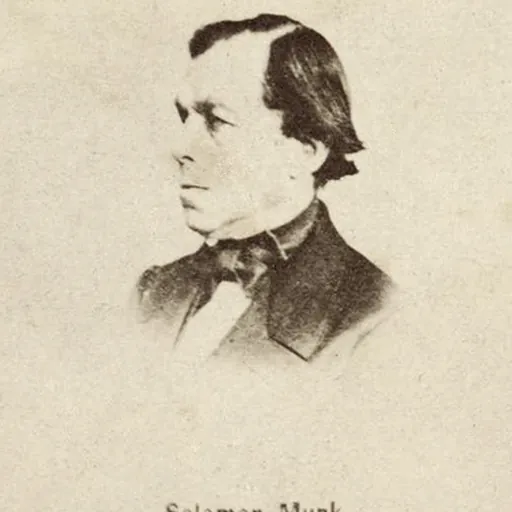
About Salomon Munk
Lived 1803 – 1867 (aged 63). Salomon Munk was a German and French orientalist, arabist, philosopher, translator, professor and university teacher.
Salomon Munk (14 May 1803 – 5 February 1867) was a German-born Jewish-French Orientalist.
Biography Munk was born in Gross-Glogau in the Kingdom of Prussia. He received his first instruction in Hebrew from his father, an official of the Jewish community; and on the latter's death he joined the Talmud class of R. Jacob Joseph Oettinger. At the age of fourteen he was able to officiate as "ba'al ḳoreh" (reader of the Torah) in the synagogue of the Malbish 'Arummim society at Gross-Glogau.
In 1820 he went to Berlin, where he came into friendly relations with Leopold Zunz and with the philologist A. W. Zumpt, studying Latin and Greek with E. Gans. Two years later he entered the Joachimsthaler Gymnasium, supporting himself at the same time by tutoring. In 1824 he entered the University of Berlin, attending the lectures of Böckh, Hegel, and especially of Bopp.
As no Jews were at that time eligible for government positions in Prussia, Munk left the university without taking a degree, deciding to go to France. However, he first spent one term at the University of Bonn, studying Arabic with Freytag and Sanskrit with Lassen. On passing through Weimar he visited Goethe, who notes that fact in his journal.
In 1828 he went to Paris with the assistance of the young poet Michael Beer, the brother of Meyerbeer. Here also, as in Berlin, he at first supported himself by tutoring, among his pupils being the young brothers Alphonse and Gustave de Rothschild. In 1838 he was appointed cataloguer of Hebrew, Chaldaic, Syriac, and Arabic manuscripts in the Bibliothèque Nationale de Paris.
Munk now devoted himself to the study of the Judæo-Arabic literature of the Middle Ages and to the works of Maimonides, more especially the latter's Moreh Nebukim. He went direct to the Arabic original, supplementing the texts he found at the Bibliothèque from texts he had copied at Oxford. At the same time he made a thorough study of Aristotle, who is constantly quoted by Maimonides. In this way he gathered the necessary material for his edition of the Arabic text of the Moreh, with translation and annotations, which he published in three large volumes, long after he had become blind (1856, 1861, 1866). He had lost his eyesight in 1850 while in the course of cataloguing the Sanskrit and Hebrew manuscripts in the possession of the library.
Journey to Egypt
Munk accompanied Montefiore and Crémieux to Egypt in connection with the Damascus affair; and it was due to his knowledge of Arabic (although some claim that the credit is due to Louis Loewe) that the word "justice" was substituted for "mercy" in the firman of Mohammed Ali which exculpated the accused from the charge of ritual murder. It was also largely due to his efforts that schools modeled on European methods of instruction were established by the Egyptian Jews.
At Cairo he purchased a considerable number of Arabic and Hebrew manuscripts on behalf of the Bibliothèque Nationale. On his return Munk was elected secretary of the Consistoire Central des Israélites de France; on December 3, 1858, he was elected a member of the Académie des Inscriptions et Belles-Lettres; and a few years later he was appointed professor of Hebrew at the Collège de France, in succession to Renan. He died in Paris.
Works Munk's works include the following: Le Guide des égarés (his edition of the Moreh) Volume 1 (1856) Volume 2 (1861) Volume 3 (1866) "Reflexions sur le Culte des Anciens Hébreux," in vol. iv. of the Bible of S. Cahen "Notice sur R. Saadia Gaon et sur une Version Persane d'Isaie" (ib. vol. ix) "Palestine, Description Géographique, Historique et Archéologique," in "L'Univers Pittoresque," 1845 (translated into German by M. A. Levy, 1871–72) (Volume 4 of "L'Univers pittoresque ou histoire et description de tous les peuples, de leurs religions, moeurs, coutumes, industries: Asie") "Mélanges de Philosophie Juive et Arabe," 1859 "Notice sur Abul Walid Merwan ibn Djanah et d'Autres Grammairiens Hébreux du X. et du XI. Siècle," 1850-51 (crowned by the Institut with the "Prix Volney") "Rapport sur les Progrès des Etudes Sémitiques en France de 1840-1866," in the "Recueil de Rapports" of the Exposition of 1867.
Between 1834 and 1838 he contributed to the Temps articles on Biblical, Hebrew, and Sanskrit literature. Mention must also be made of his interpretations of Phoenician inscriptions at Marseilles and on the sarcophagus of Eshmun'azar, King of Sidon, which he deciphered after losing his sight; of his discovery of the Arabic manuscript of Al-Biruni's description of India, written in the first part of the eleventh century; and of his letter to F. Arago, of the Academy of Sciences, relating to a question on the history of astronomy, which gave rise to a controversy between Biot and Sédillot.
Don’t just read it —
keep it.
Full-length biographies made to live with: read them, listen on the way to work, watch them tonight.
- E-book
- Audio
- Video
Instant download · yours to keep · every purchase keeps this site free
Important facts
People in Salomon Munk's life
Named in this biography and alive at the same time

Related people
Same field, nearest in time



Contemporaries
People whose lives overlapped Salomon Munk's






Frequently asked questions
Who was Salomon Munk?
German-born Jewish-French Orientalist (1803–1867)
When was Salomon Munk born?
Salomon Munk was born on 14 May 1803 in Głogów.
When did Salomon Munk die?
Salomon Munk died on 5 February 1867 in Paris, 9th arrondissement of Paris.
What was Salomon Munk's occupation?
Salomon Munk was an orientalist, arabist, philosopher, translator, professor and university teacher.
What nationality was Salomon Munk?
Salomon Munk was German and French.
Sources & further reading
Cite this page
APA: Biography.guide. (2026). Salomon Munk. https://biography.guide/salomon-munk/
MLA: "Salomon Munk." Biography.guide, https://biography.guide/salomon-munk/.
Chicago: "Salomon Munk." Biography.guide. https://biography.guide/salomon-munk/.
Data last updated: 2026-09-20 · Spot an error? Report a correction.
Page generated 2026-09-27 05:10 UTC