Saint Rosalia
Italian saint of Palermo, honored for divine intermediation during the plague there
About Saint Rosalia
Lived 1130 – 1170 (aged 39–40). Saint Rosalia was a hermit.
Rosalia (; ; 1130–1166), nicknamed ("the Little Saint") was a virgin and hermit on Monte Pellegrino. She is venerated as the patron saint of Palermo in Italy, Camargo in Chihuahua, and three towns in Venezuela: El Hatillo, , and El Playón. She is especially invoked in times of plague. During the COVID-19 pandemic, she was invoked by some citizens of Palermo to protect the city.
Life Rosalia was born of a Norman noble family that claimed descent from Charlemagne. Devoutly religious, she retired to live as a hermit in a cave on Mount Pellegrino, where she died alone in 1166. Tradition says that she was led to the cave by two angels. On the cave wall, she wrote "I, Rosalia, daughter of Sinibald, Lord of [Monte] delle Rose, and Quisquina, have taken the resolution to live in this cave for the love of my Lord, Jesus Christ."
1624 plague In 1624, a plague beset Palermo. During this hardship Rosalia reportedly appeared first to a sick woman, then to a hunter, to whom she indicated where her remains were to be found. She ordered him to bring her bones to Palermo and have them carried in procession through the city.
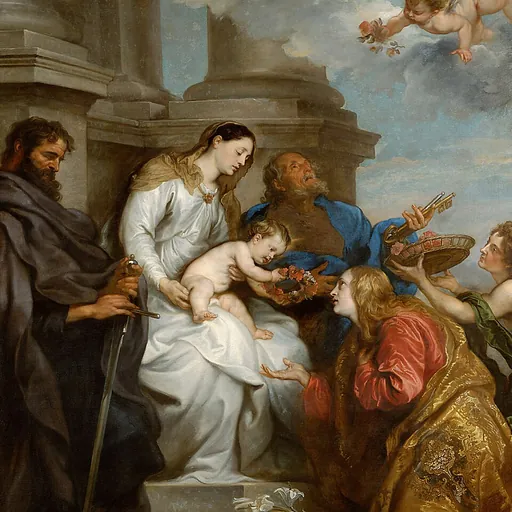
Her post-1624 iconography is dominated by the work of the Flemish painter Anthony van Dyck, who was trapped in the city during the 1624–1625 quarantine, during which time he produced five paintings of Rosalia, now in Madrid, Houston, London, New York and Palermo itself. In 1629 he also produced Saint Rosalia Interceding for the City of Palermo and Coronation of Saint Rosalia to assist Jesuit efforts to spread devotion to her beyond Sicily.
Context and religious devotion
Norman Sicily and Religious Diversity Saint Rosalia lived in the twelfth century, during the Norman Kingdom of Sicily. This kingdom came to be after the Normans conquered the region in the eleventh century. Sicily became a strong and well-organized kingdom under King Roger II and his successors.
Rosalia and Norman Sicilian Society Rosalia’s story is a strong example of how older traditions from the medieval period continued to shape people’s beliefs in later centuries. The discovery of her remains connects back to the Norman period. Looking at what Saint Rosalia meant to her people, she represents several important values of Norman Sicilian society. Her life of devotion and isolation reflects the importance of religion, and her connection to Palermo shows how local identity mattered. In a diverse society with many different cultures, saints helped create a sense of unity. Saint Rosalia gave the Sicilian people a sense of protection and hope. Saints were seen as protectors who could perform miracles, such as healing the sick, and save cities from suffering. The fact that most people believed this shows that devotion to saints was not a small part of their culture; it was a key belief in their society. In twelfth-century Sicily, noble women were usually expected to help their families through marriage, manage their homes, raise children, and live through their aristocratic status. Her decision reflected a broader movement in medieval Europe in which noble women abandoned wealth and social status to devote themselves to God.
Women, Sanctity, and Medieval Devotion Rosalia’s identity as a female hermit also helps historians understand changing attitudes towards women and sanctity during this time period. Women often had limited political authority and power, so religious devotion was one of the only ways noblewomen could have influence and recognition. Female saints such as Rosalia became important examples of holiness because their sacrifices of humility, chastity, obedience to God, and isolation were ideals admired by medieval society.
Veneration
In Palermo, the Feast of Saint Rosalia is held each year on 14 July, and continues into the next day. It is a major social and religious event in the city. A statue of St. Rosalia carried through the streets of Bivona, Sicily The feast of St. Rosalia is on 4 September.
On 4 September, a tradition of walking barefoot from Palermo up to the Sanctuary of Santa Rosalia high up on Mount Pellegrino is observed in honor of Rosalia. In Italian-American communities in the United States, the July feast is generally dedicated to Our Lady of Mount Carmel while the September feast, beginning in August, brings large numbers of visitors annually to the Bensonhurst section of Brooklyn in New York City.
Santa Rosalia is venerated as the patroness of the Italian sardine fishing fleet in Monterey, California.
Also, although St. Rosalia lived in a period after the Great Schism, some Orthodox faithful today recognise and venerate her as a saint.
In biology
Rosalia was proposed as the patron saint of evolutionary studies in a paper by G.E. Hutchinson. This was due to a visit he paid to a pool of water downstream from the cave where St. Rosalia's remains were found, where he developed ideas based on observations of water boatmen.
In art Saint Rosalia was an important subject in Italian Renaissance and Baroque painting, particularly in sacre conversazioni (group pictures of saints flanking the Virgin Mary) by artists such as Riccardo Quartararo, Mario di Laurito, Vincenzo La Barbara, and possibly Antonello da Messina.
It was the Flemish master Anthony van Dyck (1599–1637), who was caught up in Palermo during the 1624 plague, who produced the most paintings of her. His depictions a young woman with flowing blonde hair, wearing a Franciscan cowl and reaching down toward the city of Palermo in its peril became the standard iconography of Rosalia from that time onward. Van Dyck's series of St. Rosalia paintings have been studied by Gauvin Alexander Bailey and Xavier F. Salomon, both of whom curated or co-curated exhibitions devoted to the theme of Italian art and the plague. In March 2020, The New York Times published an article about the Metropolitan Museum of Art's painting of Saint Rosalia by Van Dyck in the context of COVID-19.
Van Dyck also made designs for prints which were engraved by Philips van Mallery for the publication Vita S. Rosaliae Virginis Panormitanae Pestis Patronæ iconibus expressa, which was published by Cornelis Galle the Elder in Antwerp in 1629. Only a few copies of the work, which recounts the life of Saint Rosalia, survive.
Don’t just read it —
keep it.
Full-length biographies made to live with: read them, listen on the way to work, watch them tonight.
- E-book
- Audio
- Video
Instant download · yours to keep · every purchase keeps this site free
Important facts
Related people
Same field, nearest in time




Contemporaries
People whose lives overlapped Saint Rosalia's

Frequently asked questions
Who was Saint Rosalia?
Italian saint of Palermo, honored for divine intermediation during the plague there
When was Saint Rosalia born?
Saint Rosalia was born in 1130 in Palermo.
When did Saint Rosalia die?
Saint Rosalia died on 4 September 1170 in Palermo.
What was Saint Rosalia's occupation?
Saint Rosalia was a hermit.
Sources & further reading
Cite this page
APA: Biography.guide. (2026). Saint Rosalia. https://biography.guide/saint-rosalia/
MLA: "Saint Rosalia." Biography.guide, https://biography.guide/saint-rosalia/.
Chicago: "Saint Rosalia." Biography.guide. https://biography.guide/saint-rosalia/.
Data last updated: 2026-09-21 · Spot an error? Report a correction.
Portrait: Wikimedia Commons · author & licence
Page generated 2026-09-27 05:00 UTC