Saint Nonnus
Christian saint, said to have been an Egyptian monk who became a bishop in Syria and was responsible for the conversion of St Pelagia the harlot during one of the Synods of Antioch.
About Saint Nonnus
Lived 400 – 471. Saint Nonnus was a presbyter.
Nonnus (, Nónnos, born - died ) was legendary 4th- or 5th-century (It is conventional to date Nonnus and Pelagia to the 5th century—Bunson & al.) date his death to —but a form of the story was already appearing in John Chrysostom's sermons in Antioch in 390
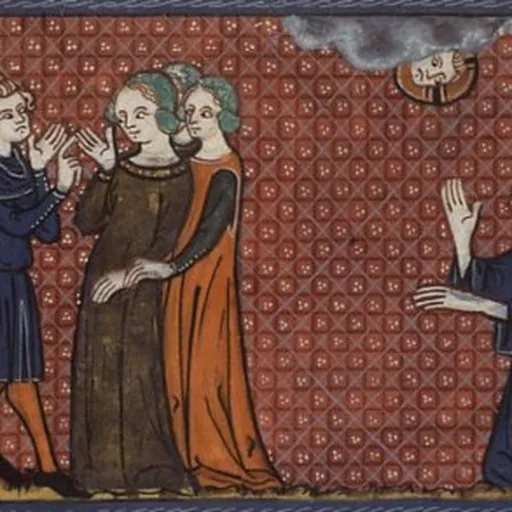
As Nonnus addressed a church council in Antioch, the town's most famous courtesan Margarita ("Pearl") passed by. Observing her beauty, Nonnus chastised the members of the assembly for taking less care of their souls than she did of her body. She appeared at his next Sunday sermon and Nonnus's sermon on hell prompted her to repent. She wrote him a letter and was permitted to see him with other witnesses; convinced of her sincerity, he took her confession and baptized her by her birth name Pelagia. After being pursued by the devil for a few days, she donated the property from her former employment to the church and lived with the deaconess Romana before departing for Jerusalem to disguise herself as a male hermit under the name Pelagius. The story significantly omits dates and (on 8 occasions) the name of the archbishop under whom Nonnus served.
History The historical St Pelagia — mentioned by St Ambrose and in two sermons by John Chrysostom — was an Antiochene virgin who committed suicide to avoid rape during the Diocletianic Persecution. St Marina — the Latin equivalent of "Pelagius" — was another bride who disguised herself as a monk to escape an unwanted marriage. Aspects of their stories were apparently combined with apocryphal accounts of Mary Magdalene, Biblical accounts of Solomon and the Queen of Sheba and of Jesus and various women in the New Testament, and even with Greek myths regarding Aphrodite to create the story of the harlot Pelagia. Chrysostom's sermon also mentions an anonymous (but apparently famous) actress and prostitute "from a wicked city in Phoenice" (possibly Heliopolis) who seduced "the empress's brother" but converted "in our own day". Constantius II's wife Eusebia had two brothers, Eusebius and Hypatius, joint consuls in 359, who both lived for many years in Antioch. In his account, attempts were made to lure her back to her former life by the Roman prefect and some of his soldiers, This Nonnus has been further conflated with the contemporary poet Nonnus of Panopolis, but this is probably a mistake. Another Nonnus present at Chalcedon was the bishop of Zerabenna in Arabia, which lay under the jurisdiction of Antioch.
Don’t just read it —
keep it.
Full-length biographies made to live with: read them, listen on the way to work, watch them tonight.
- E-book
- Audio
- Video
Instant download · yours to keep · every purchase keeps this site free
Important facts
People in Saint Nonnus's life
Named in this biography and alive at the same time
Related people
Same field, nearest in time




Contemporaries
People whose lives overlapped Saint Nonnus's



Frequently asked questions
Who was Saint Nonnus?
Christian saint, said to have been an Egyptian monk who became a bishop in Syria and was responsible for the conversion of St Pelagia the harlot during one of the Synods of Antioch.
When was Saint Nonnus born?
Saint Nonnus was born in 400.
When did Saint Nonnus die?
Saint Nonnus died in 471.
What was Saint Nonnus's occupation?
Saint Nonnus was a presbyter.
Sources & further reading
Cite this page
APA: Biography.guide. (2026). Saint Nonnus. https://biography.guide/saint-nonnus/
MLA: "Saint Nonnus." Biography.guide, https://biography.guide/saint-nonnus/.
Chicago: "Saint Nonnus." Biography.guide. https://biography.guide/saint-nonnus/.
Data last updated: 2026-09-20 · Spot an error? Report a correction.
Page generated 2026-09-27 05:10 UTC