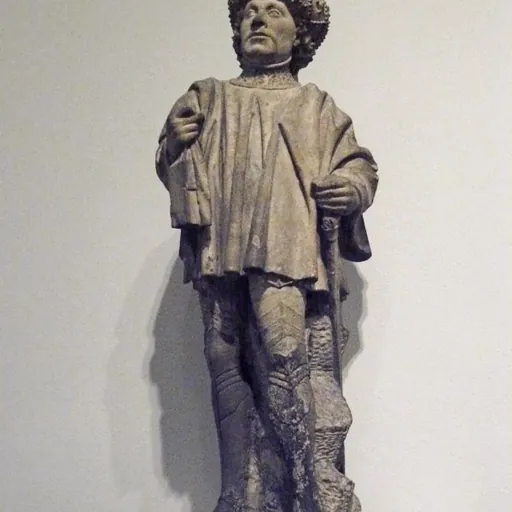
About Saint Bavo
Lived 589 – 654 (aged 64–65). Saint Bavo was a monk.
Saint Bavo of Ghent (also known as Bavon, Allowin, Bavonius, Baaf; AD 622–659) is a Roman Catholic and Eastern Orthodox saint. He exchanged a dissolute lifestyle for that of a missionary under the guidance of Saint Amand.
Vita Bavo was born near Liège, to a Frankish noble family that gave him the name Allowin. A wild young aristocrat of the Brabant area, he contracted a beneficial marriage, and had a daughter.
As a soldier he led an undisciplined and disorderly life. Shortly after the death of his wife, Bavo decided to reform after hearing a sermon preached by Saint Amand ( 584 – 679) on the emptiness of material things.
For some time thereafter, Bavo joined Amand in the latter's missionary travels throughout France and Flanders. On one occasion, Bavo met a man whom he had sold into slavery years before. Wishing to atone for his earlier deed, Bavo had the man lead him by a chain to the town jail. Bavo built an abbey on his grounds and became a monk. He distributed his belongings to the poor and lived as a recluse, first in a hollow tree and later in a cell in the forest by the abbey.
His relics were housed at the abbey in Ghent (in present-day Belgium).
Veneration Bavo is the patron saint of Ghent, Zellik, and Lauwe in Belgium, and Haarlem in the Netherlands. His feast in the Catholic Church and the Eastern Orthodox Church is October 1.
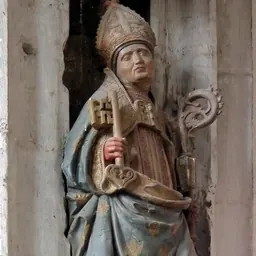
He is most often shown in Christian art as a knight with a sword and falcon. The most popular scene is the moment of his conversion, which has many stories attached to it. Because he is so often shown with a falcon, he came to be considered the patron saint of falconry. In medieval Ghent, taxes were paid on Bavo's feast day, and it is for this reason he is often shown holding a purse or money bag.
According to Rodulfus Glaber, the city of Bamberg is named after him, with Bamberg meaning "Mount of Bavo".
Legacy Several churches are dedicated to him, including: Saint Bavo Cathedral, in Ghent Sint-Bavokerk and Cathedral of Saint Bavo, both in Haarlem Sint-Bavokerk in Heemstede, Lauwe, and Zellik Saint Bavo Church and School, in Mishawaka, Indiana in Wilrijk
Additionally, the football club VVSB is named after him.
His picture is also part of the coat of arms of the Antwerp suburb Wilrijk. Rembrandt painted a Saint Bavo, dated between 1662 and 1665.
Images
Don’t just read it —
keep it.
Full-length biographies made to live with: read them, listen on the way to work, watch them tonight.
- E-book
- Audio
- Video
Instant download · yours to keep · every purchase keeps this site free
Important facts
Related people
Same field, nearest in time


Contemporaries
People whose lives overlapped Saint Bavo's





Frequently asked questions
Who was Saint Bavo?
Roman Catholic and Eastern Orthodox saint
When was Saint Bavo born?
Saint Bavo was born in 589 in Liège.
When did Saint Bavo die?
Saint Bavo died on 1 October 654 in Ghent.
What was Saint Bavo's occupation?
Saint Bavo was a monk.
Sources & further reading
Cite this page
APA: Biography.guide. (2026). Saint Bavo. https://biography.guide/saint-bavo/
MLA: "Saint Bavo." Biography.guide, https://biography.guide/saint-bavo/.
Chicago: "Saint Bavo." Biography.guide. https://biography.guide/saint-bavo/.
Data last updated: 2026-09-20 · Spot an error? Report a correction.
Portrait: Wikimedia Commons · author & licence
Page generated 2026-09-27 04:58 UTC