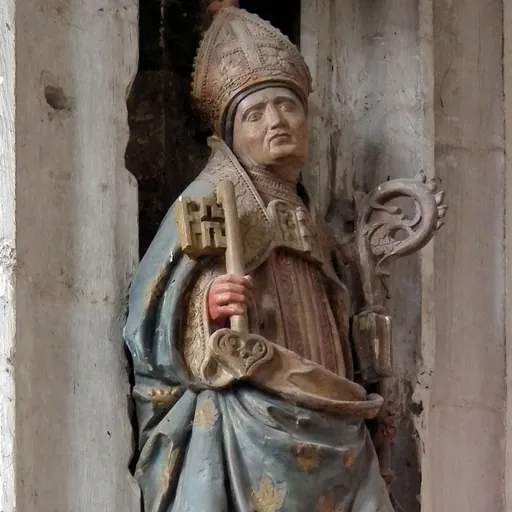
About Richarius
Lived 600 – 645. Richarius was a French monk and presbyter.
Richarius of Celles (; ; – April 26, 645) was a Frankish hermit, monk, and the founder of two monasteries. He is venerated as a saint in the Catholic and Eastern Orthodox Churches.
Life Statue of St. Richarius in Church of St. Omer in Houchin, oft-invoked for protection of children Riquier's vita was probably written at the end of the 7th century. Shortly after 800 it was revised by Alcuin at the request of Abbot Angilibert, who dedicated his work to Charlemagne.
Richarius was born a pagan in the late 6th century in the county of Ponthieu near Amiens in Picardy in the north of Francia. According to the vita written by Alcuin, Richarius gave shelter to two Welsh missionaries, Caidocus and Frechorius, who were treated with great hostility by the local people who blamed the strangers for crop failure. Because he "welcomed God in the persons of the travelers... this was why he was granted God's mercy." Richarius converted to Christianity under their influence. After his conversion, he fasted on barley bread mixed with ashes, and drank only water. He was ordained a priest, and traveled to England, preaching the Gospel and curing the sick. Travelling by donkey rather than horse, he read the psalter as he rode.
In 638, after some years in England, Richarius founded a monastery in his hometown in Ponthieu that was named Centule (or Centula, alteration of Latin Centum Turres: hundred towers).
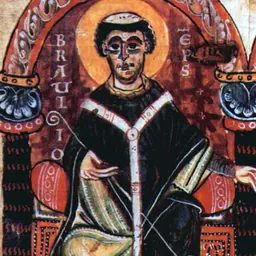
His relics were first put in a coffin made of an oak trunk and then translated to the abbey of Centula. One hundred and fifty years later, Charlemagne built a golden shrine to enclose the relics and had the Saint-Riquier Gospels made for the shrine. In 950 Count Arnulf I of Flanders transferred the bones to Montreuil, then to the Abbey of Saint Bertin in today's St-Omer; in 980 Hugo Capet returned them to St-Riquier. Above the tomb of Riquier, an abbey was built, which was later named after him, as was the city.
Aside from Saint-Riquier, the villages of Saint-Riquier-en-Rivière and Saint-Riquier-ès-Plains in Normandy bear his name.
Medieval monks compiled a catalogue of flowers for each day in the year, and dedicated each flower to a particular Saint, on account of it flowering about the time of the Saint's feast day. The flower Erysimum barbarea (yellow rocket or wintercress) is associated with Richarius, whose feast day in the Roman Catholic Church is April 26. A feast for the translation of his relics is celebrated on October 9.
Don’t just read it —
keep it.
Full-length biographies made to live with: read them, listen on the way to work, watch them tonight.
- E-book
- Audio
- Video
Instant download · yours to keep · every purchase keeps this site free
Important facts
People in Richarius's life
Named in this biography and alive at the same time

Related people
Same field, nearest in time


Contemporaries
People whose lives overlapped Richarius's



Frequently asked questions
Who was Richarius?
French saint
When was Richarius born?
Richarius was born in 600 in Ponthieu.
When did Richarius die?
Richarius died on 26 April 645 in Crécy-en-Ponthieu.
What was Richarius's occupation?
Richarius was a monk and presbyter.
What nationality was Richarius?
Richarius was French.
Sources & further reading
Cite this page
APA: Biography.guide. (2026). Richarius. https://biography.guide/richarius/
MLA: "Richarius." Biography.guide, https://biography.guide/richarius/.
Chicago: "Richarius." Biography.guide. https://biography.guide/richarius/.
Data last updated: 2026-09-23 · Spot an error? Report a correction.
Portrait: Wikimedia Commons · author & licence
Page generated 2026-09-27 05:08 UTC