
About Saint Anthony of Kyiv
Lived 983 – 1073 (aged 89–90). Saint Anthony of Kyiv was a Kievan Rus’ monk.
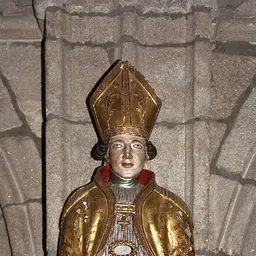
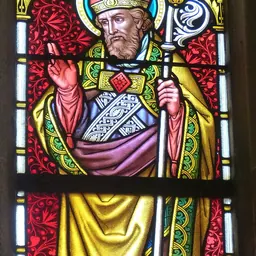
Anthony of Kiev, also called Anthony of the Caves (, ; 983 – 1073), was a monk and the founder of the monastic tradition in Kievan Rus'. Together with Theodosius of Kiev, he co-founded the Kiev Pechersk Lavra (Kiev Monastery of the Caves).
Early life
He was born in Liubech (present-day Ukraine) in Chernigov Principality and was baptized with the name "Antipas". He was drawn to the spiritual life from an early age and left for the Greek Orthodox Esphigmenou Monastery on Mount Athos to live as a hermit. He lived in a secluded cave there overlooking the sea, which is open to visitors today. In circa 1011, the abbot gave Anthony the job of expanding monasticism in his native Kiev (present-day Kyiv, Ukraine), which had only recently begun its conversion to Christianity.
Return to Kiev Anthony returned to Kiev, and found several monasteries established on the order of local princes, but these were not as austere as Anthony was used to from his time on Mount Athos. He instead chose to live in a small cave which had been dug by the presbyter Hilarion.
In 1015, his peaceful austerity was interrupted by the death of Vladimir the Great, and the subsequent fratricidal war for the throne between Vladimir's sons Yaroslav and Sviatopolk, and Anthony returned to Mount Athos. When the conflict ended, the abbot sent Anthony back to Kiev, prophesying that many monks would join him on his return.
Establishment of Kiev Pechersk Lavra Anthony became well known in the area for his strict asceticism. He ate rye bread every other day and drank only a little water. His fame soon spread beyond Kiev, and several people began to ask for his spiritual guidance or blessing. Soon, some people even offered to join him. Eventually, Anthony accepted the company of a few of them. The first was a priest named Nikon. Devoted to the model of the solitary hermit set by his namesake Anthony the Great, Anthony then left his cave for a nearby mountain so he could continue to live the solitary life. There he dug another cave for himself and lived in seclusion there. This cave became the first of what would later be known as the Far Caves.
In time, Barlaam, was called by Iziaslav to head a new monastery, St. Demetrios, which had been built at the gates of the city. The monks requested Anthony to name a replacement, and he named Theodosius.
As the number of monks grew and crowding became a problem, Anthony requested that Iziaslav give them the hill in which the caves were located. He did so, and the monks built a wooden church in honour of the Dormition of the Theotokos, and some cells there, encircling the area with a wooden fence. Theodosius continued to consult Anthony in the guidance of the community and, as the monastery grew, so did Anthony's reputation.
Exile and return
When Iziaslav and his brothers were facing a popular uprising involving the Cumans, they came to Anthony for his blessing. They did not get it. Anthony foretold that because of their sins they would be defeated, and that the brothers would be buried in a church they would build. Shortly thereafter Iziaslav left because of the rebellion. He suspected Anthony of sympathizing with the opposition and arranged to banish Anthony upon his return. Before he could do so, Iziaslav's brother, Sviatoslav, arranged for Anthony to be secretly taken to Chernigov. Anthony dug himself a cave there. The Eletsky Monastery there is said by some to be built on the site of Anthony's cave. Eventually Iziaslav was again reconciled to Anthony and asked that he return to Kiev.
On his return, Anthony and Theodosius decided to build a larger stone church to accommodate the ever-increasing number of monks. Anthony himself did not live to see the church completed. He died in 1073 at the age of ninety, shortly after blessing the foundation of the new church. Shortly before his death he called the monks together and consoled them about his coming death. He also asked them that his remains be hidden away forever. The monks carried out his request. He was reportedly buried in his cave, but no relics have ever been found. Many however have subsequently come to the cave to pray and many of them have reported being healed there.
Veneration St. Anthony is venerated as a saint and the founder of monasticism in Kievan Rus'. His feast day falls on 10 July. Since the Russian Orthodox Church as well as Ukrainian Orthodox Church (Moscow Patriarchate) follow the Julian Calendar, the day on which his feast is celebrated is currently 23 July on the modern Gregorian Calendar. Saint Anthony is also venerated by Greek Catholics and is listed in the Martyrologium Romanum of the Roman Catholic Church with a feast day of 7 May.
His relics have never been found.
Don’t just read it —
keep it.
Full-length biographies made to live with: read them, listen on the way to work, watch them tonight.
- E-book
- Audio
- Video
Instant download · yours to keep · every purchase keeps this site free
Important facts
People in Saint Anthony of Kyiv's life
Named in this biography and alive at the same time
Related people
Same field, nearest in time


Contemporaries
People whose lives overlapped Saint Anthony of Kyiv's




Frequently asked questions
Who was Saint Anthony of Kyiv?
monk
When was Saint Anthony of Kyiv born?
Saint Anthony of Kyiv was born in 983 in Liubech.
When did Saint Anthony of Kyiv die?
Saint Anthony of Kyiv died on 7 May 1073 in Kyiv.
What was Saint Anthony of Kyiv's occupation?
Saint Anthony of Kyiv was a monk.
What nationality was Saint Anthony of Kyiv?
Saint Anthony of Kyiv was Kievan Rus’.
Sources & further reading
· Wikipedia: Saint Anthony of Kyiv
Cite this page
APA: Biography.guide. (2026). Saint Anthony of Kyiv. https://biography.guide/saint-anthony-of-kyiv/
MLA: "Saint Anthony of Kyiv." Biography.guide, https://biography.guide/saint-anthony-of-kyiv/.
Chicago: "Saint Anthony of Kyiv." Biography.guide. https://biography.guide/saint-anthony-of-kyiv/.
Data last updated: 2026-09-20 · Spot an error? Report a correction.
Page generated 2026-09-27 05:20 UTC