
About Saíde Mingas
Lived 1934 – 1977 (aged 43). Saíde Mingas was an Angolan economist, politician, writer, military personnel and minister.
Avelino Henrique Saíde Vieira Dias Rodrigues Mingas (13 February 1934 – 27 May 1977) was an Angolan revolutionary, economist, writer, and politician who was a notable figure in the anti-colonial struggle for independence in Angola. He was the first Minister of Finance of Angola and one of the ten members of the first national legislature, the Revolutionary Council of the People (or the "Council of the Revolution"). He was also a member of the Central Committee of the Popular Movement for the Liberation of Angola (MPLA). A close associate of Agostinho Neto and Lúcio Lara, he was killed by people associated with the fractionists during the 1977 Angolan coup attempt.
Biography Mingas was born in the Ingombota district of Luanda, on 13 February 1934, the son of André "Mongone" Rodrigues Mingas and Antónia Diniz de Aniceto Vieira Dias. Some of his siblings are also notable figures in Angolan history, such as singers and composers André Mingas and Ruy Mingas, the latter of whom wrote the Angolan national anthem; linguist and investigator Amélia Mingas; athlete and administrator Júlia Rodrigues Mingas; and police captain José "Zé" Rodrigues Mingas. and through his uncle, Liceu Vieira Dias, a pioneer of Angolan pop music and a founding member of the MPLA. he was able to receive extensive schooling, However, he soon began involving himself with the anti-colonial struggle, mainly using literature as his form of political expression.
He became a militant in the nationalist movements, influenced by his uncle. However, as a result of both his uncle and his father being arrested in the beginning of the 1960s, he moved to Portugal for his studies. There, he came to be known as an excellent athlete and sportsman. While playing for a local sports team, he was warned that he would be arrested. He was able to outsmart the Portuguese police under the pretext of participating in a sports competition in Spain, and subsequently fled to Paris. He makes mention of his time in Cuba and Sweden in his poems, publishing them in a collection for the first time in Stockholm. He adopted the literary pseudonym "Gasmin Rodrigues". Frustrated and obliged to, he received permission with other commanders to reformulate the EPLA and transformed it into the People's Armed Forces of Liberation of Angola (FAPLA).
On 8 November 1974 he lodged with the “delegation of 26” of the party, led by secretary-general Lara. His participation contributed to his rapid ascension into leadership positions in the MPLA, including being elected to the Central Committee of the Movement. In January 1975, at the Alvor Agreement, he organized the Presidential Council on the Transition of Government as the minister of Planning and Finances.
The functions of the transitional governments cabinet were suspended in August 1975, with Mingas returning to combat as a major in FAPLA, being on the front lines to capture Luanda. The MPLA forces were victorious with guaranteed control of the capital. Even while in armed combat, he took part in, as a request of Manuel Rui, the writing of a constitutional document as a coordinator, writing the main economic tenets of the Angolan Constitution of 1975.
With the proclamation of Angolan independence on 11 November 1975, he took office as part of the aforementioned Revolutionary Council, along with heading the Directory of Finance and Accounting Services. He reformed the directory and, in March 1976, became the first Minister of Finance of the new country. In terms of financial and economic policy, he established a period of especially cautious transition against enormous financial difficulties for the country,
Death By 1976, there began to be a secretly formed opposition group within the MPLA called the Fractionists (or the nitistas), that had promoted inflammatory rhetoric against a purported “white-mestiço elite”, as well as against socioeconomic policies that they had attributed to the continuing widespread and deeply embedded poverty in Angola. This came after the war for independence but right as the civil war began to take form. The latter point made Mingas, a moderate within the movement, a personal adversary of the nitistas.
On their side, during a meeting with the Central Committee of the MPLA in February 1977, Mingas was one of those who accused the nitistas of “fractionalism”. Along with this, on 21 May 1977, he became aware of documents relating to the expulsion of Nito Alves and José Jacinto Van-Dúnem from the party.
On 27 May 1977, the nitistas attempted to overthrow the state. Various national leaders were taken hostage, among them Mingas, who had driven to meet with Neto and lead a group to attempt to retake the 9th Brigade headquarters and take control of the mutinous troops. as well as various governmental institutions. There are many other monuments and public places spread throughout the country.
In 2019, president of Angola João Lourenço ordered the revision of the official history of the events of the 1977 coup attempt inside the “Reconciliation Plan in Memory of Victims of Armed Conflict in Angola”. Mingas’ daughter, lawyer Xissole Madeira Vieira Dias Mingas, received, in June 2021, her father's official death certificate.
Don’t just read it —
keep it.
Full-length biographies made to live with: read them, listen on the way to work, watch them tonight.
- E-book
- Audio
- Video
Instant download · yours to keep · every purchase keeps this site free
Important facts
People in Saíde Mingas's life
Named in this biography and alive at the same time
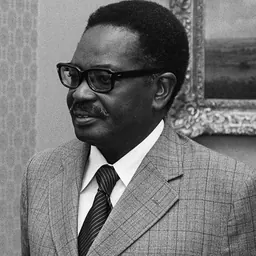






Related people
Same field, nearest in time

Contemporaries
People whose lives overlapped Saíde Mingas's






Frequently asked questions
Who was Saíde Mingas?
Angolan politician
When was Saíde Mingas born?
Saíde Mingas was born on 13 February 1934 in Luanda.
When did Saíde Mingas die?
Saíde Mingas died on 27 May 1977 in Luanda.
What was Saíde Mingas's occupation?
Saíde Mingas was an economist, politician, writer, military personnel and minister.
What nationality was Saíde Mingas?
Saíde Mingas was Angolan.
Sources & further reading
Cite this page
APA: Biography.guide. (2026). Saíde Mingas. https://biography.guide/saide-mingas/
MLA: "Saíde Mingas." Biography.guide, https://biography.guide/saide-mingas/.
Chicago: "Saíde Mingas." Biography.guide. https://biography.guide/saide-mingas/.
Data last updated: 2026-09-20 · Spot an error? Report a correction.
Page generated 2026-09-27 05:09 UTC