
About Sadiq al-Mahdi
Lived 1935 – 2020 (aged 84). Sadiq al-Mahdi was a Sudanese politician.
Sadiq al-Mahdi (; 25 December 1935 – 26 November 2020), also known as Sadiq as-Siddiq, was a Sudanese political and religious figure who was Prime Minister of Sudan from 1966 to 1967 and again from 1986 to 1989. He was head of the National Umma Party and Imam of the Ansar, a Sufi order that pledges allegiance to Muhammad Ahmad (1844–1885), who claimed to be the Mahdi, the messianic saviour of Islam.
Political life Sadiq al-Mahdi was Prime Minister of Sudan on two occasions: first briefly between 1966 and 1967 and second from 1986 until his ousting on 30 June 1989.
First term as prime minister (1966–1967) After the 1965 elections, a coalition government was formed between the National Umma Party and the National Unionist Party. Muhammad Ahmad Mahgoub of the Umma party became prime minister, and Ismail al-Azhari of the NUP became president. However, this coalition collapsed in October 1965 after the two parties failed to agree on control of the Ministry of Foreign Affairs. In July 1966, Prime Minister Mahgoub resigned after a parliamentary vote of censure. thumb Mahgoub's resignation split the Umma party into two factions: the opposition faction was led by Mahgoub and endorsed by Sadiq's uncle, the Imam al-Hadi al-Mahdi, while Sadiq led the faction that was willing to work with the NUP. As Sadiq's faction was larger, he became prime minister with NUP support. He supported regional development and greater autonomy for the southern provinces. These proposals were unpopular with many educated Sudanese civilians and army officers. In May 1967, Sadiq lost the support of his coalition partners, and Mahgoub returned as prime minister in a coalition with the National Unionist Party and the People's Democratic Party. In the 1968 elections, Sadiq's faction won more seats than Mahgoub's faction, but Sadiq lost his own seat to a candidate from Mahgoub's faction.
In the opposition (1967–1986)
Jaafar Nimeiry took power in Sudan through a coup on 25 May 1969. After the attack on Aba Island in March 1970, From abroad, Sadiq formed an opposition organization known as the National Front. In 1977, Sadiq and Nimeiry negotiated an agreement that freed 1,000 political prisoners, granted amnesty to Sadiq, allowed nonpartisan opposition candidates in Parliament, and planned further democratic reforms. Sadiq then returned and started forming an opposition to Nimeiry's Sudanese Socialist Union.
Actions during the Second Sudanese Civil War
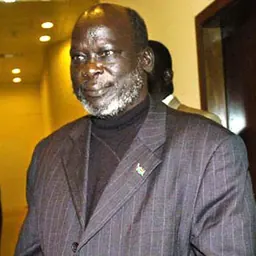
He established a new Ministry of Peace and the Constitution. He met with John Garang on 31 July 1986 at the OAU summit in Addis Ababa, those 9 hours were fruitless as they both were confident in their military strength.
Between 5 and 11 of August 1986 a 25-member delegation from the National Alliance for the Salvation of the Country (NASC) met with a 31-member delegation from the SPLM/A. The meetings were candid but amicable and practical, and both sides were optimistic that this was a positive beginning to ending their differences.
On 26 August 1986 a Shilluk contingent of the SPLA shot down with a Soviet SAM-7 missile a Sudan Airways Fokker Friendship approaching Makkal, killing sixty passengers. When he learnt about the tactless celebration by gloating SPLA commanders, Sadiq denounced the SPLA as a “terrorist group”. He then unleashed the Anyanya II to destroy a wide swath of Shilluk villages, which precipitated a mass migration of Shilluk IDPs to the North.
1989 coup and afterwards
Sadiq continued to lead the Umma Party in opposition to Bashir after being ousted. He spent a period in exile, but eventually returned to Sudan in November 2000. In 2014, the government alleged that Sadiq had collaborated with rebels, forcing him to flee to Egypt. He eventually returned to Khartoum on 26 January 2017.
In April 2019, Bashir was himself ousted by a coup after months of mass protests. Sadiq affirmed his party's support for the protests and confirmed that they would not be part of any future civilian transitional government. He also opined that Sudan should join the International Criminal Court and hand over Bashir to face charges. In May 2019, Sadiq announced his retirement from electoral politics.
On October 24, 2020, as Sudan began to normalize diplomatic relations with Israel, Mahdi strongly condemned the move, while accusing U.S. president Donald Trump (a chief facilitator of the deal) of being racist against Muslims and black people, and calling Israel an "apartheid state."
Personal life Sadiq al-Mahdi was born on 25 December 1935 in Al-Abasya, Omdurman, Sudan.
He was the paternal grandson of Sayyid Abd al-Rahman al-Mahdi, founder of the Umma Party, and great-grandson of Muhammad Ahmad, the Sudanese sheikh of the Ansar and self-proclaimed Mahdi who started the Mahdist War to end Egyptian rule in Sudan. He was also the paternal uncle of Sudanese-British actor Alexander Siddig.
Sadiq al-Mahdi married twice and had ten children, including a son named Siddig after his grandfather al-Imam al-Siddiq, born in 1968, who is now a leader in National Umma Party, and a daughter, Mariam, who is the leader of the National Umma Party.
On 26 November 2020, Sadiq died of complications from COVID-19, after being admitted to a hospital in Abu Dhabi, United Arab Emirates, for nearly a month.
Publishing career He was the author of a variety of scholarly and political books, including The Southern Question (1964); Speeches in Exile (1976); Questions on Mahadism (1979); Legitimate Penalties and Their Position in the Islamic Social System (1987); Democracy in Sudan: Will Return and Triumph (1990); Challenges of the Nineties (1991). In addition to his political career, he is remembered for helping theorize and explicate "a new kind of religious thought which would draw out of the Qur’an and Hadith a shari‘a which was adapted to the needs of the modern world." Professor of History Albert Hourani characterizes Sadiq's intellectual contributions as "responsible but bold."
Don’t just read it —
keep it.
Full-length biographies made to live with: read them, listen on the way to work, watch them tonight.
- E-book
- Audio
- Video
Instant download · yours to keep · every purchase keeps this site free
Important facts
Family & relationships
People in Sadiq al-Mahdi's life
Named in this biography and alive at the same time





Related people
Same field, nearest in time





Contemporaries
People whose lives overlapped Sadiq al-Mahdi's





Frequently asked questions
Who was Sadiq al-Mahdi?
Prime Minister of Sudan (1966–1967, 1986–1989)
When was Sadiq al-Mahdi born?
Sadiq al-Mahdi was born on 25 December 1935 in Omdurman.
When did Sadiq al-Mahdi die?
Sadiq al-Mahdi died on 26 November 2020 in Abu Dhabi.
What was Sadiq al-Mahdi's occupation?
Sadiq al-Mahdi was a politician.
What nationality was Sadiq al-Mahdi?
Sadiq al-Mahdi was Sudanese.
Sources & further reading
Cite this page
APA: Biography.guide. (2026). Sadiq al-Mahdi. https://biography.guide/sadiq-al-mahdi/
MLA: "Sadiq al-Mahdi." Biography.guide, https://biography.guide/sadiq-al-mahdi/.
Chicago: "Sadiq al-Mahdi." Biography.guide. https://biography.guide/sadiq-al-mahdi/.
Data last updated: 2026-09-20 · Spot an error? Report a correction.
Page generated 2026-09-27 05:28 UTC