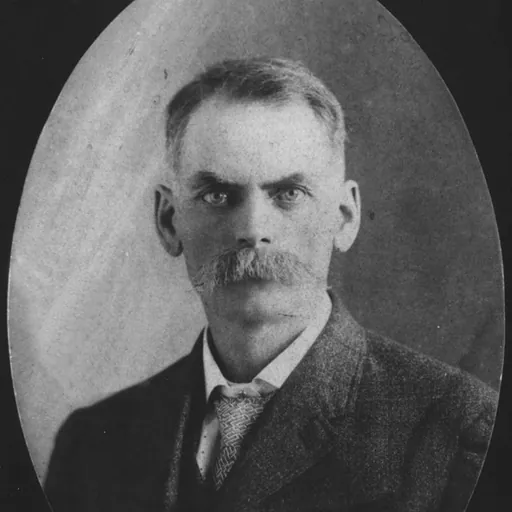
S. N. Leek
Founding settler of Jackson Hole, (formerly known as Jackson's Hole) Wyoming
About S. N. Leek
Lived 1858 – 1943 (aged 84–85).
Stephen Nelson Leek (1858–1943) was a founding settler of Jackson Hole, (formerly known as Jackson's Hole) Wyoming. In addition to being a trapper, hunting guide, and dude rancher, Leek is best known as a wildlife photographer who documented dead and starving elk during annual winter famines at the beginning of the twentieth century as a way to promote their protection. Known as the "Father of the Elk," Leek played an instrumental role in convincing Congress to establish the National Elk Refuge in 1912.
Biography
Early life Leek was born in Turkey Point, Ontario, Canada in 1858. At a young age his family moved to the United States, first to Illinois, Nebraska, and Utah. In the 1880s, Leek moved west to Wyoming, first to the Bighorn Mountains where he lived in a cabin (that is now on display at the Old Trail Town in Cody), and sometime between 1886 and 1888 to Jackson. Leek was among those who moved west through the Homestead Acts, laws that allowed settlers to declare ownership of "unclaimed" land and providing 160-acre plots to qualified applicants who paid a fee of $10–15. Leek's homestead was located on Flat Creek, just south of Jackson, at the time called Marysvale. There, he began cattle ranching, expanding his ranch to 400 acres over the decades.
Marriage and children In 1897 Leek married Sarah (Etta) Wilson (d. 1931), relative of Elijah Nicholas Wilson, founder of the town of Wilson, Wyoming. Together, they had two sons.
Albert (Lester) Nelson Leek (1898-1934) Holiday (Holly) Leek (1905-1968)
The "elk problem" When Leek and other homesteaders established their farms in the open fields of Flat Creek, they began to erect fencing across the valley floor. These fences immediately disrupted migration routes that elk had used for millennia, creating a maze of barriers. Livestock also consumed the best forage, leaving limited resources for wildlife. By the late 1880s, the Jackson elk, swollen to about 50,000 after several mild winters, now encountered these new obstructions and a series of harsh winters.
Following the establishment of the Elk Refuge, Leek continued a career as a wildlife photographer in addition to ranching and outfitting. The south entrance of Teton Range. Photograph by Stephen N. Leek, in National Parks Portfolio (1921) Leek's photographs were widely re-published, featured in such articles as William Temple Hornaday's book Our Vanishing Wildlife: Its Extermination and Preservation (1913) and article "Masterpieces of Wild Animal Photography" in Scribner's magazine (1920). His work was also used by the National Parks Department for promotional material for Grand Teton and Yellowstone national parks.
Much of Leek's photographic archive has been digitized by the American Heritage Center at the University of Wyoming.
Leek's Camp In 1927, Leek established Leek's Camp on the east shore of Jackson Lake in Grand Teton National Park, consisting of a central log structure and several guest cabins. Leek's Camp was a dude ranch and resort and was one of the earliest outdoor recreation resorts in the Jackson Hole area. The main building, Leek's Lodge, was nominated for the National Register of Historic Places in 1974 and listed on the Register in 1975, but later removed from the list in 2014. All that remains today is a chimney.
Political views Despite Leek's wildlife conservation legacy, his involvement in the Bannock War of 1895 makes him a complicated figure to celebrate today. Leek has been described as a "racial extremist" because of his views on Indigenous peoples, including their hunting rights. The Bannock War of 1895 led to the U.S. Supreme Court's Race Horse decision which ended all treaty-reserved rights to hunt off reservation.
Recognition The National Park Service and Wyoming Historical Society erected a historical marker titled "Stephen Leek's Camera Conservation" under the topic list of Environment in Grand Teton National Park, located at 43° 55.809′ N, 110° 38.367′ W.
Leek was inducted into the Wyoming Outdoor Hall of Fame in 2015.
Don’t just read it —
keep it.
Full-length biographies made to live with: read them, listen on the way to work, watch them tonight.
- E-book
- Audio
- Video
Instant download · yours to keep · every purchase keeps this site free
Important facts
People in S. N. Leek's life
Named in this biography and alive at the same time

Contemporaries
People whose lives overlapped S. N. Leek's



Frequently asked questions
Who was S. N. Leek?
founding settler of Jackson Hole, (formerly known as Jackson's Hole) Wyoming
When was S. N. Leek born?
S. N. Leek was born in 1858.
When did S. N. Leek die?
S. N. Leek died in 1943.
Sources & further reading
· DBpedia: Stephen Nelson Leek
Cite this page
APA: Biography.guide. (2026). S. N. Leek. https://biography.guide/s-n-leek/
MLA: "S. N. Leek." Biography.guide, https://biography.guide/s-n-leek/.
Chicago: "S. N. Leek." Biography.guide. https://biography.guide/s-n-leek/.
Data last updated: 2026-09-22 · Spot an error? Report a correction.
Portrait: Wikimedia Commons · author & licence
Page generated 2026-09-27 05:01 UTC