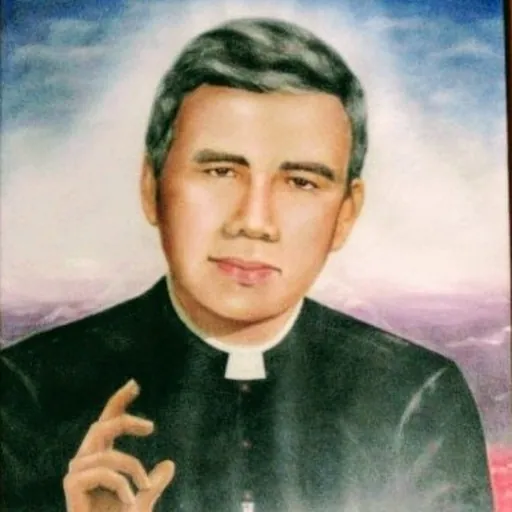
About Rutilio Grande
Lived 1928 – 1977 (aged 48). Rutilio Grande was a Salvadoran catholic priest, regular priest and catholic theologian.
Rutilio Grande García, SJ (5 July 1928 in El Paisnal – 12 March 1977 in Aguilares) was a Salvadoran Jesuit priest assassinated in 1977 by Salvadoran security forces. He was the first priest assassinated before the Salvadoran Civil War started and was a close friend of Archbishop Óscar Romero. His beatification, through his status as a martyr, was approved by Pope Francis on 21 February 2020, with the ceremony being held in San Salvador on 22 January 2022.
Life and work
Rutilio Grande was born on 5 July 1928, the youngest of 7 children, to a poor family in El Paisnal, El Salvador. His parents, Salvador Grande and Cristina García, divorced when he was young, and he was raised by his older brother and grandmother, a devout and strong Catholic woman. At the age of 12, Rutilio was noticed by Archbishop Luis Chávez y González during his annual visit to their village and invited to attend the high school seminary in San Salvador, the capital of the country.
At the age of 17, following his final year in the high school seminary (minor seminary), Grande entered the Jesuit process of formation called the novitiate. Thus began a period of time outside of El Salvador. Grande first travelled to Caracas, Venezuela, since there was no Jesuit novitiate in Central America. Initially, Grande felt called to the Oriental missions of the church. After two years in Caracas, he pronounced his vows of poverty, chastity and obedience and then travelled to Quito, Ecuador, to study the humanities, which he completed in 1950. The following three years were spent as a professor in a minor seminary in El Salvador, where he taught sacred history, history of the Americas and of El Salvador, and writing.
Grande continued his studies for the priesthood at the major seminary of San José de la Montaña, where he became friends with Romero, a fellow student. Grande was ordained a priest in mid-1959 in the city of Oña, in Spain. He returned to Spain in 1962 to complete studies left undone due to his physical and mental struggles. In 1963, he attended Lumen Vitae Institute in Brussels, Belgium, where he studied new directions in pastoral ministry inspired by Vatican II. He was particularly influenced by his experiences of an inclusive liturgy which insisted upon the widest and deepest lay participation possible at that time. As his biographer states, "Very probably at this moment his fundamental lines of pastoral action matured. Certainly, a part of this epoch in pastoral theological development was to always look for the greatest participation possible by the base or least empowered part of a community, and to never proceed autonomously or without hearing the community." He taught a variety of subjects, including liturgy, catechesis, pastoral theology, and introduction to the mystery of Christ (philosophy). He also fully utilized the social sciences in an effort to understand the reality within which he lived and ministered. During this time, Grande initiated a process of formation for seminarians which included pastoral "immersions" in the communities they would someday serve. This included time with people listening to their problems and their reality. Grande put it this way, "the first contact with the people was to be characterized by a human encounter; to try to enter into their reality in order to leave with common reality."
Upon his return to El Salvador in 1973, Grande embarked on a team-based Jesuit evangelization "Mission" to Aguilares, El Salvador. Deeply engaged in the lives of the people he served, Grande led with the Gospel but did not shy away from speaking on social and political issues, which had profound consequences for the church. He could be credited with promoting a "pastoral" liberation ministry that began in scripture and allowed lay people in El Salvador to work for social transformation without resorting to Marxist analysis. Grande was prophetic on issues of land reform, the relationship of rich and poor, liturgical inclusiveness, workers' rights, and making the Catholic faith real for very poor people. He was fond of saying that "the Gospel must grow little feet" if Christ is not to remain in the clouds. Grande had been master of ceremonies at Romero's installation as bishop of Santiago de María in 1975 and remained a friend and confidant of Romero, whom he inspired through his ministry and through the ultimate sacrifice he made.
Grande had served in the parish of Aguilares off and on from 1967 to 1977. He was responsible, along with many other Jesuits, for establishing Christian base communities (CEBs, in Spanish) and training "Delegates of the Word" to lead them. Grande spoke against the injustices at the hands of an oppressive government and dedicated his life's work to organizing the impoverished, marginalized rural farmers of El Salvador as they demanded respect for their rights. Local landowners saw the organization of the peasants as a threat to their power.
Grande challenged the government in its response to actions he saw as attempts to harass and silence Salvadoran priests. Mario Bernal Londono, a Colombian priest serving in El Salvador, had been kidnapped January 28, 1977 – allegedly by guerrillas – in front of the Apopa church near San Salvador, together with a parishioner who was safely released. Bernal was deported by the Salvadoran government. On 13 February 1977, Grande preached a sermon that came to be called "the Apopa sermon", denouncing the government's expulsion of Londono, an action that some later believed helped to provoke Grande's murder: I am fully aware that very soon the Bible and the Gospels will not be allowed to cross the border. All that will reach us will be the covers since all the pages are subversive – against sin, it is said. So that if Jesus crosses the border at Chalatenango, they will not allow him to enter. They would accuse him, the man-God ... of being an agitator, of being a Jewish foreigner, who confuses the people with exotic and foreign ideas, anti-democratic ideas, and, that is, against the minorities. Ideas against God, because this is a clan of Cain's. Brothers, they would undoubtedly crucify him again. And they have said so.
Death and aftermath
On 12 March 1977, Rutilio Grande was assassinated by Salvadoran security forces, just outside his hometown, suffering martyrdom for the people he served and loved. During the funeral procession that would ultimately inter Grande and the other two under the foot of the altar of the church in El Paisnal, the slogan could be heard: "Rutilio's walk with El Paisnal is like Christ's journey with the Cross."
After the Mass on 12 March, Romero had spent hours listening to stories of suffering local peasant farmers, and the rest of his time in prayer. The next morning, after meeting with his priests and advisers, Romero announced that he would not attend any state occasions nor meet with President Molina – both traditional activities for his longtime predecessor – until the death was investigated. As no investigation ever was conducted, this decision meant that Romero never attended state occasions throughout his three-year reign as archbishop. He also appointed another Jesuit, Jon de Cortina, to succeed Grande as parish priest. Romero's sermon said, in part:
“The true reason for [Grande's] death was his prophetic and pastoral efforts to raise the consciousness of the people throughout his parish. Father Grande, without offending and forcing himself upon his flock in the practice of their religion, was only slowly forming a genuine community of faith, hope, and love among them, he was making them aware of their dignity as individuals, of their basic rights. His was an effort toward comprehensive human development. This post-Vatican Council ecclesiastical effort is certainly not agreeable to everyone, because it awakens the consciousness of the people. It is work that disturbs many; and to end it, it was necessary to liquidate its proponent. In our case, Father Rutilio Grande.” In March 2018, the Salvadoran Ambassador to the Holy See noted that Pope Francis was a strong advocate of the canonization of Rutilio Grande, whose path to sainthood had been delayed by "misunderstandings and slander." Early in 2019, when Pope Francis was asked on the cause for Rutilio's beatification, he replied that "well informed people tell me that the declaration of martyrdom is going well."
The Holy See announced on 21 February 2020, that Pope Francis, having met with the prefect of the Congregation for the Causes of Saints, formally approved the beatification of Father Grande and his two lay companions, though the rite was delayed due to the COVID-19 pandemic, hence a tentative date of August 2020 was scrapped. The beatification Mass was eventually celebrated on 22 January 2022, with Cardinal Gregorio Rosa Chávez presiding on the Pope's behalf. Grande two lay companions who were killed with him Nelson Rutilio Lemus, a 16 year old who often assisted at Mass, and Manuel Solórzano, a 72-year-old catechist, were beautified as well.
On 15 March 1991, a group of Salvadorans returning from Nicaragua after 11 years of being refugees founded Comunidad Rutilio Grande. Among the group's many projects is "Radio Rutilio," a radio station featuring local youth as broadcasters of community news and announcements. The community also participates in a partnership with a Lutheran congregation in the United States to provide secondary education to children in the Rutilio Grande community. In addition, the community has also maintained a sister city relationship with the town of Davis, California, since 1996.
As of 2005, Grande's nephew Orlando Erazo was the parish priest in El Paisnal.
Don’t just read it —
keep it.
Full-length biographies made to live with: read them, listen on the way to work, watch them tonight.
- E-book
- Audio
- Video
Instant download · yours to keep · every purchase keeps this site free
Important facts
People in Rutilio Grande's life
Named in this biography and alive at the same time
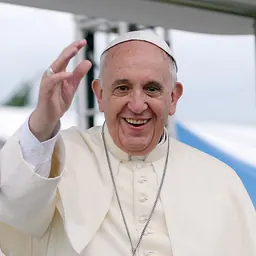



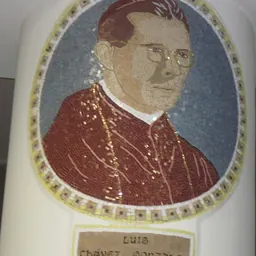
Related people
Same field, nearest in time


Contemporaries
People whose lives overlapped Rutilio Grande's


Frequently asked questions
Who was Rutilio Grande?
Salvadoran martyr (1928-1977)
When was Rutilio Grande born?
Rutilio Grande was born on 5 July 1928 in El Paisnal.
When did Rutilio Grande die?
Rutilio Grande died on 12 March 1977 in El Paisnal.
What was Rutilio Grande's occupation?
Rutilio Grande was a catholic priest, regular priest and catholic theologian.
What nationality was Rutilio Grande?
Rutilio Grande was Salvadoran.
Sources & further reading
Cite this page
APA: Biography.guide. (2026). Rutilio Grande. https://biography.guide/rutilio-grande/
MLA: "Rutilio Grande." Biography.guide, https://biography.guide/rutilio-grande/.
Chicago: "Rutilio Grande." Biography.guide. https://biography.guide/rutilio-grande/.
Data last updated: 2026-09-23 · Spot an error? Report a correction.
Portrait: Wikimedia Commons · author & licence
Page generated 2026-09-27 05:06 UTC