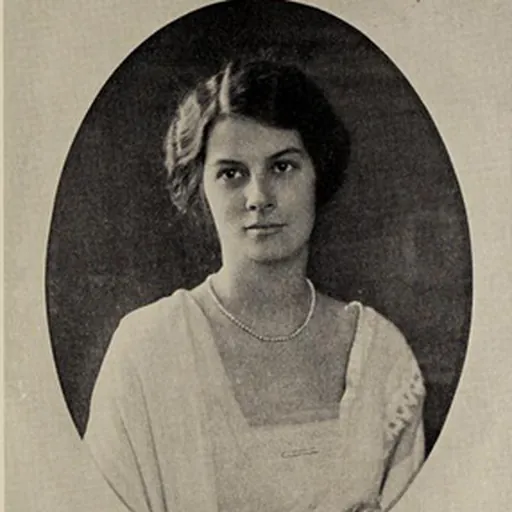
Ruth Wales du Pont
American socialite, philanthropist, and classical composer
About Ruth Wales du Pont
Lived 1889 – 1967 (aged 78). Ruth Wales du Pont was an American socialite, philanthropist and classical composer.
Ruth Wales du Pont (June 10, 1889 – November 7, 1967) was an American socialite, philanthropist, amateur classical composer, and spouse of Henry Francis du Pont, who founded Winterthur Museum, Garden and Library.
Early life and family Ruth Wales was born in the wealthy New York suburb of Hyde Park on June 10, 1889, the only child of Edward Howe Wales and Ruth Holmes Hawks Wales. Her father was a stockbroker, Theodore Roosevelt aide, US Navy Reserve commodore, and philander who preferred to stay in Washington, D.C. Ruth grew up in Hyde Park with her grandmother and mother, to whom she was very close. Her paternal grandfather was New York City Parks Commissioner Salem Howe Wales, while her maternal uncle by marriage was US Senator Elihu Root. Franklin Delano Roosevelt was her neighbor and later attended her wedding. She boarded at the elite preparatory Miss Spence's School from the age of 12, where she excelled academically.
Henry and Ruth had two daughters, Pauline Louise du Pont Harrison (1918–2007) and Ruth Ellen du Pont Lord (1922–2014). In her memoirs, Ruth Ellen recalled her mother as kind but aloof, rarely lifting or holding the child in her lap.
Musical compositions Ruth took piano lessons from the age of 13 and became an amateur classical composer. Even a year into her marriage, she traveled weekly to the Peabody Conservatory in Baltimore, where she studied harmony under famed conductor Gustav Strube. She quit her studies amid the pressures of family life in the 1920s, though she continued to write music and play Winterthur's grand piano to entertain guests. She composed a chorus for a ragtime, one organ sonata, at least one waltz, one berceuse, four dances, fugues (all but one of which she lost at a railway station), and the introduction and first act of an opera she called A New England Romance, based on the novella Ethan Frome by Edith Wharton. Ruth also produced original songs and scores for some of her favorite poems, including Robert Louis Stevenson's "The Night Rider" and "Home from the Hill."
Ruth's compositions were publicly performed in various Delaware venues. In 1976, the Christ Church Christiana Hundred held a music festival featuring her pseudo-Baroque "Fugue in G Minor for Organ," performed by Stefan Kozinski. This piece was later recorded for a 1993 album entitled Music from the Banks of the Brandywine, conducted by Brian Cox and mostly consisting of pieces by Alfred I. du Pont. In 1995, the New Tankopanicum Orchestra's concert at Winterthur Museum featured the first public performance of music she composed. In 2014, the Wilmington Community Orchestra, conducted by Brian Cox, held the world premiere of another piece she wrote.
Personal beliefs Like her husband, Ruth was a staunch Republican who deplored her old friend Franklin Delano Roosevelt's New Deal policies. When her younger daughter vowed to vote for FDR, Ruth was outraged. She considered FDR "a traitor to his class" and in 1936 "made so vitriolic a speech in support of Alfred Landon, the Republican candidate, that one Winterthur resident in the audience said it was sure to gain votes for Roosevelt."
Death and legacy Ruth died on November 7, 1967, at Delaware Division Hospital in Wilmington, where she had been hospitalized since October 12. She was interred in the Du Pont de Nemours Cemetery in Wilmington. Ruth was survived by her husband, both daughters, eight grandchildren, and two grand-grandchildren. However, in 2020, an exhibit at Winterthur Museum recounted Ruth's life and featured various objects belonging to her, including her sheet music collection and a recreation of her wedding dress.
In 1961, Ruth and her husband donated land on Captains Neck Lane in Southampton to conservation. The preserve was named the Ruth Wales du Pont Sanctuary.
Ruth was a trustee of the reconstruction of Tryon Palace in New Bern, North Carolina. The mansion had been designed by her ancestor, the architect John Hawks.
Don’t just read it —
keep it.
Full-length biographies made to live with: read them, listen on the way to work, watch them tonight.
- E-book
- Audio
- Video
Instant download · yours to keep · every purchase keeps this site free
Important facts
Family & relationships
People in Ruth Wales du Pont's life
Named in this biography and alive at the same time




Related people
Same field, nearest in time

Contemporaries
People whose lives overlapped Ruth Wales du Pont's



Frequently asked questions
Who was Ruth Wales du Pont?
American socialite, philanthropist, and classical composer
When was Ruth Wales du Pont born?
Ruth Wales du Pont was born on 10 June 1889 in Hyde Park, New York.
When did Ruth Wales du Pont die?
Ruth Wales du Pont died on 7 November 1967 in Wilmington, Delaware.
What was Ruth Wales du Pont's occupation?
Ruth Wales du Pont was a socialite, philanthropist and classical composer.
What nationality was Ruth Wales du Pont?
Ruth Wales du Pont was American.
Sources & further reading
· Wikipedia: Ruth Wales du Pont
Cite this page
APA: Biography.guide. (2026). Ruth Wales du Pont. https://biography.guide/ruth-wales-du-pont/
MLA: "Ruth Wales du Pont." Biography.guide, https://biography.guide/ruth-wales-du-pont/.
Chicago: "Ruth Wales du Pont." Biography.guide. https://biography.guide/ruth-wales-du-pont/.
Data last updated: 2026-09-22 · Spot an error? Report a correction.
Portrait: Wikimedia Commons · author & licence
Page generated 2026-09-27 05:02 UTC