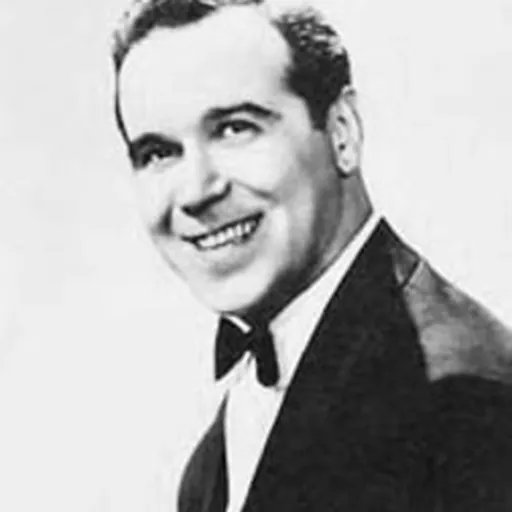
Russ Morgan
American big band leader and arranger, songwriter
About Russ Morgan
Lived 1904 – 1969 (aged 65). Russ Morgan was an American bandleader, conductor, jazz musician, composer and songwriter.
Russell Morgan (April 29, 1904 – August 7, 1969) was an American big band leader and arranger during the 1930s and 1940s. He was best known for being one of the composers of the song "You're Nobody till Somebody Loves You", with Larry Stock and James Cavanaugh, and was the first to record it in 1944.
In the early 2020s, he regained popularity due to some of his music being sampled by the Caretaker on his albums An Empty Bliss Beyond This World and Everywhere at the End of Time, the latter of which plays loops of progressively degraded big band music to portray Alzheimer's disease. Some of Morgan's songs sampled by the Caretaker include “Goodnight my Beautiful” (sampled in "Libet's Delay", "Back There Benjamin", "Libet's All Joyful Camaraderie", and "Libet Delay"), "Moonlight and Shadows" (sampled in "Childishly Fresh Eyes"), and "Room with a View" (sampled in "My Heart Will Stop in Joy").
Biography Early life Born into a Welsh family in Scranton, Pennsylvania, United States,
At the age of 14, Morgan earned money as a pianist in a theater in Scranton. He purchased a trombone and learned to play it. In 1921, he played trombone with the Scranton Sirens, which became popular in Pennsylvania during the 1920s. Besides Morgan, several of its members became famous, including Jimmy Dorsey on saxophone and clarinet, Billy Lustig on violin, and Tommy Dorsey on trombone, taking Morgan's place when Morgan left the band. He then joined Paul Specht's orchestra and toured throughout Europe with the orchestra.
Mid-career While at Brunswick, Morgan met Rudy Vallée, who was impressed with his ability. Vallée insisted he form an orchestra of his own. He then invited Morgan to appear as a guest on his popular Fleishman Yeast radio show. Vallée was instrumental in getting Morgan his first engagement in New York City, along with his own orchestra, at the Biltmore Hotel
Biggest hit singles I'm in a Dancing Mood (vocal Red Jessup) (1936) The Merry-Go-Round Broke Down (vocal Jimmy Lewis) (1937) The Dipsy Doodle (vocal Jimmy Lewis) (1937) I Double Dare You (vocal Bernice Parks) (1938) Bei Mir Bist Du Schoen (vocal Bernice Parks) (1938) I've Got a Pocketful of Dreams (vocal Russ Morgan) (1938) The Lambeth Walk (vocal Jimmy Lewis) (1938) Wishing (Will Make It So) (vocal Mert Curtis) (1939) Somebody Else Is Taking My Place (vocal Morganaires) (1942) Dance with a Dolly (vocal Al Jennings) (1944) There Goes That Song Again (vocal Russ Morgan) (1944) So Tired (vocal Russ Morgan) (1948) Cruising Down the River (vocal Skylarks) (1949) Sunflower (vocal Skylarks) (1949) Forever and Ever (vocal Skylarks) (1949)
Late career and death During the spring and summer of 1950 he hosted a televised version of In the Morgan Manner. The show originated from Chicago and was aired on the American Broadcasting Company (ABC) network. In 1953, Russ Morgan And His Orchestra released "The Tennessee Wig-Walk" as a single. Morgan had another TV program on CBS in 1956 with Helen O'Connell as the featured singer. In 1958, Morgan's nineteen-piece band had been reduced to eleven men, with his sons Jack Morgan on trombone and David Morgan on guitar. In 1965, he was booked for an eight-week engagement at the Top o' the Strip at the Dunes Hotel in Las Vegas.
Legacy
Russ Morgan's work lives on in many works of media. Much of his music is used in Analog Horror, such as in Vita Carnis. Leyland Kirby also sampled Morgan's songs in the album, Everywhere at the End of Time, an album that attempts to represent the stages of dementia, the most known/famous example being Libet's Delay, which samples "Goodnight, My Beautiful", and Childishly Fresh Eyes, which samples "Moonlight and Shadows". These songs are featured many times in different forms as the album progresses, eventually becoming corrupted to simulate the feeling of dementia.
Russ Morgan's "Were You Foolin'?" was also heavily popularized by the video game Ultrakill, where a 30-second loop of the instrumental plays in the background while the player is using a Terminal, though technically the song is credited under Bob Causer and His Cornellians (Russ' alias at the time).
Most of Morgan's most popular songs come from an album of previously unreleased songs that were released in 1978, nearly 10 years after his death. Among his most known songs are "Goodnight, My Beautiful", "Moonlight and Shadows", "So Tired", "Room With a View", "Moonlight Serenade", "To You", and "What Do You Know About Love?".
Don’t just read it —
keep it.
Full-length biographies made to live with: read them, listen on the way to work, watch them tonight.
- E-book
- Audio
- Video
Instant download · yours to keep · every purchase keeps this site free
Important facts
People in Russ Morgan's life
Named in this biography and alive at the same time




Related people
Same field, nearest in time


Contemporaries
People whose lives overlapped Russ Morgan's



Frequently asked questions
Who was Russ Morgan?
American big band leader and arranger, songwriter (1904–1969)
When was Russ Morgan born?
Russ Morgan was born on 29 April 1904 in Scranton.
When did Russ Morgan die?
Russ Morgan died on 7 August 1969 in Las Vegas.
What was Russ Morgan's occupation?
Russ Morgan was a bandleader, conductor, jazz musician, composer and songwriter.
What nationality was Russ Morgan?
Russ Morgan was American.
Sources & further reading
Cite this page
APA: Biography.guide. (2026). Russ Morgan. https://biography.guide/russ-morgan/
MLA: "Russ Morgan." Biography.guide, https://biography.guide/russ-morgan/.
Chicago: "Russ Morgan." Biography.guide. https://biography.guide/russ-morgan/.
Data last updated: 2026-09-21 · Spot an error? Report a correction.
Portrait: Wikimedia Commons · author & licence
Page generated 2026-09-27 04:59 UTC