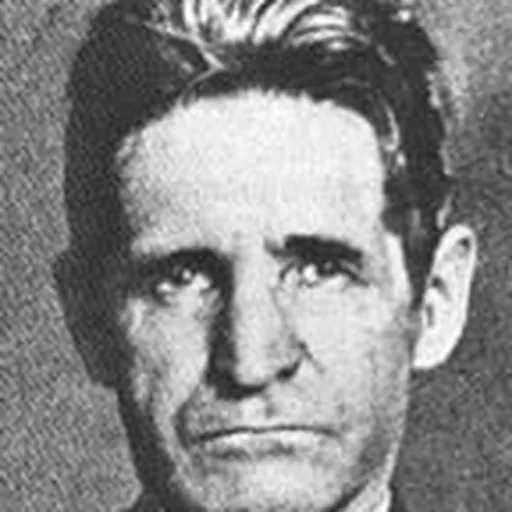
Rupert Mayer
German Jesuit priest and leading figure of the Catholic resistance movement in Nazi Germany in Munich
About Rupert Mayer
Lived 1876 – 1945 (aged 69). Rupert Mayer was a German theologian, catholic priest, resistance fighter and catholic theologian.
Rupert Mayer (23 January 1876 – 1 November 1945) was a German Jesuit priest and a leading figure of the Catholic resistance to Nazism in Munich. In 1987, he was beatified by Pope John Paul II.
Early life Mayer was born and grew up in Stuttgart, one of five siblings. He finished his secondary education in 1894 and studied philosophy and theology in Freiburg, Switzerland; Munich and Tübingen. He was, among other things, a member of A.V. Guestfalia Tübingen and K.D.St.V. Aenania München, two Studentenverbindungen that belong to the Cartellverband der katholischen deutschen Studentenverbindungen. In 1899, he was ordained a priest and served for a year as an assistant pastor in Spaichingen before joining the Society of Jesus in Feldkirch, Vorarlberg, Austria (then Austria-Hungary) in 1900. After his novitiate, he went to the Netherlands for further studies between 1906 and 1911, and then moved about Germany, Switzerland and the Netherlands preaching missions in many parishes. In 1912, he was transferred to Munich, where his ministry was largely to migrants who had come to the city seeking employment.
Army chaplain Iron Cross medal of Fr. Rupert Mayer, exhibited in the Bürgersaalkirche of Munich From 1914, Mayer volunteered as a chaplain in the First World War. He was initially assigned to a camp hospital; but was later made a Field Captain and sent to the fronts in France, Poland and Romania as chaplain to a division of soldiers. His bravery was legendary and he was held in great esteem by the soldiers.
Protest against the Nazis In January 1933, when Adolf Hitler became Chancellor of Germany, he began to close church-affiliated schools and started a campaign to discredit the religious orders in Germany. Mayer spoke out against this persecution from the pulpit of St. Michael's in downtown Munich and because he was a powerful influence in the city, the Nazis could not tolerate such a force to oppose them. On 16 May 1937, the Gestapo ordered Mayer to stop speaking in public which he obeyed, but he continued to preach in church.
Mayer spoke out against anti-Catholic baiting campaigns and fought against Nazi church policy. Since he believed that a Catholic could not be a National Socialist, conflict inevitably arose between him and the Nazis.
Veneration
Rupert Mayer's grave in the Bürgersaalkirche's "Lower Church"
Since his death in 1945, Mayer's followers called for his beatification. On 26 September 1951, Cardinal Michael von Faulhaber opened the information process in the Archdiocese of Munich and Freising regarding the call to sanctity and virtues. In 1951, Jesuit provincial Otto Faller completed and formally forwarded the beatification information to Rome.
In 1956, Pope Pius XII, who had personally known Rupert Mayer during his time as nuncio in Munich, awarded him the title Servant of God. and a Gymnasium bear his name.
In Cebu City, Philippines, Sacred Heart School - Ateneo de Cebu, has a section named after him. Another Jesuit school in the Philippines, Xavier University - Ateneo de Cagayan, has a high school section that bears his name. Regis Jesuit High School in Aurora, Colorado dedicated the chapel to him. The parish church of Oberbozen (Soprabolzano) on South Tyrol's Ritten, inaugurated in 1991, has been dedicated to P. Rupert Mayer. In 2006 Fordham University dedicated a chapel in his name at their Lincoln Center campus in Manhattan, New York. A missionary school is named after him in Zimbabwe. Ateneo de Davao University's Senior High School in the Philippines has a senior high school section named after him.
In 1988 he was pictured on a German postage stamp with Edith Stein in honour of their beatifications.
In 2014 a movie was made of his life, called Father Rupert Mayer and starring Oliver Gruber. The movie can be seen on YouTube.
Prayer of Rupert Mayer The following text come from the song produced by Bukas Palad Music Ministry: Lord, what You will let it be so Where You will there we will go What is Your will help us to know
Lord, when You will the time is right In You there's joy in strife For Your will I'll give my life
To ease Your burden brings no pain To forego all for You is gain As long as I in You remain
REFRAIN: Because You will it, it is best Because You will it, we are blest Till in Your hands our hearts find rest Till in Your hands our hearts find rest
Don’t just read it —
keep it.
Full-length biographies made to live with: read them, listen on the way to work, watch them tonight.
- E-book
- Audio
- Video
Instant download · yours to keep · every purchase keeps this site free
Important facts
People in Rupert Mayer's life
Named in this biography and alive at the same time



Related people
Same field, nearest in time

Contemporaries
People whose lives overlapped Rupert Mayer's

Frequently asked questions
Who was Rupert Mayer?
German Jesuit priest and leading figure of the Catholic resistance movement in Nazi Germany in Munich (1876-1945)
When was Rupert Mayer born?
Rupert Mayer was born on 23 January 1876 in Stuttgart.
When did Rupert Mayer die?
Rupert Mayer died on 1 November 1945 in Munich.
What was Rupert Mayer's occupation?
Rupert Mayer was a theologian, catholic priest, resistance fighter and catholic theologian.
What nationality was Rupert Mayer?
Rupert Mayer was German.
Sources & further reading
Cite this page
APA: Biography.guide. (2026). Rupert Mayer. https://biography.guide/rupert-mayer/
MLA: "Rupert Mayer." Biography.guide, https://biography.guide/rupert-mayer/.
Chicago: "Rupert Mayer." Biography.guide. https://biography.guide/rupert-mayer/.
Data last updated: 2026-09-24 · Spot an error? Report a correction.
Portrait: Wikimedia Commons · author & licence
Page generated 2026-09-27 05:08 UTC