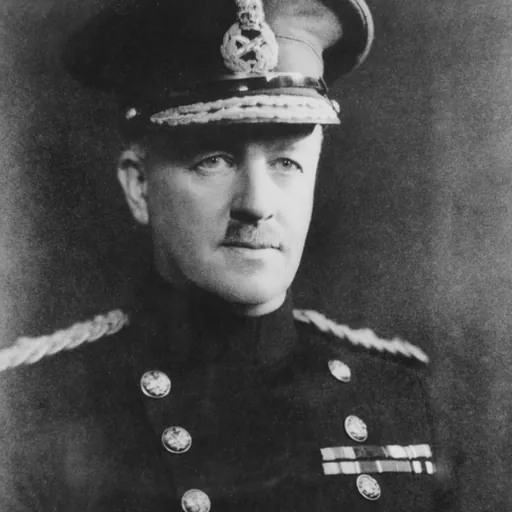
Rupert Downes
Australian general, surgeon and historian
About Rupert Downes
Lived 1885 – 1945 (aged 60). Rupert Downes was an Australian historian, military personnel and surgeon.
Major General Rupert Major Downes (10 February 1885 – 5 March 1945) was an Australian soldier, surgeon and historian.
The son of British Army officer Major Francis Downes, Downes joined the Australian Army as a trumpeter while he was still at school. He attended the University of Melbourne, graduating with his medical degrees in 1907 and a Doctor of Medicine degree in 1911. He was commissioned as a captain in the Australian Army Medical Corps in 1908, and after the outbreak of World War I he joined the First Australian Imperial Force (AIF) in 1914 as its youngest lieutenant colonel. He served in the Gallipoli campaign, and was appointed Assistant Director of Medical Services (ADMS) of the newly formed Anzac Mounted Division in 1916, which he combined with the post of ADMS AIF Egypt. In 1917, he became Deputy Director of Medical Services (DDMS) of the Desert Mounted Corps. After the war, he wrote articles on medical aspects of the Sinai and Palestine campaign, and the section on the campaign for the Official History of Australia in the War of 1914–1918.
Returning to Australia, Downes became an honorary consulting surgeon at the Royal Children's Hospital, Melbourne, and Royal Victorian Eye and Ear Hospital, and honorary surgeon at Prince Henry's Hospital. He became a foundation fellow of the College of Surgeons of Australasia in 1927, and president of the Victorian branch of the British Medical Association in 1935. He lectured on medical ethics at the University of Melbourne, writing the course textbook. He was also Victorian state commissioner of the St John Ambulance Brigade, which he led for 25 years, and president of the St John Ambulance Association for eight years.
In 1934 Downes became Director General of Medical Services, the Australian Army's most senior medical officer, with the rank of major general. He oversaw the construction of major military hospitals in the capital cities. In 1944 he accepted a commission to edit the medical series volumes of the Official History of Australia in the War of 1939–1945 but he was killed in a plane crash in March 1945, before he could begin the work.
Education and early life Rupert Major Downes was born on 10 February 1885 in Mitcham, South Australia. He was the youngest of fifteen children of Colonel Major Francis Downes—a British Army officer—and his wife Helen Maria, Chamberlin, only five of whom survived to adulthood. After service in the Crimean War, Colonel Francis Downes served as commandant of the Colonial forces of South Australia and Victoria and retired with the rank of major general in the Australian Army in 1902.
Tom Roberts's The Big Picture painting of the opening of the first parliament in 1901. Downes is in the white helmet, behind the Duke of Cornwall and York's legs. alt=Painting of a group of people stand on a stage, a sea of people looking on. The Duke of Cornwall and York in a naval uniform stands at the front of the stage. Behind him are two women in mourning black for the death of Queen Victoria. Rupert was educated at Haileybury in Melbourne as a boarding school student. In March 1901, at the age of 16, he joined the Victorian Horse Artillery (St Kilda Battery), a part-time volunteer militia unit, as a trumpeter. In May 1901 he served in this capacity at the opening of the inaugural Parliament of Australia by The Duke of Cornwall and York at the Royal Exhibition Building. He left the Army in 1903. That year he became a medical student at the University of Melbourne. A good result in his first year examinations earned him a residential scholarship to Ormond College, and he graduated with the double degree of Bachelor of Medicine and Bachelor of Surgery (MBBS) in 1907.
Soon after graduation, Downes re-enlisted in the Army. He was commissioned as a captain in the Australian Army Medical Corps on 1 July 1908 and promoted to major on 26 March 1913. He served his residency at Melbourne Hospital and became a general practitioner in Malvern, Victoria, but soon returned to the university to pursue a doctorate. His Doctor of Medicine (MD) thesis, entitled "The anatomical relations of the thymus, especially considered in regard to thymic death with an account of cases of abnormality", was accepted in 1911. He also did the coursework for a Master of Surgery (MS), and this degree was conferred in 1912.
Downes married Doris Mary Robb on 20 November 1913 at St John's Church, Toorak. They had three children, all given the same middle name as Rupert: Rosemary Major, born in 1914; Valerie Major, born in March 1918; and John Rupert Major, born in 1922.
First World War Downes joined the Australian Imperial Force (AIF) on 2 October 1914, shortly after the outbreak of the First World War, assuming command of the 2nd Light Horse Field Ambulance with the rank of lieutenant colonel; Doris spent 11 hours in a crowded lifeboat, before being rescued by a passing steamer, which took her to Bombay. From there she eventually made her way back to Australia via Singapore and Batavia. In 1918 she was appointed an Officer of the Order of the British Empire (OBE) for her volunteer work among soldiers' families as secretary of the Friendly Union of Soldiers' Wives and Mothers.
On 10 August 1917, Downes became Deputy Director of Medical Services (DDMS) of the Desert Mounted Corps, while still retaining the post of ADMS AIF Egypt. and was appointed a Companion of the Order of St Michael and St George on 1 January 1918. His citation read:
Interwar years Returning to Australia, Downes was discharged from the AIF, but remained in the Army as a reservist. He became an honorary consulting surgeon at the Royal Children's Hospital, Melbourne, and Royal Victorian Eye and Ear Hospital, and honorary surgeon at Prince Henry's Hospital. and became a Knight of Grace of the order in 1937. At the same time, Doris became an Officer of the Order of Saint John, in recognition of her fundraising efforts for the Victorian branch. She later served as a member of its council from 1942 to 1953. Downes was instrumental in persuading the state branches to come together as a national organisation, arguing that without a national body, the organisation would be eclipsed by the Red Cross.
Army Medical officers participate in a training exercise in the southern highlands of New South Wales in April 1936. Downes is front row, third from the left. Downes remained in the Army throughout the inter-war period. He became a colonel in the Australian Army Medical Corps on 8 January 1920. He was DDMS of the 3rd Military District (Victoria) from 1 July 1921 to 26 June 1933, and Officer in Charge of Voluntary Aid Detachments from 1 July 1921 to 15 March 1940.
Death and legacy Major General Colin Simpson, General Sir Thomas Blamey and Lieutenant General Sir Leslie Morshead pay their respects at the military funeral service for Major Generals Alan Vasey and Downes in Cairns. alt=A group of soldiers in shirt sleeves stand at attention. Downes was the DMS of the Second Army until 22 August 1944. Due to the run-down of the Army in the latter stages of the war, the Second Army, always mainly a paper organisation, increasingly had less to do. Now nearly sixty, Downes accepted an invitation to write the medical history series of the Official History of Australia in the War of 1939–1945. As part of this, in March 1945, he decided to accompany Major General George Alan Vasey to New Guinea, where Vasey's 6th Division had encountered an atabrine-resistant strain of malaria in the Aitape-Wewak campaign.
On 5 March 1945, the RAAF Lockheed Hudson aircraft they were travelling in crashed into the sea about off Machans Beach, just north of the mouth of the Barron River near Cairns in Queensland. Downes and Vasey were killed along with all nine other Australian service personnel on board. Downes became the third most senior Australian officer to die in the Second World War, after General Sir Brudenell White, who died in the Canberra air disaster in 1940, and Lieutenant General Henry Wynter, who died from natural causes on 7 February 1945. The bodies were recovered and buried in the Cairns War Cemetery with full military honours. A memorial service was held at St Paul's Cathedral, Melbourne, on 9 March 1945.
Gavin Long, the editor in chief of the Official History of Australia in the War of 1939–1945, prevailed on Allan S. Walker to write the medical series volumes. Walker discarded Downes's plans to have specialists write different sections, and ultimately wrote three volumes himself, starting with Clinical Problems of War (1952). He was working on the fourth and final volume, on the Medical Services of the RAN and RAAF, when he was compelled to quit in November 1956 due to ill-health, and he died in January 1958. The final volume was finished by others and appeared in 1961. Downes's papers are in the Australian War Memorial. The Royal Australasian College of Surgeons established the triennial Rupert Downes Memorial Lecture in his honour. The subject of the lecture is "related to some aspect or aspects of military surgery, medical equipment (military and civil), the surgery of children, neurosurgery, general surgery, medical ethics or medical history; these being subjects in which Downes was particularly interested".
Don’t just read it —
keep it.
Full-length biographies made to live with: read them, listen on the way to work, watch them tonight.
- E-book
- Audio
- Video
Instant download · yours to keep · every purchase keeps this site free
Important facts
People in Rupert Downes's life
Named in this biography and alive at the same time





Related people
Same field, nearest in time

Contemporaries
People whose lives overlapped Rupert Downes's



Frequently asked questions
Who was Rupert Downes?
Australian general, surgeon and historian (1885-1945)
When was Rupert Downes born?
Rupert Downes was born on 10 February 1885 in Mitcham.
When did Rupert Downes die?
Rupert Downes died on 5 March 1945 in Cairns.
What was Rupert Downes's occupation?
Rupert Downes was a historian, military personnel and surgeon.
What nationality was Rupert Downes?
Rupert Downes was Australian.
Sources & further reading
Cite this page
APA: Biography.guide. (2026). Rupert Downes. https://biography.guide/rupert-downes/
MLA: "Rupert Downes." Biography.guide, https://biography.guide/rupert-downes/.
Chicago: "Rupert Downes." Biography.guide. https://biography.guide/rupert-downes/.
Data last updated: 2026-09-24 · Spot an error? Report a correction.
Portrait: Wikimedia Commons · author & licence
Page generated 2026-09-27 05:08 UTC