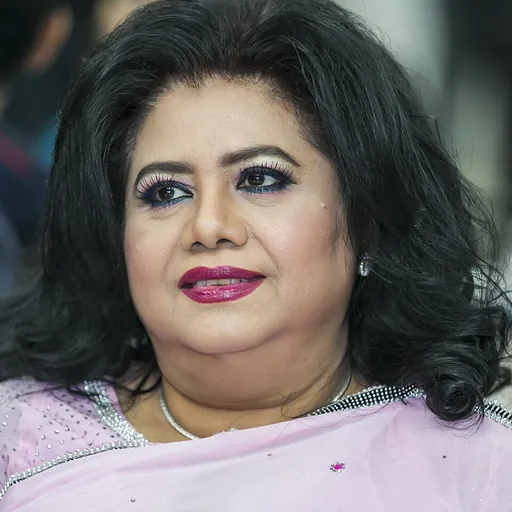
About Runa Laila
Born 1952. Runa Laila is a Bangladeshi and Pakistani singer.
Runa Laila (, ; born 17 November 1952) Over her decades-long career, she has recorded songs in several languages, gaining popularity across Bangladesh, Pakistan, and India.
Laila began her professional career in the Pakistani film industry in the late 1960s. Her early singing style was inspired by Pakistani playback singer Ahmed Rushdi with whom she frequently collaborated on duets. She gained profound international recognition with her iconic rendition of the traditional Sufi song "Dama Dam Mast Qalandar", which cemented her status as a legendary figure in South Asian music.
A highly decorated artist, Laila has won the Bangladesh National Film Awards for Best Female Playback Singer a record seven times for her vocal performances in films such as The Rain (1976), Jadur Banshi (1977), Accident (1989), and Ontore Ontore (1994). She later won Bangladesh National Film Award for Best Music Composer for the film Ekti Cinemar Golpo (2018). For her contributions to music and culture, she was awarded the Independence Award, the highest civilian honor in Bangladesh, in 1977.
Background and early life Runa Laila was born on 17 November 1952 in Sylhet, East Bengal, Dominion of Pakistan (present-day Bangladesh). Her father Syed Mohammed Imdad Ali belonged to a Bengali family of Muslim Syeds from Rajshahi. He was a civil servant posted in various towns such as Sylhet and Karachi. Her mother, Amina Laila , was a musical artist and came from a Bengali Hindu family based in Upper Assam. Runa's elder sister, Dina Laila, married to Pakistani politician Ameen Faheem, died on December, 27 1976 from leukemia. Their maternal uncle, Subir Sen, was a notable Indian playback singer.
Laila started taking dance lessons of Kathak and Bharatanatyam genre. In those days, Ahmed Rushdi was the leading film singer who introduced rock n roll, disco and other modern genres to South Asian music. Following Rushdi's success, Christian bands specialising in jazz started performing at various night clubs and hotel lobbies in Karachi, Hyderabad, Mumbai, Dhaka and Lahore. Laila became a fan of singer Ahmed Rushdi whom she considered her guru (teacher), and tried to emulate not only his singing style but also the way he used to perform on the stage. While she was a student of Saint Lawrence Convent, she won an inter-school singing competition in Karachi in the then West Pakistan. She, along with her sister, were trained by Ustad Abdul Kader Peyarang and Ustad Habibuddin Ahmed.
Career
In 1966, Laila made her breakthrough in the Pakistani film industry with the song Unki Nazron Sey Mohabbat Ka Jo Paigham Mila for the Urdu film Hum Dono. She used to perform on PTV. In PTV, she had a show called Bazm E Laila. She started in Bollywood with director Jaidev, whom she met in Delhi, got her the chance to play at the inauguration of Doordarshan. She gained popularity in India with the songs O Mera Babu Chail Chabila and Dama Dam Mast Qalandar. In 1974, she recorded Shaadher Lau in Kolkata. Laila's name has been written on the Guinness World Records for recording 30 songs within 3 days. In 2012, Laila served as a judge on the show Sur Kshetra, an Indian television contest show for amateur singers. She described her relationship with fellow judge Asha Bhosle as that of sisters. In 2014, she collaborated with Sabina Yasmin on a song for a television play "Dalchhut Projapoti", the first time they worked on a song together. Laila has sung in seventeen languages including her native Bengali, Hindi, Urdu, Punjabi, Sindhi, Gujarati, Pashto, Baluchi, Arabic, Persian, Malay, Nepalese, Japanese, Italian, Spanish, French and English.
Personal life Laila has been married three times. She first married Khawaja Javed Kaiser, secondly a Swiss businessman Ron Daniel Pilnik and then actor Alamgir. In April 1996, a Dhaka court temporarily restrained Pilnik from entering Laila's house until her suit for a permanent injunction alleging he refused to marry on according to Islamic rules and that he abused her. Pilink later became Dubai based entrepreneur and investor.
With Khawaja Javed Kaiser, Laila has a daughter Tani Kaiser.
Charity After her sister, Dina, died in 1976 from cancer, Laila held several charity concerts in Dhaka. The money raised was used to build a cancer hospital in Dhaka. She is the first Bangladeshi to hold this post. She visited New Delhi in 2013 on her first trip as the SAARC ambassador. She met India's External and Health ministers.
Discography
Sincerely Yours (1973) Nigar Award, Pakistan (1968, 1970) Sheltech Award, Bangladesh Lux-Channel I Lifetime Performance Award, Bangladesh Saigal Award, India Critics Award, Pakistan Graduate Award, Pakistan Firoza Begum Memorial Gold Medal, Bangladesh Bangladesh Music Journalists Association (BMJA) lifetime achievement award, 2020 Meril-Prothom Alo Lifetime Achievement Award (2022) Minar-E-Dilli Awards (2026) Radio Mirchi Music Award presented by Radio Mirchi at Nazrul Mancha in Kolkata (2015) Footnotes
Don’t just read it —
keep it.
Full-length biographies made to live with: read them, listen on the way to work, watch them tonight.
- E-book
- Audio
- Video
Instant download · yours to keep · every purchase keeps this site free
Important facts
People in Runa Laila's life
Named in this biography and alive at the same time





Related people
Same field, nearest in time




Contemporaries
People whose lives overlapped Runa Laila's



Frequently asked questions
Who is Runa Laila?
Bangladeshi singer
When was Runa Laila born?
Runa Laila was born on 17 November 1952 in Sylhet.
What is Runa Laila's occupation?
Runa Laila is a singer.
What nationality is Runa Laila?
Runa Laila is Bangladeshi and Pakistani.
Sources & further reading
Cite this page
APA: Biography.guide. (2026). Runa Laila. https://biography.guide/runa-laila/
MLA: "Runa Laila." Biography.guide, https://biography.guide/runa-laila/.
Chicago: "Runa Laila." Biography.guide. https://biography.guide/runa-laila/.
Data last updated: 2026-09-22 · Spot an error? Report a correction.
Portrait: Wikimedia Commons · author & licence
Page generated 2026-09-27 05:03 UTC