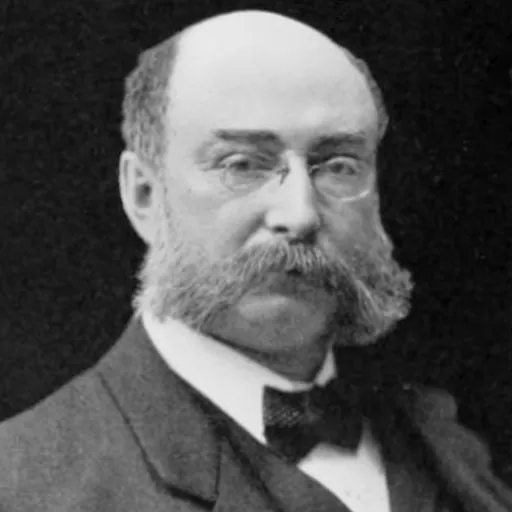
About Rudolph August Witthaus
Lived 1846 – 1915 (aged 69). Rudolph August Witthaus was an American chemist, physician and toxicologist.
Rudolph August Witthaus Jr. (August 30, 1846 December 20, 1915) was an American physician, chemist, and toxicologist. He was the top authority on poisons in the United States and was a forensic toxicologist in many important capital murder cases of the late 19th and early 20th centuries. He was also a survivor of the sinking of the SS Ville du Havre.
Early life Witthaus was born in New York City. While there, he was a member of the Fraternity of Delta Psi (St. Anthony Hall).
He returned to University Medical College, where he was the department chair and taught physiological chemistry from 1882 to 1886.
He became chair and professor of chemistry and physics at the Cornell University Medical College from 1898 to 1911. Essentials of Chemistry: Inorganic And Organic, for the Use of Students In Medicine. New York: W. Wood and Co., 1879 General Medical Chemistry for the Use of Practitioners of Medicine. New York: W. Wood & Company, 1881 The Medical Student's Manual of Chemistry. New York: W. Wood & Company, 1883 Laboratory Guide in Urinalysis and Toxicology New York: W. Wood & Company, 1886 Organic analysis: A Manual of the Descriptive and Analytical Chemistry of Certain Carbon Compounds in Common Use. with A. B. Prescott. New York: D. Van Nostrand, 1887 Essentials of Chemistry And Toxicology, for the Use of Students In Medicine. 2nd ed. New York: W. Wood & Company, 1888. The Principles of Chemistry. with Dmitry Ivanovich, George Kamensky, and A. J. Greenaway. New York: Longmans, Green and Co., 1891. Manual of Toxicology. 2nd edition. New York: William Wood and Company, 1911. Text-book of Chemistry Inorganic and Organic, with Toxicology; for Students of Medicine, Pharmacy, Dentistry and Biology, 7th edition, with R. J. E. Scott. New York: Wood and Co., 1919.
As editor and author Medical Jurisprudence, Forensic Medicine, and Toxicology, volume 1. with T. C. Becker editor. (1894) Medical Jurisprudence, Forensic Medicine, and Toxicology, volume 2. with T. C. Becker editor. (1894) Medical Jurisprudence, Forensic Medicine, and Toxicology, volume 3. with T. C. Becker editor. (1896) Medical Jurisprudence, Forensic Medicine, and Toxicology, volume 4. with T. C. Becker editor. (1896)
Journal articles "On Homicide by Morphine," A Text-Book of Chemistry Intended for the Use of Pharmaceutical and Medical Students. Journal of the American Chemical Society, vol. 17, no. 8 (1895): 656–658.
Personal life
SS Ville du Havre
In November 1873, Witthaus sailed to France aboard the steamship SS Ville du Havre.
From the safety of Paris, Witthaus noted that all of the rescued passengers were saved from the open water, while twenty officers and crew—and no passengers—reached the safety of the Loch Earn in lifeboats. In 1896, the couple separated. Witthaus filed for a divorce absolute in December 1896, making numerous claims against his wife, including indicating that she had an illness which resulted in a loss of reason. He also owned a manuscript that included Izaak Walton's The Compleat Angler, works of Rudyard Kipling, and a many manuscripts by Robert Louis Stevenson.
He was a member of the American Yacht Club, the Lotos Club, the Reform Club, the St. Anthony Club of New York, and the University Club of New York. He was also a member of the American Museum of Natural History.
Death and will In 1915, he died at his home at 2039 Broadway in New York City at the age of 69.
After his death, his brother Guy Witthaus, niece Emily Mommer, and nephew Fred E. Mommer contested his will, claiming Jennie Cowan, with whom he lived, had gotten him drunk at the Sherman Square Hotel before he wrote the will. In addition, his relatives claimed that Witthaus was "in his dotage" and had mental and memory impairments. Cowan inherited $20,000 in cash, property worth $31,712, stock and bonds worth $47,699, and a painting by Fagani. However, at the time Witthaus wrote his will, Cowan was also married and living with Robert Shore—without the knowledge of Witthaus. Her actual name was Jennie Shore.
Witthaus also made a bequest to the New York Academy of Medicine. His estate was appraised at $228,473 after it was discovered that many of his high-value art items were copies. However, the Robert Louis Stevenson manuscript collection was appraised at $31,461, and the Rudyard Kipling manuscript for $4,101.
Don’t just read it —
keep it.
Full-length biographies made to live with: read them, listen on the way to work, watch them tonight.
- E-book
- Audio
- Video
Instant download · yours to keep · every purchase keeps this site free
Important facts
People in Rudolph August Witthaus's life
Named in this biography and alive at the same time


Related people
Same field, nearest in time



Contemporaries
People whose lives overlapped Rudolph August Witthaus's

Frequently asked questions
Who was Rudolph August Witthaus?
American physician, chemist, and toxicologist (1846-1915)
When was Rudolph August Witthaus born?
Rudolph August Witthaus was born on 30 August 1846 in New York City.
When did Rudolph August Witthaus die?
Rudolph August Witthaus died on 20 December 1915 in New York City.
What was Rudolph August Witthaus's occupation?
Rudolph August Witthaus was a chemist, physician and toxicologist.
What nationality was Rudolph August Witthaus?
Rudolph August Witthaus was American.
Sources & further reading
· Wikipedia: Rudolph August Witthaus
· DBpedia: Rudolph August Witthaus
Cite this page
APA: Biography.guide. (2026). Rudolph August Witthaus. https://biography.guide/rudolph-august-witthaus/
MLA: "Rudolph August Witthaus." Biography.guide, https://biography.guide/rudolph-august-witthaus/.
Chicago: "Rudolph August Witthaus." Biography.guide. https://biography.guide/rudolph-august-witthaus/.
Data last updated: 2026-09-22 · Spot an error? Report a correction.
Portrait: Wikimedia Commons · author & licence
Page generated 2026-09-27 05:03 UTC