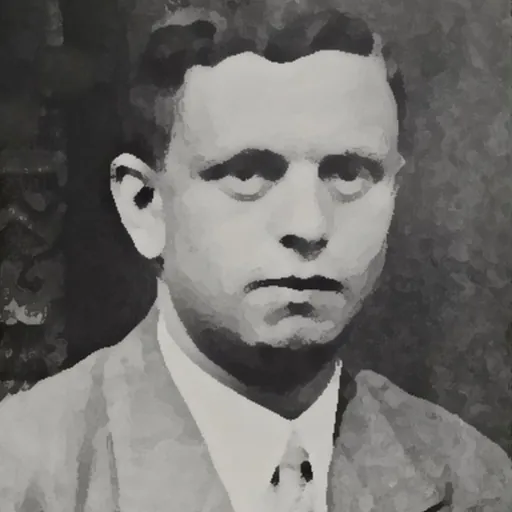
About Rudolf Schwarz
Lived 1904 – 1934 (aged 29). Rudolf Schwarz was a German editing staff, locksmith, resistance fighter and german resistance to Nazism.
Rudolf (Rudi) Schwarz (3 March 1904 – 1 February 1934) was a German Communist Party activist who after 1933 became an anti-government activist. He was arrested, detained and then, a few weeks short of his thirtieth birthday, handed over to the Gestapo who shot him at the beginning of February 1934.
In the German Democratic Republic he came to wider public attention when the popular author Stephan Hermlin included his story in a 1951 book about resistance to Nazism. After this Schwarz became something of an iconic figure, featured in cinema and television productions.
Life Rudolf "Rudi" Schwarz was born into a working-class family in Berlin. Abraham Schwarz, his father who came originally from Kosten near Posen, died in 1915. His mother, born Japha Brasch also came originally from eastern Germany: she died at a similarly young age in 1921. He completed an industrial apprenticeship and then, in 1921, joined the Young Communists ("Kommunistischer Jugendverband Deutschlands"). His principal duties involved working for what shortly afterwards became known as the Antimilitärischer Apparat ("AM"), a shadowy organisation with an intentionally misleading name, which was part of the party's paramilitary section. The "AM" is sometimes described as the intelligence service of the German Communist Party during this period. Schwarz's particular area of responsibility involved targeting members of the National Defence Force ("Reichswehr") and of the Police Service. Rudolf Schwarz later became widely credited with playing a crucial part in Scheringer's startling political conversion. By now he was, of necessity, living and operating "underground", using the party name "Horst". It was "Horst" who signed off the final report on the arrest, back in March 1933 of the party's then leader, Ernst Thälmann.
Inevitably Schwarz became a high priority target for the security services. It is known that he was still at liberty on 25 December 1933. On that date he met with Leo Roth, Siegfried Rädel, Herbert Wehner and Wilhelm Kox. The men, between them, comprised the available members of the underground party leadership for the region. Their objective was to arrange for a rapid reconfiguration of Kippenberger's party intelligence structure. Kippenberger had probably, by this time, fled abroad, as had most of the other leading party figures, apart from those who had already been arrested during 1933. Sources differ over whether it was at the end of December 1933 or during the first part of January 1934 that Rudolf Schwarz was himself captured by the authorities. He was subjected to severe interrogation-torture. Rudolf Diels, the Gestapo chief in 1934, published a memoir after 1945 in which he recalled that The Leader had reacted to Kattner's killing by demanding that "a thousand hostages from among the communists under arrest" should be shot. According to Diels, responsibility for the shooting of "John Schehr and his comrades" was down to a police commissar called Bruno Sattler. And according to at least one source Sattler had himself fired some or all of the fatal shots.
Posthumous celebrity Stephan Hermlin's book "Die erste Reihe" (loosely, "The front rank") appeared in 1951. In it he related "the stories of resistance during the Nazi era, based on the life stories and fates of the young people who sacrificed their lives in the struggle against fascism." The book comprised 31 biographical summaries on Berliners who resisted. Stephan Hermlin was a thoughtful author and a formidable talent. He had moved in 1947 from the west to the Soviet occupation zone (after October 1949 the Soviet sponsored German Democratic Republic (East Germany)). Almost all of the resistance heroes featured in "Die erste Reihe" were communists: one of the 31 was Rudolf Schwarz. The volume was an unapologetic attempt to "create heroes". Subsequent historians have opined that in the case of the section on Rudolf Schwarz, there was much detailed information available which could have given a more complete and in many ways more impressive - but also more nuanced - view of Schwarz and his contributions to sustaining the communist agenda during the Nazi period. This was simply left out, apparently so as to give the narrative a succinct format and a positive resonance. In it, the part of Rudolf Schwarz is taken by Ulrich Mühe.
In 1954 the physical remains of Rudolf Schwarz were located, exhumed, cremated and buried at the Memorial to the Socialists , the place of honour in the Friedrichsfelde Cemetery reserved by the East German government for the leaders and activists of Germany's socialist and communist history.
Don’t just read it —
keep it.
Full-length biographies made to live with: read them, listen on the way to work, watch them tonight.
- E-book
- Audio
- Video
Instant download · yours to keep · every purchase keeps this site free
Important facts
People in Rudolf Schwarz's life
Named in this biography and alive at the same time

Related people
Same field, nearest in time
Contemporaries
People whose lives overlapped Rudolf Schwarz's
Frequently asked questions
Who was Rudolf Schwarz?
German contributing editor (1904-1934)
When was Rudolf Schwarz born?
Rudolf Schwarz was born on 3 March 1904 in Berlin.
When did Rudolf Schwarz die?
Rudolf Schwarz died on 1 February 1934 in Berlin.
What was Rudolf Schwarz's occupation?
Rudolf Schwarz was an editing staff, locksmith, resistance fighter and german resistance to Nazism.
What nationality was Rudolf Schwarz?
Rudolf Schwarz was German.
Sources & further reading
· DBpedia: Rudolf Schwarz (resistance activist)
Cite this page
APA: Biography.guide. (2026). Rudolf Schwarz. https://biography.guide/rudolf-schwarz-editing-staff/
MLA: "Rudolf Schwarz." Biography.guide, https://biography.guide/rudolf-schwarz-editing-staff/.
Chicago: "Rudolf Schwarz." Biography.guide. https://biography.guide/rudolf-schwarz-editing-staff/.
Data last updated: 2026-09-24 · Spot an error? Report a correction.
Portrait: Wikimedia Commons · author & licence
Page generated 2026-10-03 09:36 UTC