
Rudolf Schoenert
German officer and fighter pilot during World War II
About Rudolf Schoenert
Lived 1911 – 1985 (aged 74). Rudolf Schoenert was a German fighter pilot.
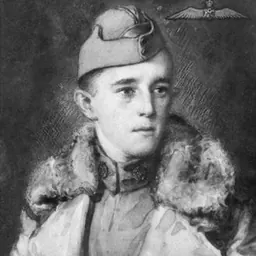
Rudolf Schoenert (27 July 1911 – 30 November 1985) was the seventh highest scoring night fighter flying ace in the German Luftwaffe during World War II. He was also a recipient of the Knight's Cross of the Iron Cross with Oak Leaves. The Knight's Cross of the Iron Cross, and its variants were the highest awards in the military and paramilitary forces of Nazi Germany during World War II.
Early life and career Schoenert was born on 27 July 1911 in Glogau in the Province of Silesia, a province of the German Kingdom of Prussia, today it is Głogów in Poland. On 22 May 1933, he started flight training as a civil pilot with the Deutsche Verkehrsfliegerschule (German Air Transport School) in Braunschweig. From 4 December 1936 to 26 February 1937, he received his recruit training. On 1 April 1937, Schoenert started working as a civil flight instructor.
World War II After five years in the Merchant Navy, Schoenert began flight training in 1933 and went on to fly commercial aircraft for Lufthansa. He was commissioned as a Leutnant in the Luftwaffe's Reserve in 1938.
Night fighter career A map of part of the Kammhuber Line. The 'belt' and night fighter 'boxes' are shown. Following the 1939 aerial Battle of the Heligoland Bight, Royal Air Force (RAF) attacks shifted to the cover of darkness, initiating the Defence of the Reich campaign. By mid-1940, Generalmajor (Brigadier General) Josef Kammhuber had established a night air defense system dubbed the Kammhuber Line. It consisted of a series of control sectors equipped with radars and searchlights and an associated night fighter. Each sector named a Himmelbett (canopy bed) would direct the night fighter into visual range with target bombers. In 1941, the Luftwaffe started equipping night fighters with airborne radar such as the Lichtenstein radar. This airborne radar did not come into general use until early 1942.
In June 1941, Schoenert joined 4./Nachtjagdgeschwader 1 (NJG 1—1st Night Fighter Wing) at Bergen in northern Holland. He was credited with his first aerial victory on the night of 8/9 July 1941 when he claimed an Armstrong Whitworth Whitley bomber shot down at 02:51 northwest of Vlieland. His total stood at 22 by 25 July 1942 and he was awarded the Knight's Cross of the Iron Cross .
Schoenert is recognized as the instigator of upward-firing armament in German night fighter force. The concept, dubbed Schräge Musik (Jazz Music) was first suggested by him in 1941. Kammhuber initially rejected the idea based on reports filed by Helmut Lent and Werner Streib. Following the Knight's Cross presentation, Schoenert again petitioned the idea to Kammhuber who approved the installation of upward-firing armament in three Dornier Do 217J, one of which issued to Schoenert.
Group commander On 1 December 1942, Schoenert was made Gruppenkommandeur (group commander) of the newly formed II. Gruppe of Nachtjagdgeschwader 5 (NJG 5—5th Night Fighter Wing). The Gruppe was equipped with Messerschmitt Bf 110 heavy fighter. Schoenert brought to the Gruppe his modified Do 217 fighter which was inspected by Oberfeldwebel Paul Mahle, an armorer attached to II. Gruppe. Mahle analyzed the concept and installed upward-firing guns into the cockpit of two Bf 110 night fighters.
Schoenert claimed the first aerial victory with Schräge Musik in May 1943.
In his autobiography, fellow night fighter pilot Wilhelm Johnen recalls an evening at Parchim airfield where Schoenert opened a window, gazed at the sunset and described how as a young sailor he had had friends of varied nationalities, 'Britishers, Norwegians, Danes and Germans' and that in the future 'the iron carapace in which the nations shroud themselves, the outward symbols of which are emblems and threats, must be swept away, for the more the modern world uses science, the bloodier will the battles become ... this bloody murder must come to an end'.
On 5 August 1943, Schoenert was appointed Gruppenkommandeur of I. Gruppe of Nachtjagdgeschwader 100 (NJG 100—100th Night Fighter Wing), replacing Hauptmann Heinrich Prinz zu Sayn-Wittgenstein who was transferred. NJG 100 was operating on the Eastern Front, where he claimed to have shot down 30 Soviet aircraft by early 1944. While there, he utilised a Junkers Ju 87D-5 "Stuka" dive-bomber with the configuration in an effort to target the slow-flying Soviet biplane fighter-bombers. On 1 January 1944, Schoenert was appointed commander of Nachtjagdgruppe 10 (NJGr 10—10th Night Fighter Group) and transferred command of I. Gruppe of NJG 100 to Major Alois Lechner.
On 11 April 1944, Schoenert was awarded the Knight's Cross of the Iron Cross with Oak Leaves , the 450th soldier to receive this distinction. The presentation was made by Adolf Hitler at the Berghof, Hitler's residence in the Obersalzberg of the Bavarian Alps, on 5 May 1944. Also present at the ceremony were Anton Hafner, Otto Kittel, Günther Schack, Emil Lang, Alfred Grislawski, Erich Rudorffer, Martin Möbus, Hans-Karl Stepp, Wilhelm Herget, Günther Radusch, Otto Pollmann and Fritz Breithaupt, who all received the Oak Leaves on this date.
On 15 November, Schoenert and Leutnant Karl Schnörrer, Oberst Gordon Gollob, Major Georg Christl, Hauptmann Heinz Strüning, Major Josef Fözö formed the guard of honor at Walter Nowotny funeral at the Zentralfriedhof in Vienna. Nowotny had been killed in action on 8 November 1944. The eulogy was delivered by Generaloberst Otto Deßloch.
On 6 March 1945, Schoenert succeeded Oberstleutnant Walter Borchers as Geschwaderkommodore (wing commander) of NJG 5. During a sortie east of the Elbe on 27 April 1945, an electrical fault rendered Schonert's radar unserviceable and his Junkers Ju 88G was shot down by a Royal Air Force (RAF) de Havilland Mosquito. He survived and was rescued by German troops.
Schoenert survived the war. Schoenert's radio and wireless operator was usually Oberfeldwebel Johannes Richter.
Summary of career Aerial victory claims According to US historian David T. Zabecki, Schoenert was credited with 64 aerial victories. Obermaier lists Schoenert with 65 aerial victories claimed in 376 combat missions, including 35 Soviet aircraft on the Eastern Front. Boiten lists him with 57 confirmed plus six further unconfirmed aerial victories. Foreman, Parry and Mathews, authors of Luftwaffe Night Fighter Claims 1939 – 1945, researched the German Federal Archives and found records for 59 nocturnal victory claims. Mathews and Foreman also published Luftwaffe Aces — Biographies and Victory Claims, listing Schoenert with 62 claims.
Chronicle of aerial victories Claim Date Time Type Location Serial No./Squadron No. – 4. Staffel of Nachtjagdgeschwader 1 – 1 9 July 1941 02:51 Whitley northwest of Vlieland Whitley Z6555/No. 78 Squadron RAF 2 9 July 1941 03:40 Whitley northwest of Vlieland 3 17 July 1941 00:50 Wellington west of Lemmer 4 4 August 1941 00:14 Wellington southwest of Stavoren 5 2 September 1941 23:34 Wellington northeast of Wangerooge 6 31 October 1941 21:37 Halifax north of Wangerooge 7 31 October 1941 22:05 Halifax north of Langeoog – 5. Staffel of Nachtjagdgeschwader 2 – 8 1/2 November 1941 Hampden 9 5/6 November 1941 Hampden 10 30 November 1941 20:52 Whitley west of Aurich Whitley Z9299/No. 77 Squadron RAF 11 10 January 1942 23:15 Wellington northwest of Langeoog 12 14 January 1942 20:50 Manchester southwest of Jever Manchester L7309/No. 207 Squadron RAF 13 26 January 1942 20:56 Whitley Whitley Z9423/No. 51 Squadron RAF – 4. Staffel of Nachtjagdgeschwader 2 – 14 28 March 1942 23:21 Halifax 15 26 April 1942 00:24 Wellington southwest of Helgoland 16 18 May 1942 00:24 Stirling northeast of Leeuwarden Stirling N6071/No. 218 (Gold Coast) Squadron RAF 17 7 June 1942 02:27 Wellington Borkum 18 20 June 1942 01:49 Wellington west of Emden Wellington Z1256/No. 300 Polish Bomber Squadron 19 23 June 1942 01:17 Wellington northwest of Baltrum 20 23 June 1942 02:07 Stirling north of Aurich – 5. Staffel of Nachtjagdgeschwader 2 – 21 20 July 1942 02:51 Halifax near Borkum 22 26/27 July 1942 Halifax Halifax W1164/No. 158 Squadron RAF 23 29 July 1942 03:28 Wellington Wellington X3488/No. 419 Squadron RCAF – Stab II. Gruppe of Nachtjagdgeschwader 5 – 24 30 March 1943 01:30 Lancaster northwest of Rerik Lancaster W4931/No. 207 Squadron RAF 25 21 April 1943 02:23 Lancaster Gedser harbour Lancaster W4756/No. 460 Squadron RAAF 26 2 August 1943 02:23 Halifax Russia – Stab I. Gruppe of Nachtjagdgeschwader 100 – 27 16 August 1943 22:08 TB-7 Russia 28 16 August 1943 23:36 R-5 Russia 29 16 August 1943 23:56 R-5 Russia 30 27 August 1943 20:20 TB-7 Krotovko 31 31 August 1943 22:01 Mitchell Russia 32 31 August 1943 22:21 Mitchell Russia 33 31 August 1943 22:37 Mitchell Russia 34 31 August 1943 23:00 Mitchell Russia 35 3 September 1943 22:34 Mitchell Poltava 36 6 September 1943 21:03 R-5 Russia 37 7 September 1943 20:58 DB-3 east of Slobodka 38 7 September 1943 21:48 DB-3 Brünischlschi 39 7 September 1943 22:17 PS-84 Grischany 40 7 September 1943 22:29 PS-84 Mischaly 41 20 September 1943 23:27 DB-3 Kislyaki 42 20 September 1943 23:57 DB-3 west Mirgorod 43? 44 11 October 1943 20:54 PS-84 north of Charvovo 45 11 October 1943 21:00 PS-84 southeast of Sapolye 46 11 October 1943 21:37 PS-84 north of Alexejevo 47 12 October 1943 22:43 U-2 southeast of Alexandroka 48 13 October 1943 01:07 DB-3 Babinovitski 49 13 October 1943 17:46 DB-3 Berseja 50 13 October 1943 21:24 DB-3 Russia 51 14 October 1943 18:21 DB-3 west of Demenino 52 14 October 1943 18:26 DB-3 west of Demenino 53 14 October 1943 18:37 DB-3 west of Demenino 54 14 October 1943 20:56 DB-3 Naravoki 55 15 October 1943 20:17 PS-84 Haschuki 56 27 October 1943 19:37 DB-3 Warafina 57 27 October 1943 22:37 R-5 Russia – Stab of Nachtjagdgruppe 10 – 59 15 February 1944 21:08 Halifax north-northwest of Berlin 60 20 February 1944 04:33 Halifax southwest of Leipzig
Awards Iron Cross (1939) 2nd Class (10 July 1941) 1st Class (22 July 1941) Honour Goblet of the Luftwaffe (Ehrenpokal der Luftwaffe) on 5 January 1942 German Cross in Gold on 18 May 1942 as Oberleutnant in the 4./Nachtjagdgeschwader 2 Knight's Cross of the Iron Cross with Oak Leaves Knight's Cross on 25 July 1942 as Oberleutnant of the Reserves and Staffelkapitän of the 4./Nachtjagdgeschwader 2 450th Oak Leaves on 11 April 1944 as Major of the Reserves and commander of Nachtjagdgruppe 10
Don’t just read it —
keep it.
Full-length biographies made to live with: read them, listen on the way to work, watch them tonight.
- E-book
- Audio
- Video
Instant download · yours to keep · every purchase keeps this site free
Important facts
People in Rudolf Schoenert's life
Named in this biography and alive at the same time


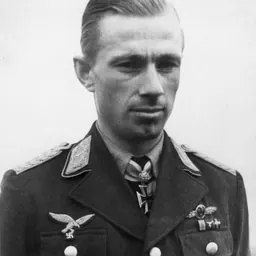
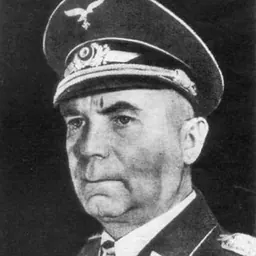
Related people
Same field, nearest in time



Contemporaries
People whose lives overlapped Rudolf Schoenert's






Frequently asked questions
Who was Rudolf Schoenert?
German officer and fighter pilot during World War II (1911–1985)
When was Rudolf Schoenert born?
Rudolf Schoenert was born on 27 July 1911 in Głogów.
When did Rudolf Schoenert die?
Rudolf Schoenert died on 30 November 1985 in Manitoba.
What was Rudolf Schoenert's occupation?
Rudolf Schoenert was a fighter pilot.
What nationality was Rudolf Schoenert?
Rudolf Schoenert was German.
Sources & further reading
Cite this page
APA: Biography.guide. (2026). Rudolf Schoenert. https://biography.guide/rudolf-schoenert/
MLA: "Rudolf Schoenert." Biography.guide, https://biography.guide/rudolf-schoenert/.
Chicago: "Rudolf Schoenert." Biography.guide. https://biography.guide/rudolf-schoenert/.
Data last updated: 2026-09-20 · Spot an error? Report a correction.
Page generated 2026-09-27 05:25 UTC