
About Rudolf Moroder
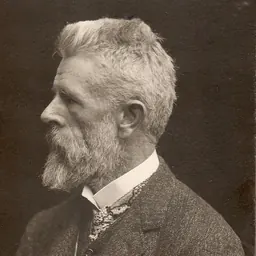
Lived 1877 – 1914 (aged 37). Rudolf Moroder was an Italian sculptor, painter and wood sculptor.
Rudolf Moroder-Lenèrt (26 January 1877 in Urtijëi, County of Tyrol – 22 December 1914 in Radlow, Galicia) was an Austrian sculptor specializing in religious art, who was a member of the Moroder family of South Tyrol, which was notable for the many artists of repute they produced.
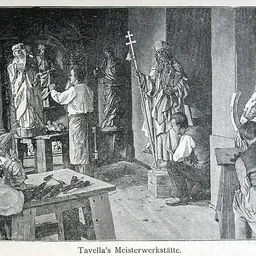
alt=Nativity carved by Rudolf Moroder and painted by Josef Moroder-Lusenberg exposed at the Museum Gherdëina in Urtijëi. Nativity carved by Rudolf Moroder and painted by Josef Moroder-Lusenberg exposed at the Museum Gherdëina in Urtijëi. Life Rudolph was the son of Franz Moroder-Lenèrt, a leading politician of the region, and of Marianna Moroder-Lusenberg, the sister of the noted sculptor Josef Moroder-Lusenberg. During a period of military service in the Austro-Hungarian Army in Vienna, he recognized that his true interest was in being an artist. He began his training in the craft under Anton Runggaldier (known as "Tone da Passua") and then became an assistant in the studio of Franz Tavella.
In 1902 Moroder opened his own studio in Lenèrt House, home of the firm, Moroder Brothers, where his brother-in-law, Ludwig Moroder, also worked. His own works ranged across a number of religious themes, and were mostly created for the various churches and cathedrals of the Grand Duchy of Baden and the Kingdom of Württemberg. He created a famous set of the Stations of the Cross for the Church of St. Ann in Silesia.
Moroder re-entered military service when World War I broke out. Stationed at a base in Radlow in Austrian Galicia, he was there when the position was overrun by enemy forces. He, along with many of his comrades, was bayonetted to death, dying at the age of 37. His body was buried there.
Works Moroder decided to submit a work to an art exhibit at the World's Fair of 1900, to be held in Paris. He chose his wooden sculpture of St. Elizabeth of Hungary with a Beggar, which he had sculpted in 1898 at the age of 21, based on a design by Christian Delago. He won the gold medal in the exhibition for this piece. The work is now in the Rosary Chapel of the parish church of Urtijëi, known for the large number of significant works of art from that period created by the large, local artistic community of the region.
Another of Moroder's pieces, a large, wooden sculpture of Saint Peter, stands in the sanctuary of the church, next to the main altar.
Gallery
Don’t just read it —
keep it.
Full-length biographies made to live with: read them, listen on the way to work, watch them tonight.
- E-book
- Audio
- Video
Instant download · yours to keep · every purchase keeps this site free
Important facts
People in Rudolf Moroder's life
Named in this biography and alive at the same time

Related people
Same field, nearest in time



Contemporaries
People whose lives overlapped Rudolf Moroder's





Frequently asked questions
Who was Rudolf Moroder?
sculptor specializing in religious art (1877-1914)
When was Rudolf Moroder born?
Rudolf Moroder was born on 26 January 1877 in Urtijëi.
When did Rudolf Moroder die?
Rudolf Moroder died on 22 December 1914 in Radłów.
What was Rudolf Moroder's occupation?
Rudolf Moroder was a sculptor, painter and wood sculptor.
What nationality was Rudolf Moroder?
Rudolf Moroder was Italian.
Sources & further reading
· DBpedia: Rudolf Moroder-Lenèrt
Cite this page
APA: Biography.guide. (2026). Rudolf Moroder. https://biography.guide/rudolf-moroder/
MLA: "Rudolf Moroder." Biography.guide, https://biography.guide/rudolf-moroder/.
Chicago: "Rudolf Moroder." Biography.guide. https://biography.guide/rudolf-moroder/.
Data last updated: 2026-09-20 · Spot an error? Report a correction.
Page generated 2026-09-27 05:26 UTC