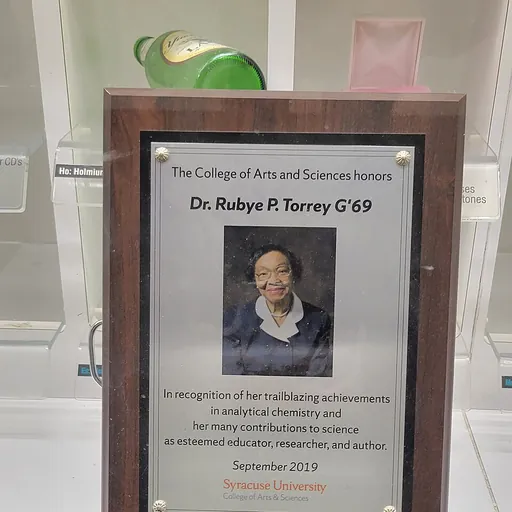
About Rubye Prigmore Torrey
Lived 1926 – 2017 (aged 91). Rubye Prigmore Torrey was an American chemist.
Rubye Mayette Prigmore Torrey (February 18, 1926 – October 26, 2017) was a notable African American female chemist and educator. She earned her bachelor's and master's degree at Tennessee State University and her PhD from Syracuse University. Her main research interests included food chemistry, the electroanalysis of drinking water and human hair, and research ethics. She is known for developing a mechanism to decompose hydrogen sulfide, which earned her a place in Sigma Xi.
She is well known for her influence and work as a student, professor, and researcher at Tennessee State University, where she established a chemistry research laboratory and founded “Research Day,” which is now a week long annual event. Torrey was an active participant in the American Society for the Advancement of Science and was an important member of the Women Chemist Committee and Committee on Safety for the American Chemical Society, where she retains Emeritus membership.
Early life and education Rubye Prigmore Torrey, the last of three girls, was born in Sweetwater, Tennessee to parents Olivia Lee Mayette Prigmore and Professor C. Claiborne.
Torrey later became the first African American female to earn a PhD in radiation-electroanalytical chemistry from Syracuse University in 1968. She served on the University Research Committee, After the success of the first edition, Torrey applied for and received a grant from the National Science Foundation for the "Technologically Assisted Physical Science" program, with the aim of increasing the number of students graduating with chemistry, physics and mathematics degrees.
Work in ethics After spending some time as a chemist for the National Institute of Standards and Technology (formerly known as the National Bureau of Standards), Torrey returned to the college realm as a chemistry professor and assistant vice president for research at Tennessee Technological University.
Under Dr. Torrey's guidance, the Sigma Xi Club on the Tennessee Technological University campus became a valid chapter.
For many years, Dr. Torrey was a reviewer for Federal government agencies, and evaluated proposals for the National Science Foundation and the Department of Education. Upon her retirement from academia, Torrey started a consulting business.
Personal life Torrey was an active Presbyterian throughout her life and was specifically very involved in the First Presbyterian Church of Nashville for forty plus years. She sang in the choir there for 45 years and served on a number of different committees as a deacon and an elder.
In September 1957, Rubye married husband Claude A. Torrey and later had two children, daughter Claudia O. Torrey and son Michael Torrey. Mr. Torrey was a biologist and biochemist, who had graduated from the school of Medical Technology of Meharry Medical School. Rubye credits him as an important and helpful influencer in her scientific career, stating, “We worked as a team. I feel like this is the only way one can balance a family and career in science, particularly in chemistry. Set your goals, make your plan, and work your plan”.
Torrey died on October 26, 2017, at the age of 91.
Race and gender In an interview published in Sisters in Science: Conversations with Black Women about Race, Gender, and Their Passion for Science, author and interviewer Diann Jordan questions Torrey about her intersectional status as an African American, female scientist. She expresses her struggles in identifying her equal access to opportunities, never knowing if she is withheld from access due to sexism and racism or if they were truly legitimate reasons. One of her most notable statements follows, “Our acceptance as scientists is what is needed. We do not need to be viewed as black scientists or Negro scientists or African American Scientists; we need to be simply accepted as scientists...This is the link that is missing and must be supplied of we and the generations that follow are to reach the level of being all we can be.” Torrey believes the key to bringing black women into the sciences is increased visibility through mentorship by those already in the field.
Don’t just read it —
keep it.
Full-length biographies made to live with: read them, listen on the way to work, watch them tonight.
- E-book
- Audio
- Video
Instant download · yours to keep · every purchase keeps this site free
Important facts
People in Rubye Prigmore Torrey's life
Named in this biography and alive at the same time




Related people
Same field, nearest in time




Contemporaries
People whose lives overlapped Rubye Prigmore Torrey's


Frequently asked questions
Who was Rubye Prigmore Torrey?
African American chemist and educator
When was Rubye Prigmore Torrey born?
Rubye Prigmore Torrey was born on 18 February 1926.
When did Rubye Prigmore Torrey die?
Rubye Prigmore Torrey died on 26 October 2017.
What was Rubye Prigmore Torrey's occupation?
Rubye Prigmore Torrey was a chemist.
What nationality was Rubye Prigmore Torrey?
Rubye Prigmore Torrey was American.
Sources & further reading
· Wikipedia: Rubye Prigmore Torrey
· DBpedia: Rubye Prigmore Torrey
Cite this page
APA: Biography.guide. (2026). Rubye Prigmore Torrey. https://biography.guide/rubye-prigmore-torrey/
MLA: "Rubye Prigmore Torrey." Biography.guide, https://biography.guide/rubye-prigmore-torrey/.
Chicago: "Rubye Prigmore Torrey." Biography.guide. https://biography.guide/rubye-prigmore-torrey/.
Data last updated: 2026-09-24 · Spot an error? Report a correction.
Portrait: Wikimedia Commons · author & licence
Page generated 2026-09-27 05:08 UTC