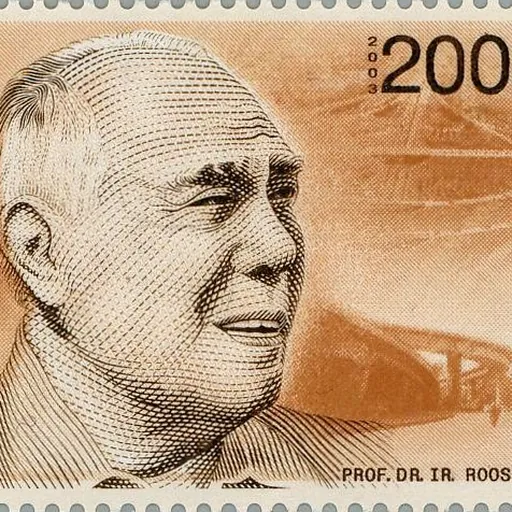
About Roosseno
Lived 1908 – 1996 (aged 87). Roosseno was an Indonesian academic, civil servant and engineer.
Roosseno Soerjohadikoesoemo (EYD: Roosseno Suryohadikusumo; 2 August 1908 – 15 June 1996) was an Indonesian politician, scholar, and engineer. He served as minister of Public Works, Transportation and Economic Affairs during the first cabinet of Prime Minister Ali Sastroamidjojo. Roosseno planned several of the most notable buildings in Jakarta, including the Hotel Indonesia, Istiqlal Mosque, and the National Monument. His extensive use of concrete as a building material led thim being dubbed Indonesia's Father of Concrete". Roosseno created and ran a "weapons laboratory" during the Indonesian National Revolution, which focused on sabotage of bridges in particular.
Politics As a member of the Great Indonesia Unity Party (PIR), Roosseno was appointed as a minister in the First Ali Sastroamidjojo Cabinet, initially as the Minister of Public Works. He was reassigned as Minister of Communication following a cabinet reshuffle on 12 October 1953, and then resigned as part of PIR's temporary departure from the coalition on 23 October 1954. He later rejoined the cabinet as Minister of Economic Affairs on 8 November 1954. As Economic Minister, Roosseno started a number of measures which tightened controls on foreign trade and banks. Roosseno also chaired the Economic Committee of the Bandung Conference in 1955.
Architecture During the Dutch period, Roosseno wrote a number of articles in the journal De Ingenieur in Ned. Indie, covering the use of reinforced concrete. He went to France in 1955 to study prestressed concrete, which strongly inspired him. Roosseno planned a number of the most notable buildings in Jakarta, including Hotel Indonesia, the Istiqlal Mosque, and the National Monument (which was Roosseno's first use of prestressed concrete). Due to Roosseno's extensive use of concrete in his designs, he was nicknamed "Indonesia's Father of Concrete". Although Roosseno was close to Sukarno, he was largely unaffected by Sukarno's fall from power. After Oentari's death, Roosseno remarried a Christian woman and converted to Christianity.
He died on 15 June 1996. After his body was given Christian funerary rites, the body was then driven to a mosque, where Roosseno was posthumously converted back to Islam before he was buried at Karet Bivak Cemetery.
Don’t just read it —
keep it.
Full-length biographies made to live with: read them, listen on the way to work, watch them tonight.
- E-book
- Audio
- Video
Instant download · yours to keep · every purchase keeps this site free
Important facts
People in Roosseno's life
Named in this biography and alive at the same time

Related people
Same field, nearest in time



Contemporaries
People whose lives overlapped Roosseno's





Frequently asked questions
Who was Roosseno?
Indonesian academic (1908-1996)
When was Roosseno born?
Roosseno was born on 2 August 1908 in Dutch East Indies, Madiun.
When did Roosseno die?
Roosseno died on 15 June 1996 in Indonesia, Jakarta.
What was Roosseno's occupation?
Roosseno was an academic, civil servant and engineer.
What nationality was Roosseno?
Roosseno was Indonesian.
Sources & further reading
· DBpedia: Roosseno Soerjohadikoesoemo
Cite this page
APA: Biography.guide. (2026). Roosseno. https://biography.guide/roosseno/
MLA: "Roosseno." Biography.guide, https://biography.guide/roosseno/.
Chicago: "Roosseno." Biography.guide. https://biography.guide/roosseno/.
Data last updated: 2026-09-23 · Spot an error? Report a correction.
Portrait: Wikimedia Commons · author & licence
Page generated 2026-09-27 05:05 UTC