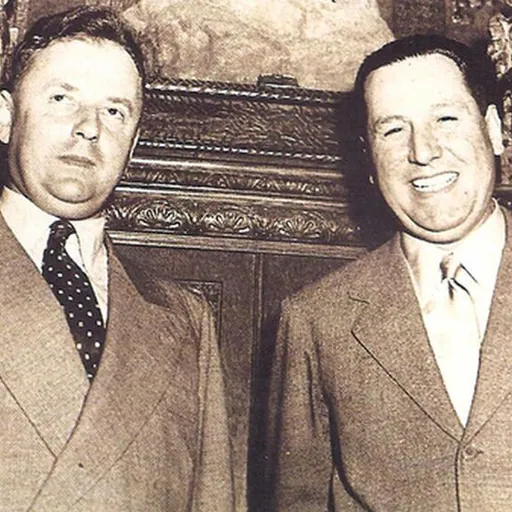
About Ronald Richter
Lived 1909 – 1991 (aged 82). Ronald Richter was an Argentine and Austrian physicist and nuclear physicist.
Ronald Richter (21 February 1909 – 25 September 1991) was an Austrian-born German scientist, later also an Argentine citizen, who became infamous in connection with the Argentine Huemul Project and the National Atomic Energy Commission (CNEA). The project was intended to generate energy from controlled nuclear fusion in the 1950s, during the presidency of Juan Perón. According to Perón’s 1951 announcement, Richter's project would deliver cheap energy in containers of half-liter and liter size. Skepticism arose to Richter’s claims both internally and within Argentina. An independent review panel organized by Perón determined Richter’s research was spurious.
Nationality Richter was born in Falkenau an der Eger (in Czech Falknov nad Ohří renamed Sokolov in 1948), Bohemia (now Czech Republic) while it was part of the Austrian empire. Richter was of German origin. He was naturalized as an Argentine citizen in the early 1950s; President of Argentina Juan Perón overrode Argentine law to enable this.
Education Richter attended the German University of Prague, graduating in 1935. Sources provide variant narratives about his studies as a doctoral candidate.
According to Gambini, Richter was awarded a doctorate in natural sciences in 1955. However, another source claims that he was not awarded a doctoral degree because he had misinterpreted his research results. He had concluded that he had discovered delta rays being emitted by the earth, but in fact he had been detecting X-rays scattered by the ground.
According to his recollection, Santos Mayo had personally heard Richard Gans say:
Kurt Sitte's recollections of Richter's research under Prof. Furth differed. He recalled:
Career
Europe
Richter worked in Germany, England and France.
In preparing his dissertation for a doctorate from the University of Prague, Richter worked at Falkenau Chemiewerke in his home town of Falkenau an der Eger (now known as Sokolov) in the Czech Republic. There he went to work with electric arc furnaces looking to develop accurate methods for measurement and control of temperatures. Richter discovered that the injection of heavy hydrogen (deuterium) caused a nuclear reaction which he could measure and gauge with Geiger counters.
Following the end of World War II, his only known jobs were a six-month stint working on explosives and a few commercial contracts. He met the aeronautical engineer Kurt Tank in London; Tank later emigrated to Argentina, hired by Perón's government under the pseudonym of Pedro Matthies.
Argentina On the recommendation of Kurt Tank in 1947, Richter was invited to Argentina to develop a nuclear program for General Juan Perón. He learned that a German fusion reactor had been smuggled to Argentina and Perón desperately needed an expert able to bring the device back to life. Richter brought knowledge of German particle accelerator technology and was received by the German industrialist and Nazi spy August Siebrecht. Siebrecht took Richter to Córdoba, where Tank was developing aircraft. Tank was interested in Richter's proposal to use nuclear energy for aircraft propulsion. Richter continued to address Tank as Prof. Dr. Pedro Matthies in his correspondence about the Huemul Project.
Perón believed that any project undertaken by a Nazi German scientist was bound to be successful. Due to his political disagreements with Argentine scientists of stature, such as Enrique Gaviola, Perón was reluctant to seek their advice on Richter's proposal, and he gave Richter carte blanche and appointed him as his personal representative in the Bariloche area. The total cost of the project was estimated at US$300 million (2003 value).
In 1951 Richter announced that he had achieved controlled nuclear fusion under laboratory conditions, a claim later proven false: it transpired that Richer had simply exploded hydrogen in an electric arc.
Project Huemul: reactions and aftermath On 24 March 1951 Perón announced to the international press "Argentina Produces Atomic Energy", and later decorated Richter with the Peronista Medal. Following international publicity and claims, scientists in Britain were hesitant to accept the claims of the unknown Richter without corroboration. In the US, the press discounted reports of Richter's work, but secretly the government started funding two projects, Sherwood and Matterhorn. An intelligence assessment by the US, later declassified, stated that he could possibly be a "mad genius [...], thinking in the year 1970." However, it soon became evident that the claims were spurious, and interest dried up. After Perón was deposed, the new government investigated Richter regarding 1,000 million Argentine pesos (about £25 million at the time) allocated to the project and unaccounted for, and arrested him. Nothing further was heard about him. Secret British government documents declassified under the 30-year rule in 1983 report that Perón had contemplated invading the Falkland Islands in 1951, possibly due to his confidence that Argentina would be the first country to exploit atomic energy for industrial purposes.
Biographical publications The following are quotations from books and articles published by journalists, biographers, physicists, and historians, with sources below:
From Eva Perón (Alicia Dujovne Ortiz, 1996):
From Juan G. Roederer (2003):
Richter, The Opera: A Musical Documentary Ronald Richter inspired an opera, Richter: Ópera Documental de Cámara, by Mario Lorenzo and Esteban Buch, with references to the spectacular experiments. It has been performed both in Argentina (Teatro Colón) and in France (Théâtre Paris-Villette).
The narrative unfolds in a lyrical atmosphere shaped by the constant Patagonian winds of the Roaring Forties and the repeated sound of waves breaking along the island’s shores, until the tranquility is disrupted by German voices and sudden explosive sounds. Summary and critique. Casullo, Eduardo. La Aventura de la Isla de la Mula: Richter.
Spectacles. Richter: Opéra documentaire de Mario Lorenzo.
Don’t just read it —
keep it.
Full-length biographies made to live with: read them, listen on the way to work, watch them tonight.
- E-book
- Audio
- Video
Instant download · yours to keep · every purchase keeps this site free
Important facts
People in Ronald Richter's life
Named in this biography and alive at the same time


Related people
Same field, nearest in time



Contemporaries
People whose lives overlapped Ronald Richter's



Frequently asked questions
Who was Ronald Richter?
Austrian scientist (1909-1991)
When was Ronald Richter born?
Ronald Richter was born on 11 October 1909 in Sokolov.
When did Ronald Richter die?
Ronald Richter died on 29 December 1991 in Viedma.
What was Ronald Richter's occupation?
Ronald Richter was a physicist and nuclear physicist.
What nationality was Ronald Richter?
Ronald Richter was Argentine and Austrian.
Sources & further reading
Cite this page
APA: Biography.guide. (2026). Ronald Richter. https://biography.guide/ronald-richter/
MLA: "Ronald Richter." Biography.guide, https://biography.guide/ronald-richter/.
Chicago: "Ronald Richter." Biography.guide. https://biography.guide/ronald-richter/.
Data last updated: 2026-09-24 · Spot an error? Report a correction.
Portrait: Wikimedia Commons · author & licence
Page generated 2026-09-27 05:08 UTC