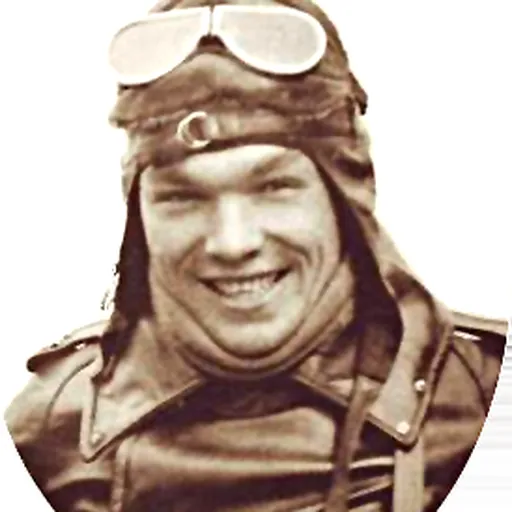
Romualdas Marcinkus
Lithuanian pilot and footballer
About Romualdas Marcinkus
Lived 1907 – 1944 (aged 36). Romualdas Marcinkus was a Lithuanian association football player, aircraft pilot, association football coach and flieger.
Romualdas Marcinkus (22 July 1907 – 29 March 1944) was a Lithuanian pilot. Marcinkus participated in an early trans-European flight on 25 June 1934, and was the only Lithuanian pilot to serve in the Royal Air Force (RAF) during the Second World War. In his youth Marcinkus was a Lithuanian multifold football champion and a playing coach for the Lithuania national football team.
While serving in the Lithuanian Air Force, Marcinkus was a parachute instructor, and headed the aviation sport and physical education department, and during his later years coached a junior football team. A few months before the Soviet occupation of Lithuania early in the Second World War, Marcinkus left Lithuania and enlisted in the French Air Force. After the Battle of France and the French capitulation, Marcinkus escaped to Britain, where he flew for the RAF. As a pilot for No. 1 Squadron RAF, he took part in various missions, including escorting bombers and night combat. On 12 February 1942, during Operation Cerberus, he was shot down, became a prisoner of war, and was sent to Stalag Luft III.
At Stalag Luft III Marcinkus became an active member of an underground group of prisoners who organized and executed the Great Escape. Marcinkus was responsible for analyzing the German railway schedules – a vital part of the plan. On the night of 25 March 1944, Marcinkus became one of 76 servicemen who escaped the prison camp. After several days he was recaptured by the Gestapo and executed.
At the end of the Second World War, Lithuania lost its independence and Marcinkus was largely forgotten. His memory was kept alive by the Lithuanian émigré press. After Lithuania regained its independence in 1990, more detailed accounts of his life were published there and abroad.
Early life Marcinkus was born on 22 July 1907 in the provincial Lithuanian town of Jurbarkas. At the time Jurbarkas, as well of the rest of Lithuania, was part of the Russian Empire. Romualdas' father, Pranas Marcinkus, served as a policeman in Jurbarkas, Tauragė, and Rumšiškės. His mother, Honorata Kroazė-Marcinkienė, came from an urban family of French origins. Marcinkus' cousin, Vanda Kroazė-Šestakauskienė, stated that the Kroazė family's origins in Lithuania began with a Frenchman named Courvoisier, who came to Lithuania with Napoleon's army during the French invasion of Russia in the 19th century and married a local Lithuanian woman. After graduating from the German School, he enrolled at the Kaunas Military School, intending to enlist in the Lithuanian army.
During this time the Lithuanian army was expanding and modernizing. The Lithuanian Air Force was especially targeted for rapid development and service in this branch was prestigious. Some of its earlier members such as Jurgis Dobkevičius and Antanas Gustaitis were instrumental in improving on aeronautical designs. While at the military school Marcinkus played for the KSK (Kauno sporto klubas) football club. After his father's death in 1927, Marcinkus took on the responsibility of supporting his remaining family, he also began playing football for LFLS Kaunas. Marcinkus became the only Lithuanian pilot to fly for the RAF during the Second World War. On the allied side, one American pilot was missing. The last mission Marcinkus carried out as an RAF pilot was on 12 February 1942.
On 11 February 1942, a German operation codenamed "Cerberus" had commenced, in which a German Kriegsmarine squadron consisting of Scharnhorst, Gneisenau and Prinz Eugen, supported by a number of smaller ships, attempted to sail to their home bases via the English Channel. Six fighters from No. 1 Squadron were tasked with intercepting German ships and attacking German torpedo boats. Marcinkus was among the pilots. On 12 February, while attacking the Scharnhorst, his plane was shot down by anti-aircraft fire and crashed into the sea. Romualdas Marcinkus suffered a spinal fracture and was rescued by Germans, subsequently becoming a prisoner of war. During the course of the battle, the British lost approximately forty planes and failed to prevent the German fleet from returning to Kiel and Wilhelmshaven.
The Great Escape
Marcinkus was sent to Stalag Luft III, a prisoner-of-war camp near Sagan that housed captured air force servicemen during the Second World War. The camp was restructured several times in order to accommodate more POWs. It would eventually hold over 10,000 inmates. Marcinkus was the only known Lithuanian at the camp. The group expanded and accepted Marcinkus into their ranks—his fluent command of several languages, most importantly German, was seen as valuable.
The prisoners delegated various tasks amongst themselves in order to better implement their escape. Marcinkus began working on creating forged documents that would aid the escapees once they were out of the confines of the Stalag. He also contributed his intelligence to analyses of the Baltic and Low Countries. According to the plan, Marcinkus needed to be among the first escapees. He was selected to lead a group of four prisoners posing as Lithuanian workers traveling back to Lithuania. On 29 March his body was cremated in Danzig's Gestapo crematorium. The Gestapo claimed that the recaptured servicemen were shot after resisting arrest and while attempting to escape again.
Commemoration
Details of the Great Escape executions reached the British Government. Its Foreign Secretary, Anthony Eden, then delivered this speech to the House of Commons:
The remaining inmates at Stalag Luft III erected a memorial to their fifty executed comrades at the end of 1944. Following the war, the Allies launched an investigation into the escaped prisoners' executions and named seventy-two individuals as responsible. Marcinkus' ashes rest in a grave at Poznań, marked by a Commonwealth War Graves Commission headstone. Marcinkus was posthumously mentioned in despatches in the 1944 King's Birthday Honours, he also received the 1939–45 Star, the Air Crew Europe Star, and the War Medal 1939–1945. British authorities attempted to contact his relatives in Lithuania, but Lithuania—as a Soviet Socialist Republic— was behind the Iron Curtain, and they were advised to stop these attempts since his relatives might suffer negative consequences. At the time Soviet authorities saw those people who maintained contacts with the West as untrustworthy. Gražina Sviderskytė, a CNN award-winning journalist, wrote a detailed account of Marcinkus' life in her book Uragano kapitonas ("Hurricane Captain"), which was published in 2004. A documentary film with the same title was produced in 2004. Marcinkus' life story was reprinted in various foreign publications in the US, Canada, and Japan.
Don’t just read it —
keep it.
Full-length biographies made to live with: read them, listen on the way to work, watch them tonight.
- E-book
- Audio
- Video
Instant download · yours to keep · every purchase keeps this site free
Important facts
People in Romualdas Marcinkus's life
Named in this biography and alive at the same time
Related people
Same field, nearest in time



Contemporaries
People whose lives overlapped Romualdas Marcinkus's



Frequently asked questions
Who was Romualdas Marcinkus?
Lithuanian pilot and footballer (1907-1944)
When was Romualdas Marcinkus born?
Romualdas Marcinkus was born on 22 July 1907 in Jurbarkas.
When did Romualdas Marcinkus die?
Romualdas Marcinkus died on 29 March 1944 in Pruśce.
What was Romualdas Marcinkus's occupation?
Romualdas Marcinkus was an association football player, aircraft pilot, association football coach and flieger.
What nationality was Romualdas Marcinkus?
Romualdas Marcinkus was Lithuanian.
Sources & further reading
· Wikipedia: Romualdas Marcinkus
· DBpedia: Romualdas Marcinkus
Cite this page
APA: Biography.guide. (2026). Romualdas Marcinkus. https://biography.guide/romualdas-marcinkus/
MLA: "Romualdas Marcinkus." Biography.guide, https://biography.guide/romualdas-marcinkus/.
Chicago: "Romualdas Marcinkus." Biography.guide. https://biography.guide/romualdas-marcinkus/.
Data last updated: 2026-09-20 · Spot an error? Report a correction.
Portrait: Wikimedia Commons · author & licence
Page generated 2026-09-27 04:58 UTC