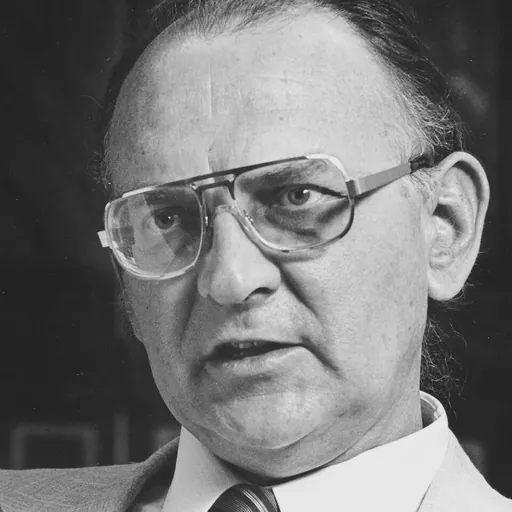
About Rolf Knierim
Lived 1928 – 2018 (aged 90). Rolf Knierim was a biblical scholar.
Rolf Paul Knierim (8 July 1928 – 29 September 2018) was a German American theologian and biblical scholar who specialized in the research of the Old Testament. He was a tenured Professor of Old Testament at the Claremont School of Theology and Avery Professor of Religion at Claremont Graduate University.
Knierim was a founding research project director at Claremont Graduate University's internationally esteemed Institute for Antiquity and Christianity, where he initiated and led the Old Testament Form-Critical Project, which produced the Institute's longest-running and most prolific publication series, the Forms of the Old Testament Literature (FOTL) Series.
In 1997, a Festschrift was published in Knierim's honor entitled, Problems in Biblical Theology: Essays in Honor of Rolf Knierim, which included contributions from scholars such as Klaus Koch, Wolfhart Pannenberg, Rolf Rendtorff, James A. Sanders, and Claus Westermann. Once a student of Gerhard von Rad and a former faculty member at the University of Heidelberg, and in his more expansive 1995 multi-essay tome, The Task of Old Testament Theology: Substance, Method, and Cases.
Life, education, and work Knierim was born in Pirmasens, Germany to parents Gottfried Knierim, a shoe factory worker, and Luise Knierim, née Buchmann. Knierim grew up in a family household deeply involved in the communal life of their local Methodist congregation, where his paternal grandmother had been a founding member. At the age of ten, Knierim signed up for school at the local Humanistisches Gymnasium, the classical high school in Pirmasens, where he received training in the reading of the classics, the study of Greek and Latin, and early exposure to the dialogue between humanistic pursuits and Christian thought.
In March 1945, after a war-battered Pirmasens had undergone severe structural damage and numerous casualties among its citizenry, Knierim was captured by American forces, interrogated, but then sent home.
In July 1955, the couple moved into an apartment atop the chapel at Eutingen where Knierim had been assigned for his first year as a pastor to serve the three villages of Eutingen, Öschelbronn, and Wurmberg, Germany. While there, Knierim published a reflection in the church newsletter addressing his congregation entitled, "Biblishes Denken" [biblical thinking], a piece he mentions in the foreword of his 1995 book, The Task of Old Testament Theology: Substance, Method, and Cases. There, years later in the opening of the 1995 book, one of the culminating works of his career, he noted that although he had become “involved in the scholarly side of the task” in his professional life over the decades that followed his pastoral service, a view had persisted for him through the years, namely that he had ”never believed that biblical thinking is reserved only for the scholars.” Soon thereafter, Knierim received a postcard from Gerhard von Rad wherein von Rad offered him a university position, and effectively “changed the direction of Rolf’s career from the practical field of ministry in the German Methodist Church to the academic field of teaching the Old Testament at the University of Heidelberg.” In November 1967, Knierim participated in the organizational meeting of the IAC Research Council, alongside five others: William H. Brownlee, James M. Robinson, IAC founder; Ernest Cadman Colwell, first director of the IAC; Hans Dieter Betz, and Loren R. Fisher. Knierim continued as IAC project co-director with Gene Tucker, and later through his retirement with Marvin A. Sweeney. The Task of Old Testament Theology: Substance, Methods, and Cases. The essay was later described by Sweeney as representing “more or less of a coming of age of form-critical theory in that it moved well beyond past conceptualizations of the method.” Sweeney went on to say that “Knierim recognizes biblical texts as literary entities that are formed in the context of a societal or life setting in which typical sociolinguistic forms of expression function and convey meaning.” Similarly, David L. Petersen saw in the article the pivotal suggestion of the reformulation of form-critical programmatic consensus up to that point, consensus that had been “built on the foundations” going back to Hermann Gunkel.
Old Testament theology as a systematic task
Remarking on Knierim and his signature approach to biblical research, Jeffrey Kuan, Claremont School of Theology president, said of Knierim that “his passion and commitment to the scientific study of the Bible was absolutely unwavering.” Knierim's scientific approach to Biblical Studies was perhaps most clearly evidenced in his firmly-held conceptualization of Old Testament theology as necessarily systematic and his hopes, albeit cautiously guarded ones, for the shape of future scholarly explorations of Old Testament theology.
In his essay, “Comments on the Task of Old Testament Theology,” Knieirm discussed the essential contours of his methodological approach, explaining that the main points “revolve above all around the issues of diversity, the systematization of the diverse theologies by comparison and their relativity to each other, the relationship of text and concept in the individual tests, and Old Testament theology as a genre sui generis.”
Ben C. Ollenburger noted that Knierim's assertion that the task of Old Testament theology is a systematic one was shocking and quite a step forward on a distinctive course of exploration. Old Testament lecturer Katrina Larkin offered a similar assessment of Knierim's programmatic proposal, positing that applying it would “be massive and involve the reconceptualization of basic interpretive paradigms.”
In his “A Posteriori Explorations” toward the end of ‘‘The Task of Old Testament Theology,’’ Knierim reflected soberly on the plausibility of the realization of a particular “utopian” dream, saying that “It is not inconceivable that someday, if not an individual, a team of like-minded Old Testament scholars will organize a comprehensive Old Testament theology using methods similar to those by which research projects in the modern sciences are organized. Such a project is, to my knowledge, currently not on the horizon.”
Doktorvater
Knierim did his role of Doktorvater. SBL Executive Director Emeritus, Antony F. Campbell, George Blankenbaker, Marvin A. Sweeney, Yoshihide Suzuki, recipient of the 1990 Japan Academy Prize for his dissertation-based work, "A Philological Study of Deuteronomy," and Mignon R. Jacobs, Dean and Professor of Old Testament at Ashland Theological Seminary.
Two dissertations completed by Knierim doctoral advisees featured discussions that specifically treated the place of Knierim's work in the development of the disciplines of biblical criticism in general, and form criticism, exegetical methodology, Old Testament theology and hermeneutics in particular: David Bruce Palmer's Text and Concept in Exodus 1:1-2:25: A Case Study in Exegetical Method, and Wonil Kim's Toward a Substance-Critical Task of Old Testament Theology.
In Text and Concept in Exodus 1:1-2:25: A Case Study in Exegetical Method, Palmer explained that "Knierim has contributed to the ferment of discussion and proposals for refinements and methodological innovations relative to form-critical methodology. This is clear first in Knierim’s interaction with the impact of structuralism and structural linguistics upon form-critical method. His developments in this regard have stood alongside those of Richter. Koch, and Hardmeier and others who have in one way or another effected newer developments in form criticism emerging from the mid-twentieth century onward...The emphasis on concept was to be a significant focus on Knierim’s part as a further development along the trajectory which the engagement between form criticism and structural linguistics had propelled methodological refinement."
Palmer went on to address a perceived blindspot in the scope of the conventional understanding of Knierim's research, as he observed that "Many who are familiar with Knierim’s contribution to form-critical research are not aware that this later development moves well beyond the methodology that is expressed, even to this day, in The Forms of the Old Testament Literature commentary series. A subtle shift of focus in Knierim’s own method may be discerned, from a primary focus upon genre and typicality, even when grounded in structure analysis of texts, to a focus upon infratextual conceptual aspects which are more fundamental than the generically typical.”
Knierim invoked Wonil Kim's Toward a Substance-Critical Task of Old Testament Theology as he discussed assessments of his The Task of Old Testament Theology: Substance, Method, and Cases
Knierim's approach was thus described by Kim as representing a departure and a paradigmatic shift into a new and decidedly different direction from even his well-known mentor, Gerhard von Rad. Concerning that which was held as central to what Knierim viewed as of the problematic nature of the conceptual plurality of Old Testament texts, Kim homed in, “Plurality in the abstract, conceptual level may be problematic in its own right, but in the configuration of Knierim's methodology the question of unity in conceptual reality and concrete reality are one question. A question of God is a question of the people affected in actu."
Don’t just read it —
keep it.
Full-length biographies made to live with: read them, listen on the way to work, watch them tonight.
- E-book
- Audio
- Video
Instant download · yours to keep · every purchase keeps this site free
Important facts
People in Rolf Knierim's life
Named in this biography and alive at the same time




Related people
Same field, nearest in time




Contemporaries
People whose lives overlapped Rolf Knierim's




Frequently asked questions
Who was Rolf Knierim?
German-American theologian (1928-2018)
When was Rolf Knierim born?
Rolf Knierim was born on 8 July 1928 in Pirmasens.
When did Rolf Knierim die?
Rolf Knierim died on 29 September 2018.
What was Rolf Knierim's occupation?
Rolf Knierim was a biblical scholar.
Sources & further reading
Cite this page
APA: Biography.guide. (2026). Rolf Knierim. https://biography.guide/rolf-knierim/
MLA: "Rolf Knierim." Biography.guide, https://biography.guide/rolf-knierim/.
Chicago: "Rolf Knierim." Biography.guide. https://biography.guide/rolf-knierim/.
Data last updated: 2026-09-22 · Spot an error? Report a correction.
Portrait: Wikimedia Commons · author & licence
Page generated 2026-09-27 05:03 UTC