
About Roland Ritchie
Lived 1910 – 1988 (aged 77). Roland Ritchie was a Canadian lawyer and judge.
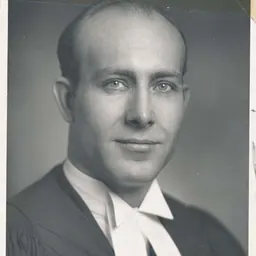
Roland Almon Ritchie, (June 19, 1910 – June 5, 1988) was a Canadian lawyer and puisne justice of the Supreme Court of Canada.
Early life and family Born in Halifax, Nova Scotia, the son of William Bruce Almon Ritchie and Lillian Stewart, Ritchie was a scion of prominent families — the Almons, Ritchies, and Stewarts were all major families in Nova Scotia. Ritchie's great-uncle, Sir William Johnstone Ritchie, had also been on the Supreme Court, serving as a puisne justice and then as the second Chief Justice of Canada. His brother, Charles Ritchie was an important Canadian diplomat and diarist.
Education Ritchie received a Bachelor of Arts degree from the University of King's College, Halifax, in 1930. He then received a Rhodes scholarship and read law at Pembroke College, Oxford University, receiving an additional Bachelor of Arts degree, in law, in 1932.
Military career Ritchie was called to the Nova Scotia Bar in 1934, but his law practice was interrupted by World War II. He joined the Royal Canadian Artillery, and eventually served as Assistant Deputy Judge Advocate with the Third Canadian Division from 1941 to 1944. In Drybones, Ritchie wrote the majority decision for the Court, holding that a provision of the Indian Act was inoperative because it conflicted with the Canadian Bill of Rights. However, in Lavell, Ritchie wrote the majority decision holding that a federal statute such as the Indian Act could not be held inoperative because of the Bill of Rights.
One of his most significant dissents, co-authored with Justice Martland, was in the Patriation Reference, where they argued that as a matter of constitutional law, the federal Parliament did not have the authority to unilaterally request that the British Parliament enact the proposed patriation constitutional amendments. Although in dissent on the legal issue, Martland and Ritchie were in the majority on the second issue in the Reference, the existence of a constitutional convention which required a significant degree of provincial support for major constitutional amendments.
Later life He served on the Court until his retirement in 1984. He retired due to poor health at age 74, a year before the mandatory retirement age of 75. In 1985 he was made a Companion of the Order of Canada. From 1974 to 1988, he was the Chancellor of the University of King's College.
Don’t just read it —
keep it.
Full-length biographies made to live with: read them, listen on the way to work, watch them tonight.
- E-book
- Audio
- Video
Instant download · yours to keep · every purchase keeps this site free
Important facts
People in Roland Ritchie's life
Named in this biography and alive at the same time


Related people
Same field, nearest in time



Contemporaries
People whose lives overlapped Roland Ritchie's






Frequently asked questions
Who was Roland Ritchie?
Canadian judge (1910–1988)
When was Roland Ritchie born?
Roland Ritchie was born on 19 June 1910 in Halifax.
When did Roland Ritchie die?
Roland Ritchie died on 5 June 1988 in Ottawa.
What was Roland Ritchie's occupation?
Roland Ritchie was a lawyer and judge.
What nationality was Roland Ritchie?
Roland Ritchie was Canadian.
Sources & further reading
Cite this page
APA: Biography.guide. (2026). Roland Ritchie. https://biography.guide/roland-ritchie/
MLA: "Roland Ritchie." Biography.guide, https://biography.guide/roland-ritchie/.
Chicago: "Roland Ritchie." Biography.guide. https://biography.guide/roland-ritchie/.
Data last updated: 2026-09-20 · Spot an error? Report a correction.
Page generated 2026-09-27 05:11 UTC