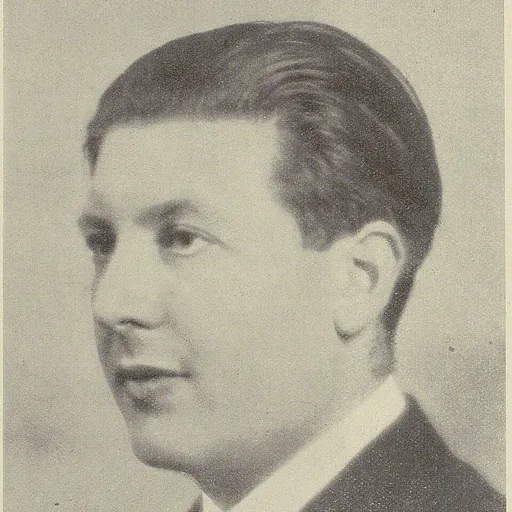
About Roland-Manuel
Lived 1891 – 1966 (aged 75). Roland-Manuel was a French composer, choreographer, musicologist, university teacher, music critic and musicographer.
Alexis Roland-Manuel (22 March 18911 November 1966) was a French composer and critic, remembered mainly for his criticism.
Biography He was born Roland Alexis Manuel Lévy in Paris, to a family of Belgian and Jewish origins. He studied composition under Vincent d'Indy and Albert Roussel. As a young man he befriended composer Erik Satie, who helped him to make numerous influential connections. In 1911, Satie introduced Roland-Manuel to Maurice Ravel, whose pupil, friend and biographer he soon became.
In 1947, he was appointed Professor of Aesthetics at the Conservatoire de Paris, where he remained until his retirement in 1961, making many contributions to musical theory and criticism, even assisting Igor Stravinsky by ghost-writing the theoretical work "The Poetics of Music". In addition to theoretical works, he wrote and composed various works for stage, especially comic operas, and screen, developing a partnership with director Jean Grémillon, for five of whose films he composed the scores.
Roland-Manuel's criticism included several monographs on the music of Ravel from the perspective of a respectful pupil and a lifetime friend. The titles include "Ravel", "Ravel et son oeuvre" and "Ravel et son oeuvre dramatique".
Arthur Honegger dedicated Pastorale d'été to Roland-Manuel.
He died in Paris in 1966.
Selected works
Stage Isabelle et Pantalon (1922) Canarie (1927; for the children's ballet L'éventail de Jeanne, to which ten French composers each contributed a dance) Le Diable amoureux (1929), opera based on the novel The Devil in Love by Jacques Cazotte Canarie (1952: for the collaborative orchestral work La guirlande de Campra) Jeanne d'Arc (1955)
Film scores Little Lise (1930) The Dream (1931) Partir (Departure, 1931) Crainquebille (1934) King of the Camargue (1935) The Brighton Twins (1936) The Strange Monsieur Victor (1938) Remorques, (Stormy Waters, 1941) Summer Light (1943) Lucrèce (1943) Le Ciel est à vous (The Woman Who Dared, 1944)
Don’t just read it —
keep it.
Full-length biographies made to live with: read them, listen on the way to work, watch them tonight.
- E-book
- Audio
- Video
Instant download · yours to keep · every purchase keeps this site free
Important facts
People in Roland-Manuel's life
Named in this biography and alive at the same time



Related people
Same field, nearest in time




Contemporaries
People whose lives overlapped Roland-Manuel's


Frequently asked questions
Who was Roland-Manuel?
French composer and musicologist
When was Roland-Manuel born?
Roland-Manuel was born on 22 March 1891 in 8th arrondissement of Paris.
When did Roland-Manuel die?
Roland-Manuel died on 1 November 1966 in 10ᵗʰ arrondissement of Paris.
What was Roland-Manuel's occupation?
Roland-Manuel was a composer, choreographer, musicologist, university teacher, music critic and musicographer.
What nationality was Roland-Manuel?
Roland-Manuel was French.
Sources & further reading
· DBpedia: Alexis Roland-Manuel
Cite this page
APA: Biography.guide. (2026). Roland-Manuel. https://biography.guide/roland-manuel/
MLA: "Roland-Manuel." Biography.guide, https://biography.guide/roland-manuel/.
Chicago: "Roland-Manuel." Biography.guide. https://biography.guide/roland-manuel/.
Data last updated: 2026-09-22 · Spot an error? Report a correction.
Portrait: Wikimedia Commons · author & licence
Page generated 2026-09-27 05:01 UTC