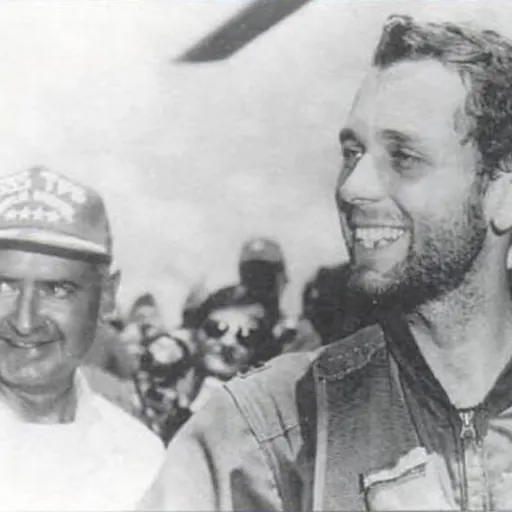
About Roger Locher
Born 1946. Roger Locher is an American military officer.
Maj. Robert Lodge (left) and Capt. Roger Locher (right) in the cockpit of F-4D 65–0784, seen earlier in 1972: the team already had two MiG-kills to their credit when they clashed with MiG-19s and MiG-21s on the morning of May 10, 1972.
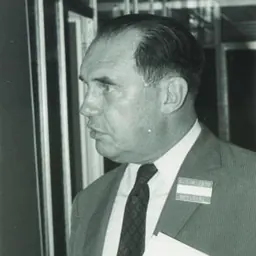
Roger Clinton Locher (born September 13, 1946) is a retired Colonel in the U.S. Air Force and a former McDonnell Douglas F-4D Phantom II Navigator/Weapon Systems Officer (WSO) and subsequent Pilot who, during Operation Linebacker in the Vietnam War, was shot down only from Hanoi, North Vietnam. The 23 days Locher spent behind enemy lines evading capture was a record for downed airmen during the war. He was one of the leading MiG killers in Vietnam with three aerial victories. No one saw him eject or his parachute open, and it was unknown whether he had died or been captured. Over the next two weeks, U.S. air crews in the area tried to raise him on UHF radio without success. The North Vietnamese did not add his name to the roster of captured airmen, which gave the Americans some hope. Traveling only at dusk and dawn, over three weeks Locher traveled about , evading farmers and living off the land.
On June 1, Locher was finally able to successfully contact a flight of F-4 aircraft overhead. Vogt committed to rescue him and canceled the scheduled attack on Hanoi that day, diverting all of the available aircraft to assist in his rescue.
MiGCAP patrol On February 21, 1972, Locher took part in the first U.S. Air Force aerial victory in four years at night over northeast Laos, about southwest of Hanoi. Major Robert A. Lodge was pilot and Locher was the weapon systems officer in an F-4D flying combat air patrol to interdict Vietnam People's Air Force (VPAF) MiGs (MIGCAP). The two men were the most experienced crew in Southeast Asia. Red Crown, the call sign for the radar-equipped stationed in the northern part of the Gulf of Tonkin, "called out bandits (MIGs) at our 060° position and proceeded to vector us on an intercept," recalled Lodge. During the air battle, they shot down a MiG-21.
Operation Linebacker 555th TFS F-4D Phantom II 65–0784, the aircraft flown by Locher the day he was shot down.
On May 8, 1972, Lodge and Locher responded to a request for assistance from Red Crown for fighters who were engaging MiGs near Yên Bái. Their element leader was Captain Stephen Ritchie and his WSO, Captain Charles B. DeBellevue.
They scored their second MiG kill, placing them in the lead of all USAF crews then flying in Southeast Asia.
On May 10, 1972, the first major day of air combat in Operation Linebacker, Locher's group was one of two flights of the F-4D MiGCap for the morning strike force. Oyster Flight, composed of four F-4s from the 555th Tactical Fighter Squadron, had three of its Phantoms equipped with the top secret Combat Tree Identification friend or foe (IFF) interrogators. The APX-80 electronic set could read the IFF signals of the transponders built into the MiGs so that North Vietnamese radar would not shoot down their own aircraft. Displayed on a scope in the WSO's cockpit, Combat Tree gave the Phantoms the ability to identify and locate MiGs when they were still beyond visual range. At 09:23, Oyster Flight was warned by EC-121 Disco over Laos, and then by the US Navy radar picket ship, the guided missile cruiser , call sign Red Crown, of four MiGs headed towards them. These were from the 921st Fighter Regiment. Four J-6s were also flying combat air patrol to protect the Thac Ba hydroelectric power station. in which a ground-controlled flight of four Shenyang J-6s were launched after the MiG-21s so that they could be steered behind the American fighters maneuvering to attack the MiG-21s. Pilot Nguyen Manh Tung of No. 2 Flight came up from below in his J-6 and hit Lodge and Locher's F-4D, Serial Number 65-0784, with his three large, 30 mm cannons as they were lining up a second shot on another MiG-21. Markle and Eaves were behind the J-6s but were unable to lock on to them before Lodge and Locher were hit.
Ejection and evasion
Locher reported later that the aircraft went into a kind of right slice. He noted that the right engine's RPM was at zero and the left was decreasing towards idle. It looked to him that the right engine had exploded. Lodge and Locher discussed their options. They saw that the hydraulic pressure was low and falling. When Lodge tried the autopilot, it didn't respond. The rear of the jet was on fire, and as the plane yawed the slipstream pushed the flames up over Locher's canopy. Locher later recalled, "We immediately went out of control, flopping from side to side. Then fire started coming in the back of the cockpit. It seared my canopy with bubbles and I couldn't see out any more. The airplane slowed down and was approaching a flat spin." Passing through 8000 MSL, Locher told Lodge that it was getting too hot and he'd better get out. Lodge looked over his right shoulder at Locher and said, "Well, why don't you eject then?" Locher successfully ejected at about but because the remaining planes were busy with the other MiGs, and due to smoke, no one saw his parachute canopy. He estimated it took about 30 seconds for the jet to impact the ground, but never saw Lodge's chute.
He was able to find plenty of water but only occasionally fruit and berries to eat. He evaded capture and covered over , gradually losing and his strength. Ritchie, in one of the F-4 aircraft overhead and who had witnessed Locher's jet fall out of the sky, remembered Locher's call sign and answered his call. Locher calmly responded, "Guys I've been down here a long time, any chance of picking me up?" Ritchie replied, "You bet!" Locher's transmissions left some Americans who did not hear his call in doubt about the authenticity of his message, and they believed that the People's Army of Vietnam may have manipulated a POW into impersonating him, setting a trap for the would-be rescuers.
On June 2, 1972, General John Vogt, commander of the 7th Air Force, consulted with Army MACV commander General Frederick C. Weyand. Vogt canceled the entire strike mission set for Hanoi that day. He dedicated all the available resources, over 150 aircraft, to rescuing Locher. bombers and an array of F-4 escorts, EB-66s, A-1Hs, F-105G Wild Weasels, and KC-135 tankers.
The Yên Bái air base, about northwest of Hanoi, was one of the most important and well-defended airbases in North Vietnam. The aircraft bombed and strafed around Yên Bái air base for two hours, reducing enemy opposition so that the helicopters could get in. Fortunately for the Americans, during the second half of May 1972 their increasingly fierce attacks on Yen Bai had forced elements of the VPAF 925th Fighter Regiment to relocate to Gia Lam Airfield. Locher's flare went unseen, and Stovall overflew his position and had to double back. Spotting the flash from Locher's signal mirror, Stovall hovered over the steep slope, rotors dangerously close to the trees, and lowered a jungle penetrator under enemy fire. Locher had successfully evaded capture for 23 days, a record for the war.
Recognition Stovall had twice flown his HH-53C further into North Vietnam than had ever been done before. Stovall was also recognized with the 1973 Jabara Award for Airmanship.
Post war After his return to the United States, he attended undergraduate pilot training and was eventually assigned to fly the Phantom again—this time in the front seat. He flew the F-4 in New Mexico, Alaska and Florida before transitioning to the F-16 and serving in instructor and flight commander positions.
Retiring from the U.S. Air Force in the rank of colonel in 1998, Locher retired in Sabetha, Kansas, where he resided as of February, 2025.
In popular culture The TV series Dogfights on the History Channel depicted the dogfight of May 10, 1972 in Season 2, Episode 10, The Bloodiest Day shown on December 3, 2007. His rescue was once again referenced in the episode Supersonic.
Don’t just read it —
keep it.
Full-length biographies made to live with: read them, listen on the way to work, watch them tonight.
- E-book
- Audio
- Video
Instant download · yours to keep · every purchase keeps this site free
Important facts
People in Roger Locher's life
Named in this biography and alive at the same time


Related people
Same field, nearest in time


Contemporaries
People whose lives overlapped Roger Locher's




Frequently asked questions
Who is Roger Locher?
USAF officer
When was Roger Locher born?
Roger Locher was born on 13 September 1946 in Sabetha.
What is Roger Locher's occupation?
Roger Locher is a military officer.
What nationality is Roger Locher?
Roger Locher is American.
Sources & further reading
Cite this page
APA: Biography.guide. (2026). Roger Locher. https://biography.guide/roger-locher/
MLA: "Roger Locher." Biography.guide, https://biography.guide/roger-locher/.
Chicago: "Roger Locher." Biography.guide. https://biography.guide/roger-locher/.
Data last updated: 2026-09-21 · Spot an error? Report a correction.
Portrait: Wikimedia Commons · author & licence
Page generated 2026-09-27 04:59 UTC