
Roger Jourdain
Ojibwe civic leader
About Roger Jourdain
Lived 1912 – 2002 (aged 89).
Roger Jourdain (July 27, 1912 – March 21, 2002) was an Ojibwe civic leader who served as chairman of the Red Lake Band of Chippewa from 1959 to 1990. Jourdain is credited with protecting Red Lake's extensive tribal sovereignty and improving tribal infrastructure during his tenure in office.
Early life
Jourdain was born on July 27, 1912. He received an eighth-grade education and worked as a machine operator, participating in the construction of the Alaska Highway and the regional airport in Bemidji, Minnesota. Additionally, Jourdain was a leading member of the "Young Man's Council", a group of Red Lake citizens desirous of governmental reform. A revised constitution supported by the Young Man's Council resulted in the replacement of Red Lake's traditionally-selected governing body by an elected tribal council, of which Jourdain was elected chair in 1959.
Chairmanship
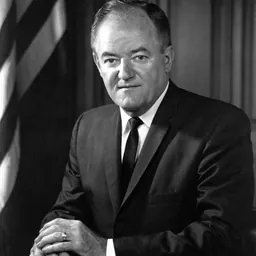
Following his election as chairman, Jourdain undertook a number of projects aimed at improving Red Lake's infrastructure. Shortly after taking office, he reopened the closed Indian Health Service hospital in the town of Red Lake and worked successfully to bring running water to the reservation. Additionally, Jourdain formed a political alliance with U.S. Senator Hubert Humphrey, subsequently changing his initial Republican political affiliation to Democratic. In 1976, Jourdain served as a delegate to the 1976 Democratic National Convention and in the Electoral College; he reprised the former role in 1984.
Jourdain worked closely with other tribes, initiating a 1967 intertribal boycott of businesses in Bemidji, Minnesota, which contains a significant Native American population. The boycott was prompted by racist comments made by a county commissioner on a Bemidji radio station. On May 19, 1979, six armed supporters of Hanson seized the Red Lake law enforcement facility and took hostages, prompting the FBI to remove Red Lake police from the reservation. Following this action, a riot erupted on the reservation during which Jourdain's home and several government facilities were burned; two teenagers died during the unrest, and damages sustained totaled $4 million. Following the civil unrest, Jourdain moved to Bemidji, where he resided for the remainder of his tenure as tribal chairman. Complaints persisted against Jourdain's administration throughout the 1980s; its handling of criminal defendants in Red Lake's tribal court was criticized as heavy-handed. He died on March 21, 2002, at North Regional Hospital in Bemidji, at the age of 89. He was preceded in death by his wife, Margaret, to whom he was married for 60 years.
Don’t just read it —
keep it.
Full-length biographies made to live with: read them, listen on the way to work, watch them tonight.
- E-book
- Audio
- Video
Instant download · yours to keep · every purchase keeps this site free
Important facts
People in Roger Jourdain's life
Named in this biography and alive at the same time
Contemporaries
People whose lives overlapped Roger Jourdain's






Frequently asked questions
Who was Roger Jourdain?
Ojibwe civic leader (1912-2002)
When was Roger Jourdain born?
Roger Jourdain was born on 27 July 1912.
When did Roger Jourdain die?
Roger Jourdain died on 21 March 2002.
Sources & further reading
Cite this page
APA: Biography.guide. (2026). Roger Jourdain. https://biography.guide/roger-jourdain/
MLA: "Roger Jourdain." Biography.guide, https://biography.guide/roger-jourdain/.
Chicago: "Roger Jourdain." Biography.guide. https://biography.guide/roger-jourdain/.
Data last updated: 2026-09-20 · Spot an error? Report a correction.
Page generated 2026-09-27 04:59 UTC