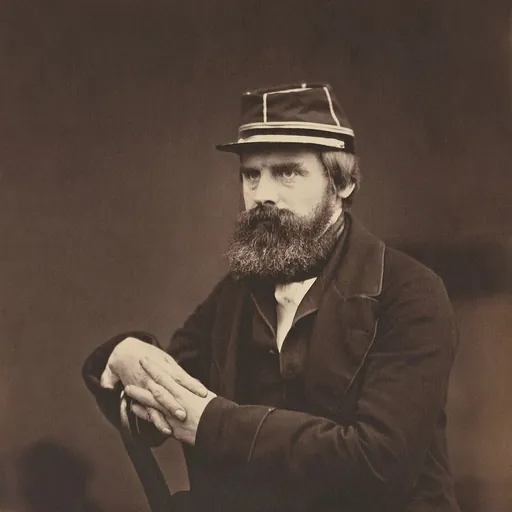
About Roger Fenton
Lived 1819 – 1869 (aged 50). Roger Fenton was a British photographer, journalist, war photographer and photojournalist.
Roger Fenton (28 March 1819 – 8 August 1869) was an English photographer, noted as one of the first war photographers.
Fenton was born into a Lancashire merchant family. After graduating from London with an arts degree, he became interested in painting. After seeing examples of the new technology of photography at the Great Exhibition in 1851, he became keenly interested in this new technique. Within a year, he began exhibiting his own photographs.
He became a leading British photographer and was instrumental in founding the Photographic Society (later the Royal Photographic Society). In 1854, he was commissioned to document events occurring in Crimea, where he became one of a small group of photographers to produce images of the final stages of the Crimean War.
Early life Fenton was born in Crimble Hall, Heywood, Lancashire, on 28 March 1819. His grandfather was a wealthy cotton manufacturer and banker, whilst his father, John, was a banker and from 1832 a member of parliament.
In 1840 Fenton graduated with a "first class" Bachelor of Arts degree from the University of London,
Queen Victoria commissioned Fenton to produce a series of royal portraits in 1854. As well as formal studio portraits, he made informal tableaux vivants of the queen at Balmoral, Windsor Castle and Buckingham Palace.
Crimean War
Marcus Sparling seated on Fenton's photographic van, Crimea, 1855. It is likely that in autumn 1854, as the Crimean War grabbed the attention of the British public, that some powerful friends and patrons – among them Prince Albert and Duke of Newcastle, Secretary of State for War – urged Fenton to go to the Crimea to record events. The London print publisher Thomas Agnew & Sons became his commercial sponsor.
Amongst Fenton's photographic subjects from this period are the City of Westminster, including The Palace of Westminster nearing completion in 1857. His are almost certainly the earliest images of the building, and the only photographs showing the incomplete Clock Tower.
Later life
In 1858 Fenton made studio genre studies based on romantically imaginative ideas of Muslim life, such as Seated Odalisque, using friends and models who were not always convincing in their roles. Although he became well known for his Crimean War photography, his photographic career lasted little more than a decade. In 1862 he sold his equipment and abandoned the profession entirely, returning to the practice of law as a barrister. In 2005, 90 of Fenton's images were included in a special exhibition devoted to this "most important nineteenth-century photographer" at the Tate Britain gallery, London. In 2007, Fenton was inducted into the International Photography Hall of Fame and Museum.
Don’t just read it —
keep it.
Full-length biographies made to live with: read them, listen on the way to work, watch them tonight.
- E-book
- Audio
- Video
Instant download · yours to keep · every purchase keeps this site free
Important facts
People in Roger Fenton's life
Named in this biography and alive at the same time

Related people
Same field, nearest in time


Contemporaries
People whose lives overlapped Roger Fenton's




Frequently asked questions
Who was Roger Fenton?
British photographer (1819–1869)
When was Roger Fenton born?
Roger Fenton was born on 28 March 1819 in Heywood, Crimble Hall, Heywood.
When did Roger Fenton die?
Roger Fenton died on 8 August 1869 in London.
What was Roger Fenton's occupation?
Roger Fenton was a photographer, journalist, war photographer and photojournalist.
What nationality was Roger Fenton?
Roger Fenton was British.
Sources & further reading
Cite this page
APA: Biography.guide. (2026). Roger Fenton. https://biography.guide/roger-fenton/
MLA: "Roger Fenton." Biography.guide, https://biography.guide/roger-fenton/.
Chicago: "Roger Fenton." Biography.guide. https://biography.guide/roger-fenton/.
Data last updated: 2026-09-20 · Spot an error? Report a correction.
Page generated 2026-09-27 05:10 UTC