
About Roel Wouters
Born 1978. Roel Wouters is a Dutch video artist and graphic designer.
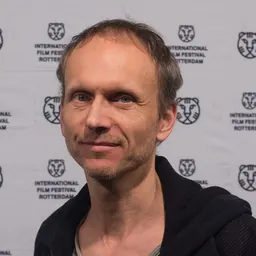
Roel Wouters (born 20 February 1976 in Haarlem, Netherlands) is a Dutch artist, designer, director, and educator based in Amsterdam. His work focuses on the cultural and social impact of digital technology, often employing participatory and rule-based design methods. His practice spans interactive installations, digital works, games, music videos, films, publications, and performances, and has been presented internationally by museums, film festivals, and cultural institutions. He is co-founder of Moniker, an award-winning, experimental design studio in Amsterdam (2012–2023) researching the social effects of technology. Wouters is the co-host of the Great Intentions podcast with Jonas Lund.
Education Wouters studied graphic design at the Royal Academy of Art, The Hague and later completed a Master of Fine Arts degree at the Sandberg Institute in Amsterdam. Wouters’ work examines how digital systems influence human behavior, communication, and perception. Rather than producing fixed outcomes, many of his projects are conceived as open systems that evolve through audience participation.
Career His practice operates at the intersection of graphic design, interaction design, film, and contemporary art. He has taught media courses at the Gerrit Rietveld Academy, the Sandberg Institute, Royal Academy of Art, The Hague, Piet Zwart Institute, Rotterdam. (HfG) Karlsruhe and at Yale University School of Art. He gives workshops and lectures at universities, symposia and international art festivals.
Conditional Design Manifesto (2008)
Wouters is a co-author of Conditional Design Manifesto, alongside Luna Maurer, Jonathan Puckey, and Edo Paulus proposing an approach to design in which creators define rules, constraints, and conditions rather than directly shaping final outcomes. Within this framework, the role of the designer shifts from authoring finished objects to constructing systems in which results emerge through interaction, chance, and collaboration. They proposed Conditional Design as a response to traditional, linear design methods.
In design education, Conditional Design is employed to teach concepts such as systems thinking, collaboration, and the creative possibilities that arise from constraints. By working within rule-based frameworks, students explore how small changes in conditions can lead to significantly different outcomes, fostering critical reflection on authorship, process, and decision-making.
The focus on collective production further encourages peer learning and constructive critique within classroom and workshop environments.
The methodology has been disseminated through the Conditional Design Workbook, which presents the manifesto alongside documented workshops and practical exercises. The publication is designed as a “do-book,” enabling educators, designers, and students to apply Conditional Design principles directly in studio, academic, and community-based environments. The workbook's structure allows exercises to be reused and adapted, reinforcing its role as both a pedagogical tool and a theoretical framework. The principles of Conditional Design were documented in the Conditional Design Workbook (2013), published by Valiz.
Designing Friction
Together with Luna Maurer Wouters wrote Designing Friction, an online manifesto advocating for the intentional incorporation of friction in digital products.
Selected works
zZz is playing: Grip (2007) A one-take, locked off, top shot music video for the band zZz, recorded live, as part of the opening of Nederclips, a show celebrating Dutch music video culture at the Stedelijk Museum in 's-Hertogenbosch in 2007. Nominee at the 2008 Dutch Design Awards and winner of awards at Festival du Clip, France and Playgrounds Festival, Tilburg.
Do Not Touch (2013) An interactive, crowd-sourced music video for the track “Kilo” by the Dutch band Light Light .The project transforms participants’ computer pointer movements into a shared visual composition, collecting and layering cursors from successive users within a single interface. The work reflects on the cultural role of the computer pointer as a long-standing interface between user and machine, foregrounding it at a time when touch-based interaction was becoming dominant. Participants are prompted to complete simple tasks and respond to questions while their enlarged cursors are recorded and combined with those of earlier users, creating a cumulative, collective performance. The project has been discussed in independent design and culture publications for its participatory approach and commentary on digital interaction and won a Dutch Design Award in 2013
Clickclickclick.click (2016) An interactive browser-based artwork co-produced by VPRO Medialab that examines online surveillance, data profiling, and behavioral monetization. Visitors encounter a minimal interface featuring a single interactive element; once interaction begins, every mouse movement and click is measured, recorded, and evaluated. As users navigate the site, written observations and a narrated voice respond to their behavior, drawing speculative and often exaggerated conclusions by comparing their actions to those of previous participants. By combining quantitative tracking with subjective interpretation, the project foregrounds how seemingly insignificant online actions can be monitored, categorized, and judged within data-driven systems. The work has been widely discussed in international media for its critical and humorous commentary on digital surveillance and user profiling. premiered at IDFA DocLab.
Do Not Draw a Penis (2018) Automated moderation artwork commissioned by the Mozilla Foundation and presented at Haus der Kulturen der Welt, Berlin.
Do Not Draw a Penis (2018) – An automated moderation artwork developed by Roel Wouters with Moniker that critically examines algorithmic content moderation and moral norms embedded in large-scale digital platforms. The project responds to the release of Google's Quick, Draw! dataset, an open-source collection of more than 15 million user-generated drawings across hundreds of categories, from which certain subjects were deliberately excluded. Do Not Draw a Penis functions as an agent that invites participants to submit drawings that fall outside the moderation guidelines commonly enforced by major technology and social media platforms. These drawings are collected and formatted to match the structure of Google's dataset, thereby foregrounding how cultural and moral boundaries are encoded in data-driven systems and widely accepted by users. At the time of publication, the project had collected approximately 10,000 drawings, which were made publicly available through an open online repository. The project was presented in Haus der Kulturen der Welt, Berlin.
Touch for Luck (2020) Multiplayer interactive game commissioned by M+ Museum for Visual Culture, Hong Kong. A virtual pond got projected on the M+ Facade from 27 January to 17 April 2022 and 13 January to 5 February 2023. The pond of fish connected to the phones of the players and allowed them to join up with others who were touching their own screens simultaneously.
Emoji Is All We Have (2023) Emoji is all we have is a film in four parts revolving around the relationship between humans and machines. Does digitalisation manoeuvre us towards a more rational, frictionless and optimised world? Do emoji have the potential to represent our emotions? Can one still be a tech optimist? Screened in media-art contexts including programs associated with Het Nieuwe Instituut.
Deep Soup (2025) Participatory short sci-fi film featuring Hugo Hamlet about the rise of a new intelligence, Deep Soup, learning from matter, not from data. Selected for the IDFA DocLab Competition for Digital Storytelling; listed on IMDb.
Don’t just read it —
keep it.
Full-length biographies made to live with: read them, listen on the way to work, watch them tonight.
- E-book
- Audio
- Video
Instant download · yours to keep · every purchase keeps this site free
Important facts
People in Roel Wouters's life
Named in this biography and alive at the same time
Related people
Same field, nearest in time



Contemporaries
People whose lives overlapped Roel Wouters's




Frequently asked questions
Who is Roel Wouters?
Dutch media artist (born 1978)
When was Roel Wouters born?
Roel Wouters was born in 1978 in Haarlem.
What is Roel Wouters's occupation?
Roel Wouters is a video artist and graphic designer.
What nationality is Roel Wouters?
Roel Wouters is Dutch.
Sources & further reading
Cite this page
APA: Biography.guide. (2026). Roel Wouters. https://biography.guide/roel-wouters/
MLA: "Roel Wouters." Biography.guide, https://biography.guide/roel-wouters/.
Chicago: "Roel Wouters." Biography.guide. https://biography.guide/roel-wouters/.
Data last updated: 2026-09-20 · Spot an error? Report a correction.
Page generated 2026-09-27 05:09 UTC