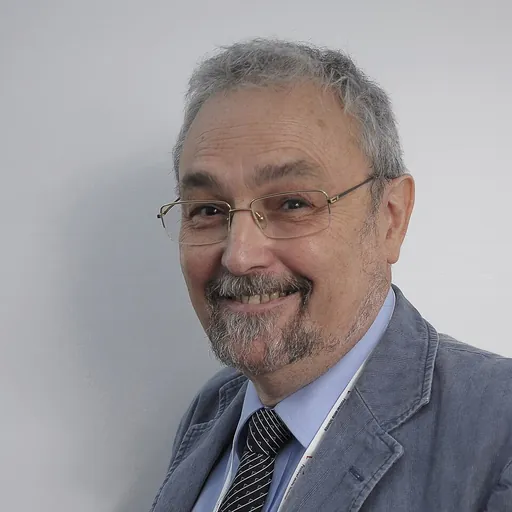
About Robin Dunbar
Born 1947. Robin Dunbar is a British biologist, anthropologist, linguist, university teacher, psychologist and academic, known for Dunbar's number and Gelada.
Education The son of an engineer, Dunbar was privately educated at Magdalen College School, Brackley. He went on to study at the University of Oxford as an undergraduate student at Magdalen College, Oxford,
Career and Research Dunbar spent two years as a freelance science writer.
Dunbar's career includes appointments at the University of Bristol, University of Cambridge from 1977 until 1982, and University College London from 1987 until 1994. In 1994, Dunbar became Professor of Evolutionary Psychology at the University of Liverpool, but left Liverpool in 2007, to take up the post of Director of the Institute of Cognitive and Evolutionary Anthropology at the University of Oxford. In 2012, Dunbar migrated over to the Department of Experimental Psychology at the University of Oxford, after receiving a competitive research grant from the European Research Council. His former postdoctoral students include Anna Machin.
Dunbar was formerly co-director of the British Academy Centenary Research Project (BACRP) "From Lucy to Language: The Archaeology of the Social Brain" and was involved in the BACRP "Identifying the Universal Religious Repertoire".
Digital versions of selected published articles authored or co-authored by him are available from the University of Liverpool Evolutionary Psychology and Behavioural Ecology Research Group.
In 2015, Dunbar was awarded the Huxley Memorial Medal—established in 1900 in memory of Thomas Henry Huxley—for services to anthropology by the council of the Royal Anthropological Institute of Great Britain and Ireland, the highest honour at the disposal of the RAI. Dunbar is also a Humanists UK Distinguished Supporter of Humanism.
Awards and honours 2026, International Cosmos Prize, Expo '90 Foundation, Japan 2019, Human Roots Award, MONREPOS 2015, Huxley Memorial Medal, Royal Anthropological Institute of Great Britain and Ireland 1998, Elected Fellow of the British Academy (FBA)
In popular culture Dunbar's work is mentioned in The Big Bang Theory, Season 4, Episode 20 ("The Herb Garden Germination"), when Amy Farrah Fowler is talking with Sheldon Cooper while listening to a lecture by Brian Greene (2011).
Dunbar is a featured character in the adaptation of Yuval Noah Harari's book Sapiens: A Brief History of Humankind into graphic novel (2020).
Dunbar's work is described in the epilogue of Blake Crouch's novel Upgrade (2022).
Published books Dunbar. 1984. Reproductive Decisions: An Economic Analysis of Gelada Baboon Social Strategies. Princeton University Press Dunbar. 1987. Demography and Reproduction. In Primate Societies. Smuts, B.B., Cheney, D.L., Seyfarth, R.M., Wrangham, R.W., Struhsaker, T.T. (eds). Chicago & London:University of Chicago Press. pp. 240–249 Dunbar. 1988. Primate Social Systems. Chapman Hall and Yale University Press Foley, Robert & Dunbar, Robin (14 October 1989). "Beyond the bones of contention". New Scientist Vol.124 (No.1686) pp. 21–25. Dunbar. 1996. The Trouble with Science. Harvard University Press. Dunbar (ed.). 1995. Human Reproductive Decisions. Macmillan Dunbar. 1997. Grooming, Gossip and the Evolution of Language. Harvard University Press. Runciman, Maynard Smith, & Dunbar (eds.). 1997. Evolution of Culture and Language in Primates and Humans. Oxford University Press. Dunbar, Knight, & Power (eds.). 1999. The Evolution of Culture. Edinburgh University Press Dunbar & Barrett. 2000. Cousins. BBC Worldwide: London Cowlishaw & Dunbar. 2000. Primate Conservation Biology. University of Chicago Press Barrett, Dunbar & Lycett. 2002. Human Evolutionary Psychology. London: Palgrave Dunbar, Barrett & Lycett. 2005. Evolutionary Psychology, a Beginner's Guide. Oxford: One World Books Dunbar. 2004. The Human Story. London: Faber and Faber Dunbar. 2010. How Many Friends Does One Person Need?: Dunbar's Number and Other Evolutionary Quirks. London: Faber & Faber (paper) Dunbar. 2014. Human Evolution. Pelican Books Dunbar. 2016. Human Evolution: Our Brains and Behavior (Illustrated) Dunbar. 2021. Friends: Understanding the Power of our Most Important Relationships. Little, Brown and Company Dunbar. 2022. How Religion Evolved: And Why It Endures. Pelican Books Camilleri, Rockey & Dunbar. 2023. The Social Brain: The Psychology of Successful Groups London: Penguin
Papers Dunbar (2020): "Structure and function in human and primate social networks: Implications for diffusion, network stability and health". Proceedings of the Royal Society A 476.2240 (2020): 20200446. Dunbar & Susanne Shultz (2023): "Four errors and a fallacy: pitfalls for the unwary in comparative brain analyses". Biological Reviews 98.4 (2023): 1278–1309. Dunbar (2024): "The social brain hypothesis–thirty years on". Annals of Human Biology 51.1 (2024): 2359920.
Don’t just read it —
keep it.
Full-length biographies made to live with: read them, listen on the way to work, watch them tonight.
- E-book
- Audio
- Video
Instant download · yours to keep · every purchase keeps this site free
Important facts
People in Robin Dunbar's life
Named in this biography and alive at the same time



Related people
Same field, nearest in time

Contemporaries
People whose lives overlapped Robin Dunbar's




Frequently asked questions
Who is Robin Dunbar?
British evolutionary psychologist (1947-)
When was Robin Dunbar born?
Robin Dunbar was born on 28 June 1947 in Liverpool.
What is Robin Dunbar's occupation?
Robin Dunbar is a biologist, anthropologist, linguist, university teacher, psychologist and academic.
What is Robin Dunbar known for?
Robin Dunbar is known for Dunbar's number and Gelada.
What nationality is Robin Dunbar?
Robin Dunbar is British.
Sources & further reading
Cite this page
APA: Biography.guide. (2026). Robin Dunbar. https://biography.guide/robin-dunbar/
MLA: "Robin Dunbar." Biography.guide, https://biography.guide/robin-dunbar/.
Chicago: "Robin Dunbar." Biography.guide. https://biography.guide/robin-dunbar/.
Data last updated: 2026-09-22 · Spot an error? Report a correction.
Portrait: Wikimedia Commons · author & licence
Page generated 2026-09-27 05:04 UTC