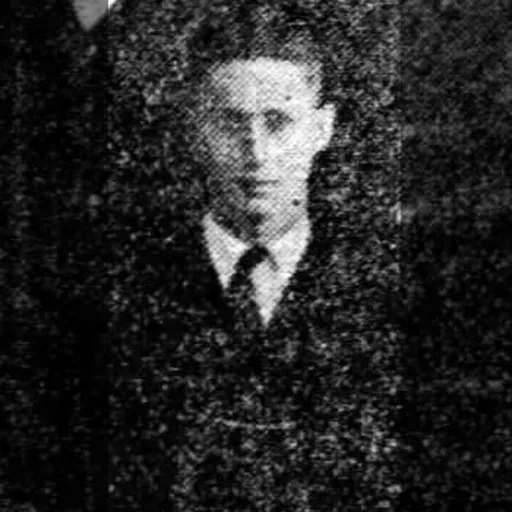
About Robert Schmertz
Lived 1898 – 1975 (aged 77). Robert Schmertz was an American architect and musician.
Robert Watson Schmertz (March 4, 1898 – June 7, 1975) was a Pittsburgh-based architect and folk musician whose music has been covered by Pete Seeger, Burl Ives, Tennessee Ernie Ford, Bill and Gloria Gaither, The Statler Brothers, The Cathedrals, Dailey & Vincent, the River City Brass Band, and Ernie Haase & Signature Sound. Born in Squirrel Hill, Pittsburgh, Pennsylvania, Schmertz attended the Carnegie Institute of Technology, where he wrote the Carnegie Tartans' fight song, "Fight for the Glory of Carnegie," and played the banjo in a jazz orchestra; after he graduated with an architecture degree in 1921, Schmertz designed buildings. He taught at Carnegie for more than thirty-five years before his retirement.
As a folk musician, Schmertz released four albums, with his third, Sing Oh! The City Oh!: Songs of Early Pittsburgh, in commemoration of the 200th anniversary of Pittsburgh's founding; a reviewer for Keystone Folklore Quarterly called it "tuneful and well-done in the folk tradition". Before his death, Schmertz completed a book of his songs, but died before it published. Ten days after he suffered a stroke, Schmertz died on June 7, 1975.
Early life Schmertz was born on March 4, 1898, in Squirrel Hill, Pittsburgh, Pennsylvania. After he completed studies at Peabody High School, where he met his future wife, Mildred,
At Carnegie, Schmertz wrote the Carnegie Tartans' fight song, "Fight for the Glory of Carnegie", wrote college musicals, led a dance band, played the banjo in a jazz orchestra, and worked on the Carnegie yearbook staff. In 1921, he graduated with a degree in architecture. Three years later, Schmertz served on a Pittsburgh-based American Institute of Architects executive committee that sought to identify western Pennsylvanian buildings constructed before 1860. Schmertz worked as a member of Fisher and Schmertz, and, later, headed the firm of Schmertz, Erwin and Associates. after his friends bought him studio time. Schmertz's second studio album, Robert Schmertz Sings His Songs, was released in 1955: from the album, Burl Ives covered "Angus McFergus McTavish Dundee" on the Captain Kangaroo show. In 1958, composer Elie Seigmeister and lyricist Edward Mabley cited Schmertz's "Monongahela Sal" and "Lock No. Ten" as inspiration for The Mermaid in Lock No. 7, a musical "in the folk idiom, expanded by modern, sophisticated treatment" that debuted at the American Wind Symphony Orchestra.
Schmertz's third album, Sing Oh! the City Oh!: Songs of Early Pittsburgh, released on Folkways Records in 1959, featured folk songs, such as "Celeron", named after Pierre Joseph Céloron de Blainville, and "The Battle of Bushy Run", after the battle of the same name, in commemoration of the bicentennial of Pittsburgh's founding. A reviewer for Keystone Folklore Quarterly described the album, to which two of his children, Gretchen Schmertz Jacob and John Schmertz, contributed, Schmertz released his final album, Ladies Beware of an Architect: Songs for Architects and Their Girlfriends, in 1960.
Schmertz's music has been covered by Pete Seeger, who called Schmertz a "very good songwriter", Burl Ives, Tennessee Ernie Ford,
Later life In 1970, Schmertz retired from his position at Schmertz, Erwin and Associates. Schmertz had four children: Gretchen Schmertz Jacob, John, Jack, and Mildred.
Before his death, Schmertz compiled a book on his songs, though he died before it published. Ten days prior to his death, Schmertz sustained a stroke, and, on June 7, 1975, died after a long illness.
Don’t just read it —
keep it.
Full-length biographies made to live with: read them, listen on the way to work, watch them tonight.
- E-book
- Audio
- Video
Instant download · yours to keep · every purchase keeps this site free
Important facts
People in Robert Schmertz's life
Named in this biography and alive at the same time






Related people
Same field, nearest in time


Contemporaries
People whose lives overlapped Robert Schmertz's


Frequently asked questions
Who was Robert Schmertz?
American architect and musician (1898-1975)
When was Robert Schmertz born?
Robert Schmertz was born on 4 March 1898 in Squirrel Hill.
When did Robert Schmertz die?
Robert Schmertz died on 7 June 1975.
What was Robert Schmertz's occupation?
Robert Schmertz was an architect and musician.
What nationality was Robert Schmertz?
Robert Schmertz was American.
Sources & further reading
· DBpedia: Robert Schmertz (artist)
Cite this page
APA: Biography.guide. (2026). Robert Schmertz. https://biography.guide/robert-schmertz/
MLA: "Robert Schmertz." Biography.guide, https://biography.guide/robert-schmertz/.
Chicago: "Robert Schmertz." Biography.guide. https://biography.guide/robert-schmertz/.
Data last updated: 2026-09-22 · Spot an error? Report a correction.
Portrait: Wikimedia Commons · author & licence
Page generated 2026-09-27 04:58 UTC