
About Robert le Coq
Lived 1310 – 1373 (aged 62–63). Robert le Coq was a French catholic priest.
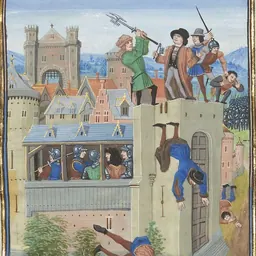
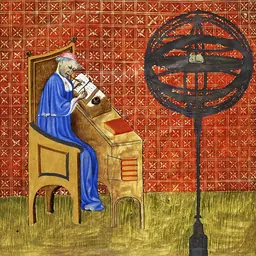
Robert Le Coq, bishop of Laon, accusing the king's officers. From the 14th century Grandes Chroniques de France. Robert le Coq (died 1373) was a French bishop and councillor.
Le Coq was born in Montdidier. He belonged to a bourgeois family of Orléans, where he first attended school before coming to Paris. In Paris he became advocate to the parlement (1347); then John II appointed him master of requests, and in 1351, a year during which he received many other honors, he became bishop of Laon. At the opening of 1354 he was sent with the cardinal of Boulogne, Peter I, Duke of Bourbon, and Jean VI, count of Vendôme, to Mantes to treat with Charles the Bad, king of Navarre, who had caused the constable, Charles d'Espagne, to be assassinated, and from this time dates his connection with this king.
At the meeting of the estates which opened in Paris in October 1356 le Coq played a leading role and was one of the most outspoken of the orators, especially when petitions were presented to the dauphin Charles, denouncing the bad government of the realm and demanding the banishment of the royal councillors. Soon, however, the credit of the estates having gone down, he withdrew to his diocese, but at the request of the bourgeois of Paris he speedily returned. The king of Navarre had succeeded in escaping from prison and had entered Paris, where his party was in the ascendant; and Robert le Coq became the most powerful person in his council. No one dared to contradict him, and he brought into it whom he pleased. He did not scruple to reveal to the king of Navarre secret deliberations, but his fortune soon turned. He ran great danger at the estates of Compiègne in May 1358, where his dismissal was demanded, and he had to flee to Saint-Denis, where Charles the Bad and Étienne Marcel came to find him. After the death of Marcel, he tried, unsuccessfully, to deliver Laon, his episcopal town, to the king of Navarre, and he was excluded from the amnesty promised in the treaty of Calais (1360) by King John to the partisans of Charles the Bad. His temporalities had been seized, and he was obliged to flee from France. In 1363, thanks to the support of the king of Navarre, he was given the bishopric of Calahorra in the kingdom of Aragon, which he administered until his death in 1373.
Don’t just read it —
keep it.
Full-length biographies made to live with: read them, listen on the way to work, watch them tonight.
- E-book
- Audio
- Video
Instant download · yours to keep · every purchase keeps this site free
Important facts
People in Robert le Coq's life
Named in this biography and alive at the same time

Related people
Same field, nearest in time



Contemporaries
People whose lives overlapped Robert le Coq's

Frequently asked questions
Who was Robert le Coq?
French bishop
When was Robert le Coq born?
Robert le Coq was born in 1310 in Montdidier.
When did Robert le Coq die?
Robert le Coq died on 12 September 1373 in Estella-Lizarra.
What was Robert le Coq's occupation?
Robert le Coq was a catholic priest.
What nationality was Robert le Coq?
Robert le Coq was French.
Sources & further reading
Cite this page
APA: Biography.guide. (2026). Robert le Coq. https://biography.guide/robert-le-coq/
MLA: "Robert le Coq." Biography.guide, https://biography.guide/robert-le-coq/.
Chicago: "Robert le Coq." Biography.guide. https://biography.guide/robert-le-coq/.
Data last updated: 2026-09-27 · Spot an error? Report a correction.
Page generated 2026-09-27 05:16 UTC