About Étienne Marcel
Lived 1315 – 1358 (aged 42–43). Étienne Marcel was a French merchant and politician.
Étienne Marcel (between 1302 and 131031 July 1358) was provost of the merchants of Paris under King John II of France, called John the Good (Jean le Bon). He distinguished himself in the defence of the small craftsmen and guildsmen who made up most of the city population.
As a delegate of the Third Estate, he played an important role in the general assemblies held during the Hundred Years' War. In 1357, he found himself at the head of a movement that tried to establish a reformed French monarchy, restraining the royal power and improving decision making. During the Jacquerie peasant rebellion, he supported King Charles II of Navarre over the Dauphin Charles. He was killed while trying to open the gates of the capital to the army of mercenaries who were allied with Charles, King of Navarre.
Context: The crisis of feudal society In 14th century France, the feudal system was in crisis because the nobility and clergy were no longer seen as fulfilling their assigned roles. They nevertheless imposed great costs that were borne mainly by the commoners. Increased taxationlinked to the costs and economic impacts of the Hundred Years’ War and of the Black Plagueimpoverished many parts of French society and fed growing protests from the bourgeoisie. In order to avoid imposing increasingly unpopular taxes, the crown resorted to debasing the currency as a way of financing its expenditures. For this reason, tax revolt and financial reform were ideas that were already firmly rooted in many parts of French society. A series of unsuccessful and expensive wars with the English brought discredit upon the French nobility. The nobility’s legitimacy was further undermined by its inability to protect commoners from the mercenaries who were marauding in the French countryside.
Birth, family origins and early career
Étienne Marcel was born somewhere between 1302 and 1310, son of Simon Marcel, a draper, and Isabelle Barbou. He was born into one of the most powerful families of the Parisian bourgeoisie. This large family of cloth merchants formed a close-knit network. The Marcel family imported fabrics from Flanders and Brabant, and they were suppliers to the court and the king, to whom they also lent money.
Étienne entered the cloth trade in the 1330s. In partnership with Jean de Saint Benoît, he sold marbled green cloth, imported from Flanders and Brabant, to the court. He married Jeanne de Dammartin, daughter of a wealthy Parisian alderman. His second wife was Marguerite des Essarts, daughter of the powerful banker Pierre des Essarts (d. 1349), whose connections offered Étienne an entry into politics and allowed him to forge new ties with wealthy merchants in the Flemish communes. Étienne owned numerous buildings in Paris and resided on the :fr:rue de la Vieille-Draperie, on the Île de la Cité.
Political career Étienne Marcel became the Provost of the Merchants of Paris (a role akin to mayor) in 1354. In this role, he represented the mercantile leaders of the Third Estate of the Estates-General, The Estates-General was a legislative and consultative assembly of the different classes (or estates) of French subjects. It had a separate assembly for each of the three estates (clergy, nobility and commoners), which were called and dismissed at the will of the king. Its role was purely advisory — unlike the English Parliament, it was not required to approve royal taxation or legislation. One of Marcel’s earliest meetings of the Estates-General – that of 1355 – sought greater control of the kingdom's finances.
Marcel’s political career gained greater prominence following the French defeat by the English at the Battle of Poitiers in 1356 during the Hundred Years' War. With King John II captured by the English, France was left in the hands of his 18 year-old son, the Dauphin Charles (later King Charles V). Seizing this moment of royal weakness, Marcel positioned himself as the leader of the Parisian bourgeoisie and a champion of reform. Marcel then forced the Dauphin to wear the red and blue hood of the Parisian rebels. The murder of the nobles undermined Marcel's support from the aristocracy.
The Dauphin, confronted with what looked increasingly like a civil war, left Paris in early 1358. In June 1358, he laid siege to the city in order to facilitate his return to the throne. At the same time, Charles, King of Navarre, had access to the city and attempted to convert Parisians to his cause. During this time, the less affluent Parisians were suffering from lack of food because of the blocked roads and surrounding armies they were more concerned with these problems than with political intrigues and government reform.
Thus, the Dauphin, Charles, who was proving to be a formidable adversary, was now in a position to retake power and save the crown for the Valois line.
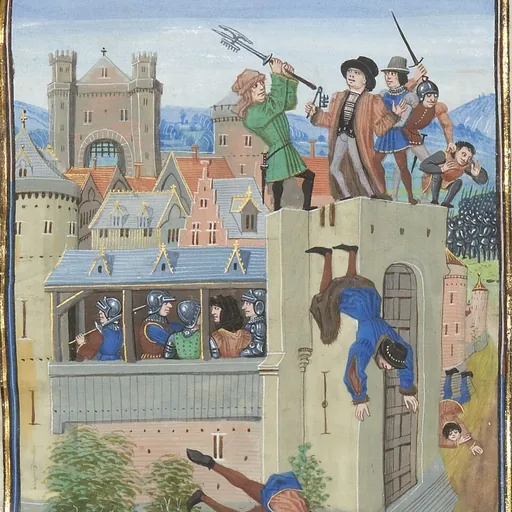
Downfall and murder Jean Maillard is depicted killing Étienne Marcel, who is shown holding the keys of Paris. Charles V enters Paris in triumph on August 2, 1358. Miniature by Jean Fouquet from the Grandes Chroniques de France, circa 1455-1460. Marcel's actions and his increasing political isolation forced him into desperate and unpopular alliances. Marcel knew well that if his bourgeois revolution failed, he would be executed. Realizing the mood of the city had turned against him, Marcel allied himself openly with Charles the Bad, King of Navarre.
Marcel also made a mistake when he let English mercenaries into Paris to bolster his defenses. Fights between the mercenaries and Parisians broke out on 22 July 1358 and the Parisians killed 24 of them. For the citizens of Paris, bringing England's allies into the city crossed the line separating political reform from treason.
On the night of 31 July 1358, and with the agreement of Charles the Bad, Marcel prepared to open the city gates to mercenaries allied with Charles stationed outside. Marcel was about to open the gates of the capital to them, but Jean Maillard prevented this. In the ensuing skirmish, Marcel was killed at the Porte Saint-Antoine.
On 2 August 1358, the Dauphin Charles re-entered Paris in triumph and, shortly thereafter, Marcel’s remaining allies were put to death. The Dauphin then dismantled the reforms Marcel had fought for.
Don’t just read it —
keep it.
Full-length biographies made to live with: read them, listen on the way to work, watch them tonight.
- E-book
- Audio
- Video
Instant download · yours to keep · every purchase keeps this site free
Important facts
Related people
Same field, nearest in time





Contemporaries
People whose lives overlapped Étienne Marcel's
Frequently asked questions
Who was Étienne Marcel?
provost of the merchants of Paris (1315-1358)
When was Étienne Marcel born?
Étienne Marcel was born in 1315 in Paris.
When did Étienne Marcel die?
Étienne Marcel died on 31 July 1358 in Paris.
What was Étienne Marcel's occupation?
Étienne Marcel was a merchant and politician.
What nationality was Étienne Marcel?
Étienne Marcel was French.
Sources & further reading
Cite this page
APA: Biography.guide. (2026). Étienne Marcel. https://biography.guide/etienne-marcel/
MLA: "Étienne Marcel." Biography.guide, https://biography.guide/etienne-marcel/.
Chicago: "Étienne Marcel." Biography.guide. https://biography.guide/etienne-marcel/.
Data last updated: 2026-09-24 · Spot an error? Report a correction.
Portrait: Wikimedia Commons · author & licence
Page generated 2026-09-27 05:08 UTC