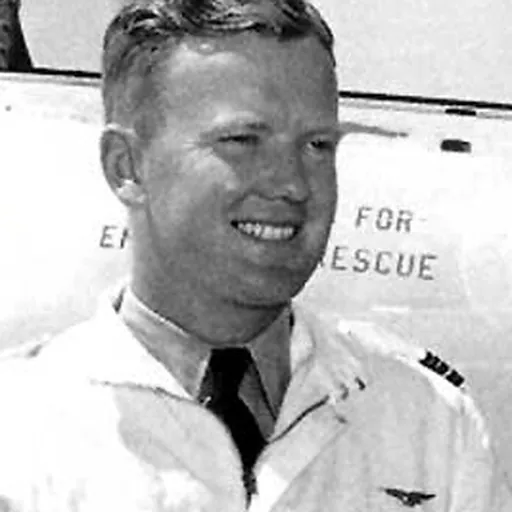
About Robert Kipp
Lived 1919 – 1949 (aged 29). Robert Kipp was a military personnel.
Robert Kipp, (12 October 1919 – 25 July 1949) was a Canadian flying ace who served in the Royal Canadian Air Force (RCAF) during the Second World War. He was credited with at least ten aerial victories.
Born in Kamloops, Kipp joined the RCAF in 1940 and once his flying training was completed, was retained in Canada on instructing duties rather than being assigned to an operational posting. He eventually was sent to the United Kingdom in early 1943, and was posted to No. 418 Squadron in November, flying the de Havilland Mosquito heavy fighter. He achieved the first of his aerial victories the following month, which began a successful six-month period of operations. He spent a period of time on staff duties from July to December before being posted to the Fighter Experimental Unit, with which he achieved more victories. He was discharged from the RCAF at the end of war but rejoined the service several months later. Appointed commander of No. 410 Squadron in 1948, he was killed in a flying accident the following July when his de Havilland Vampire jet fighter crashed at St. Hubert Airbase.
Early life Robert Allan Kipp was born in the city of Kamloops in British Columbia, Canada, on 12 October 1919, the son of Walter and Clara Kipp. He was studying pharmacology at the time of his enlistment in the Royal Canadian Air Force (RCAF) in late June 1940. Once his flight training at No. 4 Elementary Flying Training School at Windsor was completed, he was commissioned as a pilot officer.
Second World War Instead of being dispatched to the United Kingdom on an operational assignment, Kipp was retained in Canada as a flight instructor, stationed at No. 11 Service Flying Training School at Yorkton Station. It was not until early 1943 that he was sent to the United Kingdom. He spent several months at No. 12 (P) Advanced Flying School before proceeding to No. 60 Operational Training Unit at High Ercall for familiarisation on the de Havilland Mosquito heavy fighter. In November, he was posted to No. 418 Squadron. |group=Note The published citation read:
After the invasion of Normandy, No. 418 Squadron patrolled over the landing beaches and inland, often attacking transportation infrastructure and airfields. On 14 June, while on another sortie to Denmark, Kipp and Huletsky combined to destroy a He 111. The pair was stood down from operations for a rest shortly afterwards. Early the following month, Kipp was awarded the Distinguished Service Order (DSO). The published citation for the DSO read:
Later war service Kipp and Huletsky were posted to the headquarters of Air Defence of Great Britain at Bentley Priory for a few months before being transferred to RCAF Overseas Headquarters in London in September. At the end of the year, the pair returned to the RAF station at Ford with a posting to the Fighter Experimental Flight. This was a unit specialising in daytime 'Ranger' operations, making a number of test sorties. In the final months of the war in Europe, while flying Mosquitos on missions to strafe German airfields, they destroyed several aircraft on the ground in the Mühldorf and Kursheim areas: three Junkers Ju 88 medium bombers, a Messerschmitt Bf 110 heavy fighter, and a Fw 190. Six other aircraft, mostly of unidentified types, were also damaged in these attacks.
Kipp ended the war credited with having shot down ten German aircraft, with an eleventh shared with another pilot, and one shared as probably destroyed. He is also credited with damaging one aircraft and destroying seven aircraft on the ground.
Later life With the war over, Kipp was discharged from the RCAF in October 1945. However, he rejoined the service the following year as a squadron leader. In December 1948 he became commander of No. 410 Squadron, which had just become the first unit of the RCAF to be equipped with jet fighters, the de Havilland Vampire in this instance. On 25 July 1949, while performing low level aerobatics over the squadron's base at St. Hubert in Quebec, he lost control of his Vampire. He was killed when it crashed into the ground. Survived by his wife, he was buried in Kamloops Cemetery.
Don’t just read it —
keep it.
Full-length biographies made to live with: read them, listen on the way to work, watch them tonight.
- E-book
- Audio
- Video
Instant download · yours to keep · every purchase keeps this site free
Important facts
People in Robert Kipp's life
Named in this biography and alive at the same time

Related people
Same field, nearest in time



Contemporaries
People whose lives overlapped Robert Kipp's



Frequently asked questions
Who was Robert Kipp?
Canadian flying ace of WWII
When was Robert Kipp born?
Robert Kipp was born on 12 October 1919.
When did Robert Kipp die?
Robert Kipp died on 25 July 1949.
What was Robert Kipp's occupation?
Robert Kipp was a military personnel.
Sources & further reading
Cite this page
APA: Biography.guide. (2026). Robert Kipp. https://biography.guide/robert-kipp/
MLA: "Robert Kipp." Biography.guide, https://biography.guide/robert-kipp/.
Chicago: "Robert Kipp." Biography.guide. https://biography.guide/robert-kipp/.
Data last updated: 2026-09-23 · Spot an error? Report a correction.
Portrait: Wikimedia Commons · author & licence
Page generated 2026-09-27 05:08 UTC